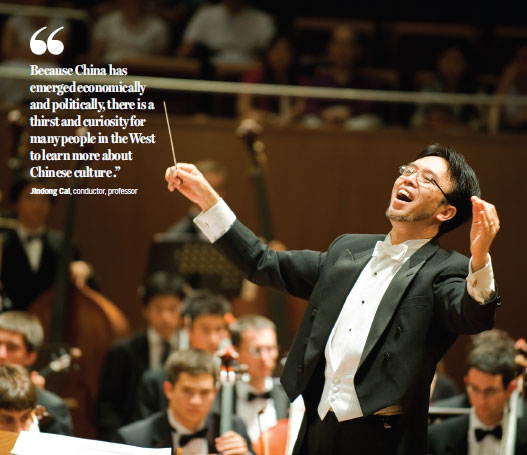
 Jindong Cai is an orchestral conductor and professor of performance at Stanford University and a three-time recipient of the prestigious ASCAP Award for Adventurous Programming of Contemporary Music. ?Provideded To China Daily |
Jindong Cai, a conductor and professor at Stanford University, is saluted for connecting East and West through classical music
Jindong Cai, an orchestral conductor and professor of performance at Stanford University, received a special thanks in Chicago earlier this year at a celebration of Shanghai Spring - the first Chinese music series ever produced by a US radio network for broadcast in North America and Europe.
Cai was attending the event as an honored guest because his book - Rhapsody in Red: How Western Classical Music Became Chinese, co-authored with his wife Sheila Melvin - served as an important resource for WFMT series producer Paolo Pietropaolo. Cai was also interviewed for the show.
"I could not have made Shanghai Spring without Rhapsody in Red and without Jindong Cai's contribution," said Pietropaolo.
Cai said that as a Chinese conductor and professor in the US, he has an obligation to serve as a conduit between the East and West through music.
"When you look at a region from a political point of view, you see conflicts and struggles," he said in an interview with China Daily. "From a cultural point of view, you see connections."
He emphasized the importance of cultural exchange in enhancing understanding between people of different backgrounds. He regards music - his profession and passion in life - as the perfect vehicle.
"Because China has emerged economically and politically, there is a thirst and curiosity for many people in the West to learn more about Chinese culture," he said. "We artists can connect people in the two worlds."
Cai, 59, began his dream of becoming a conductor when he attended the Boston Symphony Orchestra's first performance in Beijing in 1979, along with 18,000 enthusiastic Chinese at the Beijing Capital Stadium. It was the first Western orchestra performance in China after the Cultural Revolution.
"I was mesmerized by the power and beauty of the music, conducted by Maestro Seiji Ozawa," he recalled. "I thought I'd love to do that one day."
Cai came to the US to pursue graduate studies after studying violin and piano in Beijing. He attended the New England Conservatory and then the College Conservatory of Music in Cincinnati.
His breakthrough came in 1992 at the Lincoln Center Mozart Bicentennial Festival in New York. Gerhard Samuel, the concert's conductor and Cai's mentor, took ill right before the dress rehearsal. Cai stepped in to conduct for the world premiere of a new production of Mozart's unfinished German-language opera Zaide.
"That was a turning point in my career," Cai said. The concert received critical acclaim from the New York Times.
The rest is history.
Over the years, Cai has guest-conducted major symphony orchestras in the US and China, including the Arkansas Symphony, the Cincinnati Symphony, the Louisiana Philharmonic Orchestra, the Northwest Chamber Orchestra in Seattle, the China National Broadcasting Symphony, the Shanghai Symphony Orchestra, and the Guangzhou Symphony.
He is also the principal guest conductor of the Shenzhen Symphony Orchestra. In 2015, he led the Shenzhen Symphony on its first tour of the US West Coast, performing in Palo Alto, San Jose, Seattle, Los Angeles and San Diego.
In December 2015, Cai served as conductor for the Shanghai Philharmonic Orchestra at the Listening to China - 2015 Shanghai project, which aimed to encourage "understanding of traditional Chinese music culture."
In his quest for forging cultural exchange and understanding, he founded the Stanford Pan-Asian Music Festival in 2005, with the support of Stanford University. The annual festival, which includes performances and academic discussions, has brought in musicians from various Asian countries.
"Each year, we focus on an Asian country or region, or an artistic form," Cai said.
The festival, which is held around the Chinese New Year, is open to students and the public.
This year's festival featured the Forbidden City Chamber Orchestra from China and local artists representing Iran, Azerbaijan, Uzbekistan, Vietnam and Japan.
"Once we focused on music from southern Asia and had musicians from India and Pakistan," said Cai. "The two countries always have political conflicts, but if you look at the music, the south of India is very close to the music of Pakistan and the musicians all know one another."
Cai said he is personally involved in selecting the performing troupes or individual musicians for the festival.
Cai received the Asian Hero award from the California State Legislature in 2010 for his contribution to the enrichment of musical diversity in the San Francisco Bay Area.
These days Cai often crosses two continents. Besides China, where he frequently conducts major symphony orchestras, he is also the principal guest conductor of the Mongolia State Academic Theater of Opera and Ballet in Ulaanbaatar, and his guest conducting also includes symphonies in Korea and Mexico.
Cai is a three-time recipient of the prestigious ASCAP Award for Adventurous Programming of Contemporary Music and has been featured in the New York Times, the Wall Street Journal, BBC and NPR.
His second book, Beethoven in China: How the Great Composer Became an Icon in the People's Republic, also co-authored with his wife, was released by Penguin in September 2015.
"Through his writing and music-making, Cai has achieved something very few others have," Pietropaolo said. "He's a door-opener, a bridge-builder and the world of classical music in both China and the West is better off thanks to his work and his efforts."




Copyright 1995 - . All rights reserved. The content (including but not limited to text, photo, multimedia information, etc) published in this site belongs to China Daily Information Co (CDIC). Without written authorization from CDIC, such content shall not be republished or used in any form. Note: Browsers with 1024*768 or higher resolution are suggested for this site.
License for publishing multimedia online 0108263 Registration Number: 130349