At the top of Vietnam's Fansipan Mountain, throngs of giddy tourists wielding selfie sticks jostle for a photo op on the once-remote peak in the Sapa region, famed for its breathtaking views across undulating rice terraces.
Getting to the top traditionally takes a two-day trek, but these days most visitors opt for a 20-minute ride by cable car instead - the latest flashy tourist attraction to heighten concerns over rapid development destroying Sapa's natural beauty.
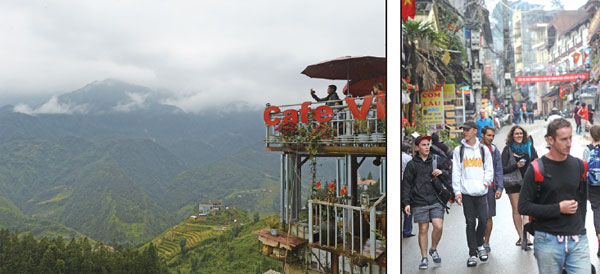
Known by some as the Tonkinese Alps, the former French outpost has seen a tourism boom in recent years with a new highway from the capital and hotels popping up at breakneck pace.
"If more and more building (happens), then one day we will lose Sapa, we won't have any more mountain," says guide Giang Thi Lang, from the Black Hmong ethnic group.
Vietnam's tourism industry has taken off in recent years, especially among domestic visitors with growing appetites and budgets for travel.
The country has also become a draw for foreign visitors turning their backs on better-known Southeast Asian destinations, such as Thailand's Chiang Mai, seeking instead a road less traveled.
But some lament the commercialization of Vietnamese treasures, with reports of locals complaining about multi-course meals served in Ha Long Bay's famous caves, or trash-strewn beaches in the resort town of Phu Quoc.
In Sapa town, where heaps of rubble mark hotel sites under construction, the number of rooms has surged from 2,500 in 2010 to 4,000 last year, according to official figures.
Visitor numbers have snowballed too, reaching around 700,000 last year, and revenues have more than tripled since 2010 to $50 million.
Part of that growth is thanks to the cable car - the longest of its kind in the world according to operators - which opened in February with the capacity to ferry 2,000 people to the top of the mountain daily.
"It's good for Sapa when they can attract more tourists ... and we have a big number of the local people that can find jobs," says Nguyen Van Manh, deputy director of Sapa's Tourist Information Center, adding that the sector provided employment to thousands.
But some locals tell a different story.
"Before the cable car, there were more porters from the village with regular work," says Hmong trekking guide Ma A Tro from Fansipan's summit, where he had just led a two-day trip.
"Now with the cable car there, village residents no longer have jobs, mostly becoming freelance construction workers."
Some tourists also say Sapa is losing its appeal, with Fansipan's picturesque summit replaced by concrete steps, souvenir shops and still-under-construction temples.
"I imagined I would come to the top and it would be really natural, but it's developed here, so for me it's a bit disappointing," says trekker Duong Hoang Minh, who hiked to the top of the 3,143-meter peak.
Even so, he decided to take the cable car down and agreed that more people can enjoy the mountain because of it.
"For other people I think it's better because it's safer for them," says the 23-year-old teacher, his white sweatpants slicked with fresh mud.
Most tourism operators agree the boom has brought much-needed development - roads, schools and clinics, for example - to a region where the majority of the population belong to one of Vietnam's 53 ethnic minorities, who have traditionally lagged behind the rest of the country.
But without sustainable growth Sapa risks "shooting itself in the foot", says Hubert de Murard, manager of the Topas Ecolodge about 18 kilometers from Sapa town.
The lodge, with its 25 white granite bungalows overlooking a rice terraced valley, employs mostly locals, was built using materials found nearby and was designed to blend in with the surrounding environment - a business model de Murard says he'd like to see newcomers adopt.
He worries that some investments have been short-sighted, aimed at maximizing the number of visitors.
"We need to be a bit more careful to avoid the mistake of mass tourism in Sapa," he says as the sun sets over the yawning valley behind him.
Agence France-Presse
|
Left: A tourist looks at mountains from a coffee shop in the northern Sapa tourist town. Right: Foreign tourists walk in a street of the Sapa town. Known by some as the Tonkinese Alps, the former French outpost has seen a tourism boom in recent years with a new highway from the capital and hotels popping up at breakneck pace. Photos By Hoang Dinh Nam / Afp |




Copyright 1995 - . All rights reserved. The content (including but not limited to text, photo, multimedia information, etc) published in this site belongs to China Daily Information Co (CDIC). Without written authorization from CDIC, such content shall not be republished or used in any form. Note: Browsers with 1024*768 or higher resolution are suggested for this site.
License for publishing multimedia online 0108263 Registration Number: 130349