 |
|
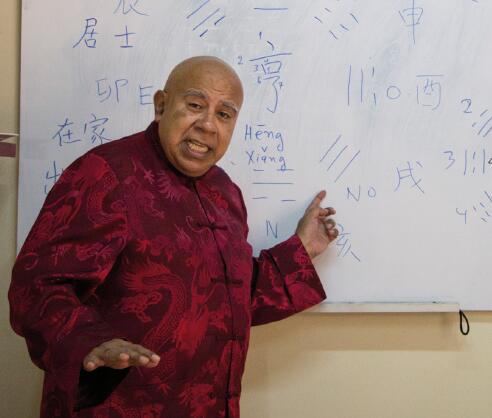
Joseph Cruz explains the philosophy of I Ching. MAY ZHOU / CHINA DAILY |
It's said that you can find a chifa restaurant on every corner in Peru. And if chifa is not included in a restaurant's name, more often than not, you will still see it on the menu. According to one all-knowing wiki, there are more than 9,000 chifa joints in Lima alone.
Chifa is a culinary tradition based on Chinese Cantonese elements fused with traditional Peruvian ingredients. A mixture of fried rice with vegetables, Chinese onions, eggs, and meat, it's cooked quickly on a high flame, often in a wok with soy sauce and oil.
The influence came from about 100,000 Cantonese coolies who immigrated to Peru in the late 1800s. Almost all male, they intermarried with Peruvian women. To acknowledge their offspring's Chinese blood, they were given the special name of tusang — native born Chinese — which is not exactly accurate because tusangs carry Peruvian blood too.
Like chifa, the Chinese DNA brought by the 10,000 Chinese has spread far and wide in Peru. Anyone in Lima will tell you that a sizable portion of the population carries some Chinese blood, though "nobody knows exactly how many, some say 10 percent, some say as high as 25 percent," said Carsten Korch, publisher of the English-language news outlet Peru This Week.
With the overwhelming presence of chifa and an untold presence of Chinese DNA in the Peruvian population, it's no surprise to find in Lima one Joseph Cruz, a Peruvian devoid of any Chinese blood but who runs a business primarily based on his passion for Chinese culture.
Through his Tian Long Tan Center (which means Heavenly Dragon Pond in Chinese), Cruz provides consultation services in oracles, astrology and rites of the I Ching, the ancient divination text and the oldest of the Chinese classics.
Over the past 10 years, the center has become a place for the dissemination of the I Ching and other aspects of the Chinese culture. With his extensive knowledge of ancient China, Cruz teaches the philosophy of the I Ching as well as Chinese calligraphy and martial arts.
As the chairman of the Peru I Ching Association, Cruz translated the Chinese text of the I Ching into Spanish in 2013.
"This translation is better than those done years ago because new discoveries in archaeology have shed new light on the meaning of the text," said Cruz.
"I enjoyed watching Chinese kung fu movies a lot in the 1970s when I was in my teens," Cruz said. "Most of the movies were from Hong Kong. I fell in love with martial arts and I began to learn it from Chinese in Chinatown."
Close interaction with the Chinese community led Cruz to read Dao De Jing, a Chinese classic of philosophy.
"I fell in love with Chinese philosophy and wanted to read more, but few works were available in Spanish," he said. "I realized that I had to learn Chinese to study and truly understand Chinese philosophy."
Cruz bought a Chinese textbook published by Beijing Language Institute and started to teach himself Chinese. In 1983, he started taking Cantonese lessons at a local Chinese school and became well versed in Cantonese over the next three years.
In the late 1980s, immigrants from the Chinese mainland began arriving in Peru. Mandarin became available, and Cruz eagerly joined those classes too.
"It only took me four months to learn how to speak Mandarin," he said. "It was easy because I could already read the Chinese words."
Beginning in 1993, Cruz started to work for a couple of Chinese companies in Lima, including Shougang. Always looking to improve his Chinese, Cruz asked a Chinese colleague to tutor him in Chinese writing.
Now, Cruz can not only express himself very well in Chinese, he even writes poetry in Chinese classic style.
Cruz is also interested in the ancient Incans of southern Peru and said that he has found a lot of similarities between the Chinese and Incan cultures.
"Both are closed cultures, both are conservative and both burned bones in ancient rituals that were found in both China and Peru going back 5,000 years," said Cruz. "The fascinating similar details between the two cultures have hooked me on Chinese culture all these years."
mayzhou@chinadailyusa.com




Copyright 1995 - . All rights reserved. The content (including but not limited to text, photo, multimedia information, etc) published in this site belongs to China Daily Information Co (CDIC). Without written authorization from CDIC, such content shall not be republished or used in any form. Note: Browsers with 1024*768 or higher resolution are suggested for this site.
License for publishing multimedia online 0108263 Registration Number: 130349