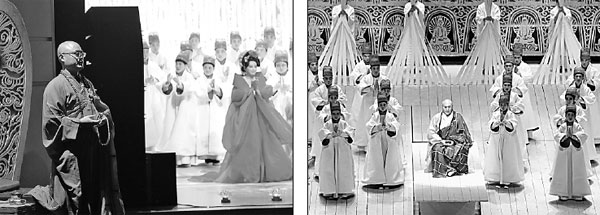
A China-made opera, Jianzhen's Journey to Japan, premiered in Tokyo on Tuesday, the anniversary of the Chinese monk's arrival in the country 1,263 years ago.
The opera's director, Xing Shimiao, calls it "a mere coincidence".
But the return of the Chinese monk caused a stir in Tokyo as Jianzhen, or Ganji as he is known in Japan, is a household name in the island nation. He is still revered as Japan's benefactor.
The production by Jiangsu Performing Arts Group made the full-house Bunkamura Orchard Hall in Tokyo's Shibuya roar, with former Japanese prime minister Yukio Hatoyama as the first person to stand and applaud.
"It is phenomenal that actors from Jianzhen's ancestral hometown of Yangzhou, Jiangsu province, put his story on Japan's stage tonight," says Hatoyama.
"What he had brought to Nara still has an influence on Japan today."
The opera highlights Jianzhen's six attempts to go to Japan from 743 to 753.
At the age of 14, Jianzhen became a disciple at the Daming Temple in Yangzhou.
At 21, he traveled to Chang'an, China's capital during the Tang Dynasty (618-907), where he apprenticed under many well-known monks.
He became well-versed not only in Buddhism, but also in literature, art, medicine, architecture and sculpture.
With its prosperous economy and strong national power, the Tang Dynasty was a magnet for foreigners, and the relationship between China and Japan was close.
Japan sent regular delegations mainly consisting of monks, students and intellectuals to China in the hope of bringing back its rich and varied culture.
The opera starts with a Japanese monk, Yoei, who studied Buddhism in China.
Japanese Emperor Shomu, who ascended the throne in 724, devoted huge sums of money to create magnificent Buddhist temples and artifacts throughout the realm. During his reign, Buddhism virtually became Japan's official state religion.
Bearing the emperor's edict, Yoei invited Chinese monks well-versed in Buddhist teachings and precepts to teach in Japan. More importantly, the emperor wanted them to establish an authentic Buddhist Ordination platform, which was absent in Japan.
In 742, Yoei visited Yangzhou where he implored Jianzhen to lecture in Japan.
Despite five failed attempts, the last of which left him blind from an infection, Jianzhen's resolve to go to Japan did not die.
In 753, the strong-minded monk joined a Japanese emissary's ship heading for Japan. After several months, the group finally landed at Kagoshima, the southwestern tip of Kyushu Island, on Dec 20, 753.
Jianzhen reached Nara in the spring of 754. In 759 Japan's imperial court granted Jianzhen a piece of land in the western part of Nara. There he founded a school and also set up a private temple, Toshodaiji.
During his 10-year stay in Japan, Jianzhen introduced Ritsu Buddhism or monastic rules to Japan. He and the Chinese monks who traveled with him introduced Chinese elements to Japanese culture, including Chinese calligraphy, sculpture, architecture and medicine.
Jianzhen died in 763. A dry-lacquer statue of him made shortly after his death (and therefore thought to be in his likeness) can still be seen in Toshodaiji in Nara.
"I'm heartened by his magnificent spirit and willpower," says Tian Haojiang, who plays Jianzhen in the opera. Tian is the recipient of the Denver University Lifetime Achievement Award.
The stage was beautifully designed with pendant, elastic strips of white cloth, which easily served to represent sea, or a temple or a prison.
The main members of the opera's production team made several trips to Japan, including the route Jianzhen traveled from Kagoshima to Nara, to get a better understanding of the great monk.
"The story of Jianzhen's journey to Japan shows us determination, faith and courage," says the opera's composer, Tang Jianping. "I like to tell his story in an operatic way, an international language."
His musical message includes Japanese ballads. Tang uses two zheng (stringed plucked instrument) - a Chinese one representing Jianzhen's homesickness; a Japanese one for Yoei, who was homesick for Japan. Tang says the two zheng represent a kind of conversation between China and Japan.
Tang's musical approach was well-received by the Japanese audience, though the opera was sung in Chinese with Japanese subtitles.
Shogo Arai, governor of Nara prefecture, says he did not expect that the story of Jianzhen's trials and tribulations to be presented in such a wonderfully musical way. "The performance tonight is a perfect interpretation," he says.
Daming Temple's Master Renru, who was invited to join the performance, sat on the edge of the stage reciting Buddhist scripts during the opera.
The opera was staged in Nara on Thursday and Friday, and will be staged in Kyoto on Tuesday and Wednesday.
|
Left: Master Renru from Yangzhou's Daming Temple, where Jianzhen was a disciple, accompanies the performance. Cai Hong / China Daily Right: The opera Jianzhen’s Journey to Japan is now touring Japan. Yoshinori Matsuda / Provided To China Daily |




Copyright 1995 - . All rights reserved. The content (including but not limited to text, photo, multimedia information, etc) published in this site belongs to China Daily Information Co (CDIC). Without written authorization from CDIC, such content shall not be republished or used in any form. Note: Browsers with 1024*768 or higher resolution are suggested for this site.
License for publishing multimedia online 0108263 Registration Number: 130349