From 'oil-exploding shrimp' to red-braised pork, food writer Fuchsia Dunlop shares her passion for the subtleties of Chinese food with a wider audience, Mike Peters reports.
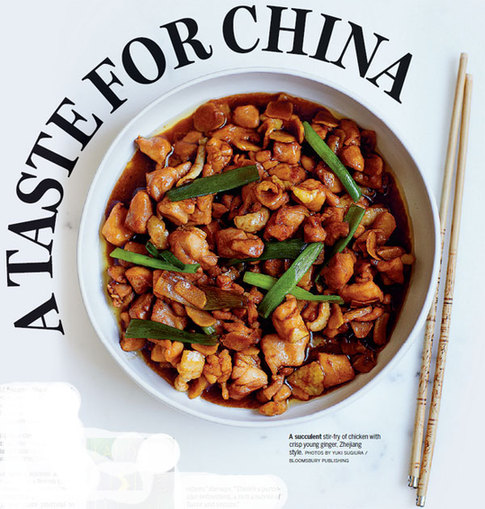
One spring afternoon on a lake in Zhejiang province, a fisherman rowed up and offered Fuchsia Dunlop some live shrimp he had caught a few moments before. Later that evening, she writes in her new cookbook: A chef in the group "cooked them up in a typical Zhejiang style, deep-frying and then stir-frying them over a high flame with a sweet, rich sauce laced with rice wine and vinegar. The deep-frying in very hot oil is known as 'oil exploding' (you bao), and it shocks the papery thin shells away from the flesh, making them delectably crisp and crunchy. The fragrant sauce clings to the prawns like lacquer, so they look as beautiful as they taste".
Dunlop has been immersed in the food culture of China, particularly of Sichuan province, for more than a decade. Until recently, however, she doubted Western readers would buy into her passion.
"For a long time people saw Chinese cuisine as cheap and junky," she says.
"A lot of Chinese restaurants in the West were started and run by Cantonese immigrants who weren't chefs - they were just trying to make a living. The selling point was 'cheap and tasty'."
|
|
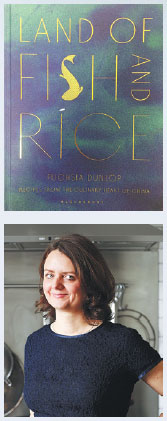
Things have changed in recent years, she says, which has prompted this year's publication of Land of Fish and Rice: Recipes from the Culinary Heart of China - her fifth and most lavishly detailed culinary journey in print.
"Immigrants are not just Cantonese anymore - so in many Chinese communities - in New York, London, wherever - you have people who are from Shanghai, Dongbei (Northeast), Hunan, and they have spread out to small cities, too.
"So the market is no longer just about ignorant Westerners," she says, grinning during a Skype interview from her home in the UK. "Chinese customers want proper Chinese food, and that's raising the standard."
Meanwhile, she says, most people interested in food now know that China's food is one of the world's great culinary cultures.
"Even in Chinatowns in the West," she says, "some people like their old favorites like sweet-and-sour pork, and that's OK. But there's also plenty of Sichuan and other dishes, so you don't have to eat lemon chicken and such anymore."
Dunlop was the first Westerner to train at the Sichuan Higher Institute of Cuisine, but it wasn't food that first brought her to China.
"I had been a student at Sichuan University, on a British Council scholarship to study history and minority cultures. However, I found it was more practical to study Chinese language first," she says.
"I'd always loved cooking, and I was asking around to see if I could cook in a small restaurant and learn. I heard about the institute from a friend and just cycled over. They let me sit in on sessions for a couple of months," she says.
After graduation from university, she went back to the culinary institute.
"I just popped in to say hello to my teachers there. They said, 'We're just starting a new course. Why don't you join?'
"I enrolled on the spot," she says. "A bit of luck, really."
Why does she consider the lower Yangtze region to be the center of Chinese gastronomy?
"It's the headquarters of one of the four great regional cuisines, but the area has also produced more literature about food than others," she says. "There's a particular refinement, a rich analysis of flavor and texture."
"You find everything from street food and farmhouse cooking to the most elaborate banquets in the country," she says. "It's also the home of some of China's most esteemed ingredients: Jinhua ham, Shaoxing wine, hairy crabs ... . But Sichuanese is the cuisine I started with."
While the 368-page book is lovingly written and rich with photos, it is clearly meant for the kitchen and not the coffee table. Besides the detailed recipes, there are tips on planning a menu, finding ingredients, buying equipment and cooking techniques.
"It's for people interested in food culture and people who like to cook," she says. "I wanted a good mix, easy-to-do dishes as well as more elaborate ones."
Dunlop sees the current battle over pork - fatty pork - in China as misplaced, though she appreciates concerns about obesity and Type 2 diabetes.
"Pork is not the problem," she insists. "If you eat meat in the normal Chinese way, it's very healthy. Chinese people eat small amounts of meat with a lot of vegetables. You can use meat as a flavoring to make vegetables taste delicious."
Dunlop laughs when I ask why she thinks many Westerners shy away from tofu.
"Tofu is seen as a substitute for things you'd prefer to be eating, like meat," she says.
"Put a plate of mapo tofu in front of somebody, and they are converted."
Contact the writer at michaelpeters@chinadaily.com.cn




Copyright 1995 - . All rights reserved. The content (including but not limited to text, photo, multimedia information, etc) published in this site belongs to China Daily Information Co (CDIC). Without written authorization from CDIC, such content shall not be republished or used in any form. Note: Browsers with 1024*768 or higher resolution are suggested for this site.
License for publishing multimedia online 0108263 Registration Number: 130349