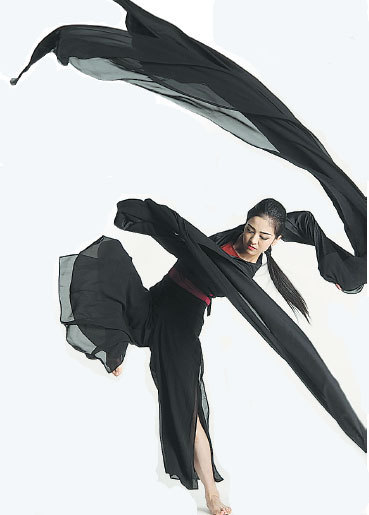
She stands still, takes a deep breath, spreads her arms like wings and then thrusts them upwards. She then stares at her long sleeves as they slowly slide down her arms.
She then repeats the move a couple of times and ends with a big smile.
This is Tang Shiyi's masterclass at the China National Opera & Dance Drama Theater, showcasing shui xiu, which means water sleeves in Mandarin. It's one of the most commonly seen elements in traditional Chinese dance.
"Shui xiu is the most attractive part of traditional Chinese dance for me. Dancers do shui xiu to perform various movements, which express the characters' emotions, such as ecstasy, sadness and any intense feeling," says Tang.
Shui xiu is also a crucial element in Tang's latest dance piece, The Flowing Dance From Tang Poetry, which will be staged in Beijing on Dec 31 and Jan 1 at the Tianqiao Performing Arts Center.
The piece, which is produced, choreographed and performed by Tang, was first played at the 18th China Shanghai International Arts Festival in October.
Tang, 26, who graduated from the Beijing Dance Academy, is now the principal dancer of the China National Opera & Dance Drama Theater, and has won many top awards, including two at the Tao Li Cup, the top dance honor for young Chinese professional dancers.
She has also played leading roles in dance dramas, such as Shui Yue Luo Shen in 2011, an adaptation of Ode to the Nymph of The River Luo (Luo Shen) written by the poet Cao Zhi of the Three Kingdoms period (220-280); Confucius (2013), which follows the great Chinese sage traveling to 14 states with his students to spread his ideas; and Zhaojun, based on the story of the legendary Wang Zhaojun, a famous ancient Chinese beauty who volunteers to marry a ruler of a Hun tribe in exchange for friendly relations with the Han Dynasty (206 BC-AD 220).
The Flowing Dance From Tang Poetry is Tang's choreography debut, and combines three classic Chinese poems from the Tang Dynasty (618-907) - Spring, River, Flower, Moon, Night, by poet Zhang Ruoxu; Song of Everlasting Sorrow by poet Bai Juyi; and Sword Dance by poet Du Fu.
The idea of having her own choreographed production came about in 2014 when Tang injured her hip during rehearsal.
"I stopped dancing for a whole year, and I was worried about my future," says Tang.
"I have portrayed many roles onstage but none of them is me. I did not want to live my life in vain. I wanted to convey my ideas through dancing."
Speaking about her show, she says that as the three poems come from different times of the Tang Dynasty and revolve around different themes - such as the tragic romance between Emperor Li Longji and his favorite concubine Yang Yuhuan, and the relationship between nature and humans - they offer her a chance to use dance to express her artistic imagination.
For the show, Tang invited director Tong Ruirui, composer Guo Sida, a live band featuring flutist Ding Xiaokui, guitarist Shan Zi, cellist Zhang Ping and guzheng (zither) player Ding Xue'r, as well as four dancers, to join in.
Speaking about his role, Tong, who has been working with Tang since she was 16, says: "When she told me about her idea of combining Tang poetry with dancing, I was very interested.
"I have choreographed many works for her and we are like teacher and student. But now she is more like my friend and she inspires me with her understanding of traditional Chinese dance."
Tong also says that though the image of the Tang Dynasty is often associated with grand and luxurious scenes, for the dance piece, the stage set, costumes and music will be simple, contemporary and abstract.
For instance, the composer Guo uses percussion to address the tempo and the set designer Liu Kedong uses bamboo poles onstage to portray the layers of space.
Tang started learning traditional Chinese dance at age 6 before receiving scholarships to study at the affiliated middle school of Beijing Dance Academy. "I have spent most of my life in the rehearsal room and yet I feel I do not know enough about traditional Chinese dance, which contains so much history, culture and Chinese philosophy.
"I want to expand traditional Chinese dance to a new dimension and this piece is my first attempt. The process is very challenging as well as compelling."
If you go
7:30 pm, Dec 31 and Jan 1. Tianqiao Performing Arts Center. No 9, Tianqiao Nandajie (south street), Xicheng district, Beijing. 400-635-3355.
|
Tang Shiyi showcases shui xiu, or water sleeves, in her latest show The Flowing Dance From Tang Poetry. Provided To China Daily |




Copyright 1995 - . All rights reserved. The content (including but not limited to text, photo, multimedia information, etc) published in this site belongs to China Daily Information Co (CDIC). Without written authorization from CDIC, such content shall not be republished or used in any form. Note: Browsers with 1024*768 or higher resolution are suggested for this site.
License for publishing multimedia online 0108263 Registration Number: 130349