A slumping box office in China in 2016 had Hollywood execs worried as they scrambled to corner the world's largest market, but could the year ahead hold even more troubling concerns for China's moneymen who want a piece of Tinseltown? Amy He reports from New York.
It was a year that saw Hollywood not show any blockbuster movies in China, a slumping box office on the mainland, more money flowing from China into the movie capital of the world, and rising concern over a stronger backlash from Washington toward that investing as Donald Trump moves into the White House with his anti-China sentiments.
Despite having several well-performing movies at the Chinese box office in 2016, Hollywood films didn't stir as much excitement from Chinese audiences as in 2015 with hits like Furious 7 and Avengers: Age of Ultron.
Overall, box office receipts were sluggish, declining for the first time in more than half a decade. Final figures won't be available until next year, but many analysts have already forecast a decline to $6.5 billion (45 billion yuan) from $8.65 billion (60 billion yuan).
The Great Wall, starring Matt Damon and directed by Zhang Yimou, may give the box office a small year-end bump, but the final totals will still reflect minimal growth over 2015's $6.34 billion (44 billion yuan).
While box office receipts were down in China, there were more China-US deals in the US movie and entertainment industry, and the majority came with the name Wanda Group and its chairman, Wang Jianlin, on them. And that's what caught the attention of lawmakers in Washington.
The real estate and entertainment conglomerate bought Legendary Entertainment at the start of the year for $3.5 billion. Wanda won shareholder approval in November to acquire Carmike Cinemas Inc for $1.2 billion and to merge it with AMC Entertainment, which Wanda acquired in 2012. If approved by regulators early next year, it will make AMC the largest theater chain in the country, operating more than 600 theaters and overtaking Regal Entertainment.
And that deal was followed by Wanda moving into the American TV market by paying $1 billion for Dick Clark Productions, which produces such awards shows as the Golden Globes and the annual New Year's Eve show in Times Square.
In a personal appearance at a gala in Los Angles In November that he hosted for movie industry executives and stars, Wang announced a 40 percent rebate on movies made at the multi-billion dollar studio Wanda is building in Qingdao, also its headquarters. And Wang eventually said he was interested in owning one of Hollywood's "Big Six" studios.
While Trump was criticizing China for unfair trade deals and taking jobs from Americans during his race for the White House, in September more than a dozen members of Congress wrote a letter to the Government Accountability Office (GAO) urging that it review foreign transactions in major US sectors, including media, and the members mentioned Wanda by name. In response to the letter, Wang said that his company's interests were purely business-related.
But the negative comments from Congress gained momentum after Trump won the presidential election in November. Democratic Senator Chuck Schumer, the incoming minority party leader, wrote another letter repeating the concerns expressed by the mostly-Republican group that wrote to the GAO.
Many in the industry had brushed off the GAO letter, saying that it wouldn't lead to further oversight because investment in Hollywood is good for the economy. Schumer's letter changed those opinions.
Democratic danger
"The reason why this Schumer letter is so dangerous in a sense - aside from the fact that it's from a senator - is that he's a Democrat," said Stanley Rosen, a politics professor at the University of Southern California.
"There are plenty of Republicans who have the same view, and he's making it into a bipartisan issue."
"Every action has a reaction. Part of the reason for the backlash is the Chinese success in the US," said Rosen. "Mao talks about principle contradictions, but from the point of view of Schumer, let's say, or the Congress people, when you're so successful, you're going to attract a lot of attention and unwanted attention, and that's going to produce a backlash against that success."
Aynne Kokas, a media studies professor at the University of Virginia, said that while the letters are not an indication that Wang should stop pursuing a Big Six studio, the company will need to be a "lot more creative and strategic if [Wang] wants to make it happen."
"The question becomes, if the Wanda investment in the US was the beginning of something or the end of something. I think there's an argument to be made that that may have been the end of dramatic, large-scale Chinese investment in Hollywood without any oversight from Washington," she said.
Trump and Congress aside, Chinese investment in Hollywood may slow down due to China's clampdown on external capital outflow, which reportedly was the reason why a Chinese acquisition of a Hollywood property is not going forward. Anhui Xinke New Materials, a Chinese copper company, had said it would acquire an 80 percent stake in Midnight Investments, but it was reported in late December that the deal will not happen.
As for the decline in ticket sales at China's movie box office, industry watchers said it was bound to happen in the world's biggest market.
Nothing lasts forever
"It's similar to the GDP that slowed down a few years ago - you can't keep up the double-digit growth forever," said Jonathan Papish, film analyst and writer for China Film Insider. "Things are starting to level off and the years of 30 to 50 percent growth from the previous years are probably over."
Regulators also clamped down on movie ticket subsidies, which were long offered to customers by online ticketing websites, movie distributors and producers. The subsidies allowed lower ticket prices for customers while companies benefited by collecting more extensive data on consumers, giving them information to better market to their desired demographics.
Companies like Alibaba and Tencent offered discounts as steep as 50 percent for certain movies, which led to inflated sales in a country where tickets cost on average $5 a movie, compared to the $8.51 in the US. Once ticket prices were adjusted around Lunar New Year, consumer demand went down.
"They weren't as willing to buy movie tickets that were normal prices, so we saw a little bit of a slowdown from that," said Papish.
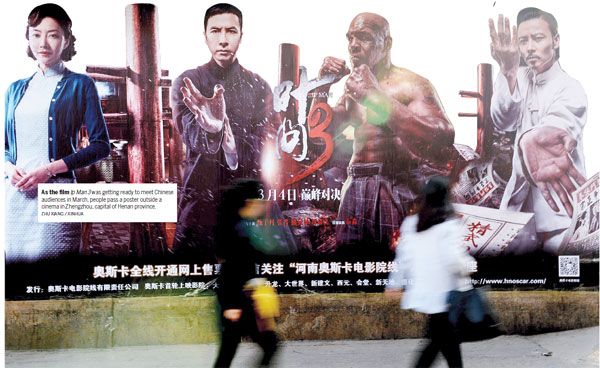
More aggressive accounting practices also went into effect this year after regulators looked into claims that distributors and producers were manipulating box office statistics in their favor. Ip Man 3, a martial arts movie starring Donnie Yen and Mike Tyson, was investigated on a claim that it had inflated sales numbers.
There were also fewer high-performing domestic films in the market this year, aside from the record-shattering totals for Stephen Chow's The Mermaid, which was released around Lunar New Year and made $526 million, the highest-ever for a movie in China.
"This year, the quality of the domestic fare has been lacking. I think Chinese moviegoers are staying away from the cinemas because of that," Papish said. "I still think in the next five years [China's box office] will surpass Hollywood, but I think that the market in China is really going to vary based on the quality of films that come out in that particular year."
High hopes
Papish said he expects several films will bring in high box office receipts next year, including the eighth installment of the Fast and Furious franchise.
"I think it can waver over the next few years. You might see 5 percent growth, a 5 percent decline. You're looking at a little of inconsistency in growth over the next few years," he said.
Hollywood is still looking for a recipe for a hit, for a way to best capture the attention of a "fickle market," but Papish said that he doesn't think "many lessons were learned in 2016 or 2015, unfortunately."
Kokas echoed Papish's sentiments: "We may be seeing some kind of fatigue of American big budget blockbusters - they're not getting the same numbers as they once did."
Though movies getting released in the next year or two have already been in the making for years, Hollywood can go forward by investing more in the Chinese film industry and focusing on movies that the Chinese like, as opposed to repackaging movies meant for a Western audience and at times pandering to Chinese audiences with one-off Chinese actors or product placement, Kokas said.
Money into money
"I think money putting money into domestic films is one option, and I think also making better movies in Hollywood is another option, and a more diverse range of movies, more specifically, which run very much against the current revenue model, but we may be coming to the point where that revenue model needs to change," she said.
Analysts have said that Disney has been better at adapting to the Chinese market than other studios, which may play out in the box office next month with the release of Star Wars spinoff Rogue One. The movie cast two of China's biggest stars, Donnie Yen and Jiang Wen, in major roles instead of what other studios have been doing, putting Chinese actors and actresses in peripheral roles that serve no plot-driving function.
USC's Rosen said similarly that Hollywood needs to drop the "one size fits all" attitude: "One thing that Hollywood can do is to partner with Chinese companies to do local language films - which some of them are already doing - and not worry about the international market for those kinds of films, but treat the China market as a separate market and make films for that market alone."
Contact the writer at amyhe@chinadailyusa.com




Copyright 1995 - . All rights reserved. The content (including but not limited to text, photo, multimedia information, etc) published in this site belongs to China Daily Information Co (CDIC). Without written authorization from CDIC, such content shall not be republished or used in any form. Note: Browsers with 1024*768 or higher resolution are suggested for this site.
License for publishing multimedia online 0108263 Registration Number: 130349