An ongoing exhibition examines the economic, social and cultural transformations of the BRICS countries. The works on display show how artists react to these shifts. Lin Qi reports.
Belgian artist Wim Delvoye is known for inventive but controversial works through which he reflects on the problems in a globalized world. The 52-year-old's mix-media installation, Cloaca No 5, is a machine he created with help from scientists, computer experts and designers. It mimics the human digestive system.
The device was assembled with parts manufactured by factories in different countries, similar to how many industries operate today.
Through his installation, Delvoye, who now lives and works in Teheran, Iran, reviews transnational capitalism, which offers jobs to workers in developing countries but also underpays them, and which has therefore profited big companies.
Cloaca No 5 is among the dozens of works on show at The Third Today's Documents, a three-month exhibition at Today Art Museum in Beijing.
The museum has held Documents shows in 2007 and 2010 to provide an academic perspective of contemporary creation.
The current event not only caters to art circles but also to the general public through creative, thought-provoking works, according to Gerardo Mosquera, the Cuban curator who has co-curated the current show with his Beijing-based counterpart, Huang Du.
The exhibition zooms in on the art landscapes of BRICS countries - Brazil, Russia, India, China and South Africa - as well as other emerging markets. It brings together 50 artists and art groups, some of whom are from these regions.
Other featured artists are from the West like Delvoye, whose works - like the cloaca machine - examine the challenges to economies caused by globalization.
The works also offer a glimpse into the economic, social and cultural changes in BRICS countries. They show how artists respond to the developments and complexities arising from the process.
Huang, the co-curator, says the artists are shaping the cultural landscapes in their regions in various directions.
"Their works are insightful, poetic and metaphorical. In them, visitors discover artistic powers of great potential," he says.
The exhibition has subtitles in French, English and Chinese - BRIC-a-brac, The Jumble of Growth and Lingyizhong Xuanze, which means alternative choice. Bric-a-brac means a collection of miscellaneous, small curios in French.
Meanwhile, Huang says that BRIC, which resembles the acronym BRICS, also implies a jumble of things and refers to the cultural conflicts between emerging markets and developed countries as globalization pulls different cultures closer and also causes frictions.
Huang adds that collisions have also occurred within emerging markets themselves, as they try to cope with social issues arising from development, such as urbanization, a growing wealth gap and corruption.
Singaporean artist Simryn Gill and Chinese artist Tian Longyu focus on how globalized production and consumption stimulate greed.
In her installation, Roadkill, Gill recycles daily waste, including empty bottles, tin cans and small toys, and adds tiny wheels to them. She groups them into various clusters on the ground to form an advancing army of vehicles.
The colorful objects look as if they have been made by a child.
Gill recycles junk as a metaphor for a consumerist society to show to what extent the market will expand.
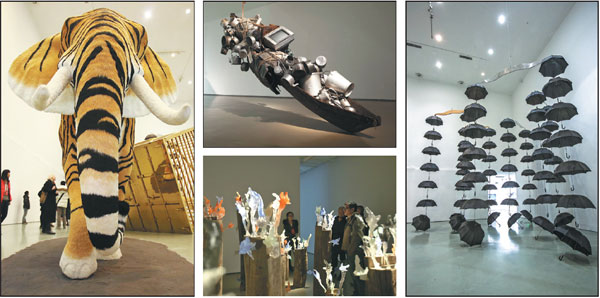
Tian, however, comments on the same problem with a 2.5-meter-high monster-like installation called A Tiger-Swallowed Elephant.
It portrays a tiger that has swallowed an elephant. The tiger's body is deformed and looks as if it has been eaten by the elephant.
Tian criticizes people's growing desires that, in turn, transform them into something with an intense desire for more, just like the disfigured tiger in his work.
Another aim of the exhibition is, as its Chinese subtitle suggests, to demonstrate the emerging markets' efforts to gain cultural identity and independence, while finding alternative approaches to development.
Brazilian artist Marepe's installation Canone (canon in Portuguese) features dozens of black umbrellas loosely threaded together in vertical columns and hung up in the air.
Marepe compares the union of umbrellas to the link between heaven and people on Earth, and between the spiritual and the earthly worlds. His creation shows connections with history and cultural traditions of northern Brazil, where he was born.
Mosquera, the curator, says the exhibition is full of metaphors that viewers will find interesting.
"Artists express their ideas and attitudes quite clearly. We are to discuss the world at this time," he says.
Contact the writer at linqi@chinadaily.com.cn
If you go
10 am-6 pm, closed during Spring Festival holidays, through March 5. 32 Baiziwan Lu (Street), Chaoyang district, Beijing. 010-5876-0600.
|
Clockwise from left: Chinese artist Tian Longyu’s work, A TigerSwallowedElephant;Indian artist Subodh Gupta’s work, Untitled; Brazilian artist Marepe’s installation, Canone; and Chinese artist Chen Chunmu’s mixmedia work, Not Just Having A Relationship are on show at Today Art Museum in Beijing as part of The Third Today’s Documents exhibition.Photos Provided To China Daily |




Copyright 1995 - . All rights reserved. The content (including but not limited to text, photo, multimedia information, etc) published in this site belongs to China Daily Information Co (CDIC). Without written authorization from CDIC, such content shall not be republished or used in any form. Note: Browsers with 1024*768 or higher resolution are suggested for this site.
License for publishing multimedia online 0108263 Registration Number: 130349