Meeting celebrated writer Milan Kundera and becoming one of his students in Paris in the 1990s was a turning point for Dong Qiang, who may have otherwise stayed in France and become a "China expert" there.
Dong returned home and is a professor of French language and literature at Peking University. He has translated dozens of important works between the two languages and has remained dedicated to promoting exchanges between the two countries, particularly in the sphere of culture.
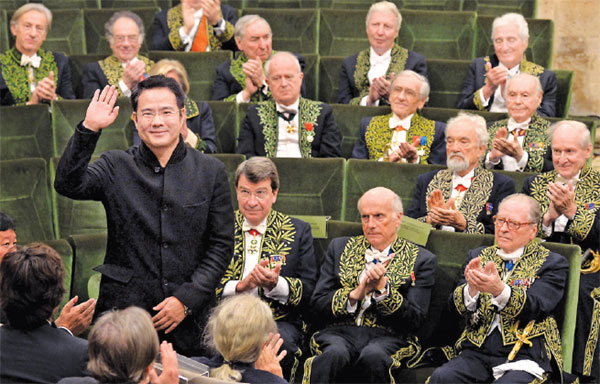
In recognition of his achievements, he was elected as a tenured correspondent in the general section of the Academy of Moral and Political Sciences, one of the five academies of the prestigious French Institute.
The 49-year-old is the first Chinese person to have been selected for the post since the academy's establishment in 1795. Britain's Prince Charles has been one of the foreign associates there since 1992.
|
Chinese scholar Dong Qiang is selected as a tenured correspondent in the general section of the Academy of Moral and Political Sciences in Paris. Provided to China Daily |
"The tenure is lifelong. I'm taking the vacancy passed from French historian Jean-Louis Cremieux-Brilhac with great honor because he was the one who fought with General Charles de Gaulle and directed Free French radio broadcasts during World War II," Dong tells China Daily at his office in Peking University.
He has just returned from the French Institute's annual meeting in mid-November, where he was officially introduced as the new correspondent.
"I was welcomed by the honor guard with their swords up," Dong says.
This, to him, rivaled the memorable hours he spent with Kundera - author of The Unbearable Lightness of Being - at Paris' School for Advanced Studies in the Social Sciences in the early 1990s.
"Kundera led me into a small room where several students already were. He hung an 'in recording' sign on the door and closed it, then started his lecture on music and novels," Dong recalls of his first lesson.
He was introduced by the literary giant as someone whose spoken French was awesome.
Dong still remembers how difficult it was to apply to study under Kundera. He succeeded because then he had just published an article on comparative study in French.
During the lectures, they discussed Kundera's essays on The Art of the Novel. Later Kundera entrusted the translation of the book to Dong for a Chinese version.
Dong also translated the Olympic Manifesto and The Dictionary of Paintings into Chinese and The Analects of Confucius into French.
He says he became labeled as a "French translator" and "French literature expert", but the honor from the academy now helps him to work and explore a broader spectrum without being categorized.
Delphine Halgand, a culture official from the French embassy in China, says her colleagues have worked closely with Dong and were not surprised when he became the first Chinese correspondent.
"He has tirelessly served Sino-French cultural collaboration and has helped to bridge the gap between the two countries," Halgand says.
Dong was born in Hangzhou, Zhejiang province, in 1967. At age 16, he enrolled in Peking University, majoring in French.
After graduation, he went to France and stayed for 12 "really hardworking" years.
Besides earning a doctorate from the University of Paris VIII, he held exhibitions, helped establish China Blue Press and gave lectures on Chinese culture.
"Many of my fellow students from China switched to business, but I stuck with literature and culture," Dong says.
"I happened to find ways to support myself, and I just couldn't let go easily. I was there to understand and study France and its culture. How could I give up without mastering it as much as possible?"
Dong talked to people and traveled to develop an understanding of how the country operates and how people live.
"If I saw a movie with beautiful scenery, I would visit the locations and see what the locals had to say," he says.
He made many friends.
In his spare time, he'd go out and enjoy French culture - exhibitions, shows, museums and cafes. He loved seeing some of the rare exhibits of ancient Chinese calligraphy housed in France.
A trained calligraphy master from childhood, he occasionally found his brushes could help him supplement his tuition fees. His time in Paris enriched his mastery of the art.
"I was homesick, and I found comfort in something I had done from childhood," he says.
Inspired by French interest in the Chinese characters he wrote, he became more absorbed in Chinese civilization and began to delve into it.
"Later, I realized, I'd always impressed the French people I met and talked to. It was because I was talking about things that felt familiar to them and also things they didn't know," he says.
"What's more, I talk in a language they understand and in manner that says 'we're equal and we're mutually respectful friends'."
In 2001, inspired by his mentor's personal experiences, Dong returned to Peking University as a professor.
"I didn't want to miss the core changes of the place of my cultural origin, like an outsider," he says.
"Kundera's motherland is within the same European cultural regime as France. But mine is not. China is different. It's evolving and becoming stronger, and it will make more connections with the rest of the world. I need to be back," he adds.
Dong teaches, translates and researches. He cooperated with the French embassy to launch the Fu Lei Prize in 2009.
The prize takes its name from Fu Lei, a famed translator who had introduced Chinese readers to French literary masters like Honore de Balzac and Voltaire. He also enhanced China-France cultural exchanges while rewarding and encouraging translators, Dong says.
In 2013, Dong set up the youth prize under the Fu Lei Prize to recognize the younger generation of translators. The award ceremony has been turned into a key cultural event.
He still practices calligraphy as a hobby and only writes verses of his own creation.
The works are much in demand among collectors. He jokes he would be materially affluent were it not for his love of being teacher and a bridge between China and France.
Upon his appearance at the institute last month, Chancellor Gabriel de Broglie told Chinese media that he hopes Dong will give a better understanding of Chinese culture, society and history to France and French-speaking countries through his translations and creations.
"With its vast land area and long history, China is not easy to understand. Therefore, an efficient system of dialogues, especially via culture, should be established. My last 20 years have been dedicated to fostering an interesting and in-depth understanding," Dong says.
"I am expressing Chinese experiences with our own voice.
"French people say that one should have a roof in Paris, meaning you're established here. Now I think I have a grand dome along the Seine."
Contact the writer at meijia@chinadaily.com.cn




Copyright 1995 - . All rights reserved. The content (including but not limited to text, photo, multimedia information, etc) published in this site belongs to China Daily Information Co (CDIC). Without written authorization from CDIC, such content shall not be republished or used in any form. Note: Browsers with 1024*768 or higher resolution are suggested for this site.
License for publishing multimedia online 0108263 Registration Number: 130349