From ancient Chinese medicinal plants to meaty stews and nourishing chicken soup, we turn to the fundamentals for comfort foods as we hunker down with family and friends in cold weather. Mike Peters reports.
As you read this, Chinese chefs somewhere are preparing tubers of Gastrodia elata for a healthy, warming soup. The rhizomes of this leafless orchid (tian ma in Chinese) are valued in traditional medicine for treating headache, stress and fatigue - and traditionally for convulsions such as epilepsy.
In nature, the elusive plant depends on a parasitic relationship with two different fungi to grow. That perplexed ancient Chinese gatherers who struggled unsuccessfully to cultivate it; they ultimately gave up, declaring it to be a gift from God. In the 1960s, Chinese researchers in Yunnan and Beijing decoded the plant's interactions with fungi, leading to modern cultivation.
Legend says the healing powers of another traditional Chinese medicine, Cordyceps sinensis, were recognized more than 1,500 years ago in the mountains of Tibet. Yak herders noticed that even their oldest beasts had an extra spring in their steps when they munched on this "grass". Five centuries later, Ming Dynasty (1368-1644) emperors were fascinated by the fungi's power as an aphrodisiac, and commanded imperial physicians to study the dong chong xia cao ("winter-worm, summer grass") and develop its potential uses.
Since then, these botanical oddballs have become more utilitarian. Prized in China, Russia, Korea and Japan as both food and medicine, gastrodia is commonly cooked in soups, usually with chicken or duck. Combining it with cordyceps, home cooks and five-star hotel chefs produce hearty broths designed to boost energy and vigor in winter months.
At Macao's Studio City restaurants, for example, chefs Tam Kwok Fung and Kenneth Law have made signature dishes out of double-boiled soups based on traditional Chinese medicine ingredients. At Michelin-starred Jade Dragon, they offer an exclusive range of Chinese herbal soups in collaboration with the Chinese medicine research team from the Macau University of Science and Technology.
"Double boiling" soup requires submerging a ceramic jar containing the ingredients into a pot of boiling water, thus cooking the broth with the indirect heat from the boiling water. The double-lidded pots minimize evaporation, and allow the soup ingredients - from collagen-rich fish maw to fungus and fritillary bulbs - to slowly release their nutrients into the soup.
Hong Kong native Jackie Fong, who brought double-boiled soups to Beijing's Capital Renaissance hotel when he took over the Chinese restaurant kitchen there last year, says authentic double-boiled soups are hard to find outside South China because it literally takes hours to make them properly.
Cantonese chefs have made an art of this, even going so far as to develop special ceramic pots for the purpose, often beautifully decorated, so that the cookware becomes elegant tableware.
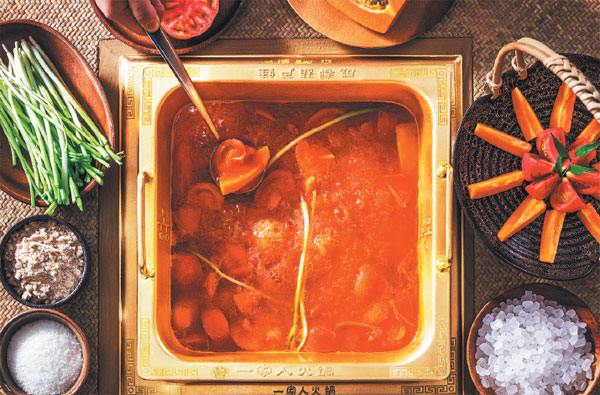
Hotpot is another way Chinese have made a wintertime art out of hot broth.
Hotpot restaurants in styles from Sichuan, Taiwan and elsewhere get crowded as weather gets colder. The delicious hot soup produced this way is even more warming when a group of friends is huddled around the steaming pot they're using to cook dinner. While many are crowded, noisy and sometimes intimidating for foreigners, some hotpot restaurants have gone high-end and even sought a Western ambience in order to be more inviting to non-Chinese.
The benefits of hot broth on a cold day, of course, are known to cooks around the world. Irish stew has become a cultural heritage, but slow-cooked meat and potatoes as a savory one-dish supper has local variations everywhere. The latest in Beijing: the soupy lobster rice "to keep you warm from the belly out" from new chef Miguel Casal at Migas.
"As the cold winter months come round," says the Spanish chef who hails from his country's windy and cold northwest, "I especially miss being at home in Spain where it's very traditional for everybody to gather at their grandma's house on a Sunday. Everybody would sit around the table while catching up and exchanging stories of what happened over the past week, as a bowl of piping hot stew was ladled out for everybody."
Eager to re-create that feeling, Casal has launched a new "spoon brunch" on Saturdays and Sundays. Hot tureens of squid with potato and ink sauce, fisherman's soup and stewed spicy chicken will rotate weekly, but the lobster rice will be a fixture, arriving at tableside "just as your starting to get full," he promises.
We think we'd like his grandma.
Contact the writer at michaelpeters@chinadaily.com.cn
|
Tomato and papaya hotpot at Yi Jia Ren restaurant in Beijing. Photos Provided To China Daily |




Copyright 1995 - . All rights reserved. The content (including but not limited to text, photo, multimedia information, etc) published in this site belongs to China Daily Information Co (CDIC). Without written authorization from CDIC, such content shall not be republished or used in any form. Note: Browsers with 1024*768 or higher resolution are suggested for this site.
License for publishing multimedia online 0108263 Registration Number: 130349