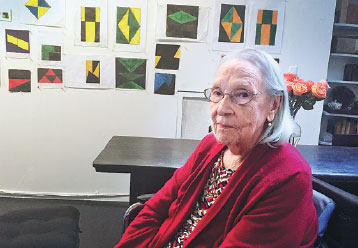
Cuban-American artist Carmen Herrera has been painting for decades. And painting. And painting. At age 89, she finally sold something.
And now, at 101, true recognition has arrived: an exhibit of her work at the Whitney Museum of American Art and a documentary on her life soon coming out in New York, where she has lived for 70 years.
Herrera may not be in her prime, but her career is going gangbusters.
"It was about time. Good lord! They waited too long," Herrera says in an interview at her apartment and studio in Union Square, where she has lived for nearly 50 years.
Fame, she says, "is pleasant but not that big a deal". She then offered her visitor a glass of whisky.
Herrera was born in Cuba in 1915 to journalist parents, studied painting as a child, traveled to Paris to study more and then began architecture at the University of Havana.
As a young woman she fell in love with Jesse Loewenthal, a New Yorker who taught English and was visiting Cuba. She moved to Manhattan with him and continued to study art.
Her work is abstract: simple and austere, but showing a strong, vivid sense of color.
Herrera is not a big talker. She does not like to discuss her art and rarely gives interviews.
"My painting is just my painting. There is no feeling associated with it. It is not good for anything," she says with a laugh, refusing to explain what her work might mean.
Her husband, who died in 2000 at age 98, encouraged her to paint every day even though it seemed no one wanted to show her work - by a woman, a Latina woman at that, and not considered feminine, as watercolors might be.
"No one paid attention to me. No one knew me," Herrera says.
She recalls, angrily, a female gallery owner who once said this to her: "I love what you paint but I am not going to give you a chance because you are a woman." This was particularly hurtful to Herrera because it came from another woman.
While Herrera has not changed, the world around her has, says Tony Bechara, a Puerto Rican artist who is her neighbor and has been her friend for many years.
"Suddenly, people were ready to receive her. The first collectors of her work had something in common: They were all women," Bechara says.
"Twenty, 30 or 40 years ago there was no such social phenomenon. There were no female collectors. Women were not in a position to help other women," he adds.
These days Herrera is a fragile woman with short, snow-white hair. She was never able to have children. She uses a wheel chair, suffers from arthritis, has trouble hearing and rarely leaves home. But in September she did venture out to attend the opening of her exhibit at the Whitney.
It features more than 50 works from the years 1948 to 1978, when, the museum says, Herrera "developed her signature style".
Herrera thought she had forgotten her older paintings, but when she saw them it all came rushing back.
"I never forgot them. It is like an old love story," she says, again chuckling, then launches into a bolera with Bechara about how you never forget a lover.
While living with her husband in Paris after World War II, Herrera joined an association of abstract artists called the Salon des Realites Nouvelles and developed her passion for straight lines and a leanness of color. She came to shun curves altogether, and painted with a maximum of three colors in each work. She later cut it down to two.
"In this chaos that we live in, I like to put order," Herrera says in the documentary The 100 Years Show, directed by Alison Klayman and coming out on Wednesday at Film Forum, in Manhattan.
But her large paintings and abstract sculptures - which predated the emergence of Minimalism by nearly a decade - were not well received when she returned to New York in 1954. Then and there, the art world was dominated by abstract expressionism done by men.
London's Lisson Gallery, which has a branch in Chelsea, began to show Herrera's work 10 years ago.
Herrera sold her first work in 2004. Since then her works have been shown at the Museum of Modern Art, the Hirshhorn Museum in Washington DC, the Tate Modern in London and at the Whitney.
They go for hundreds of thousands of dollars. But that is far less than what is fetched by the works of Frank Stella, Ellsworth Kelly or Herrera's friend Barnett Newman. These men achieved acclaim back in the 1950s and '60s.
So now Herrera can finally pay someone to help her in her studio, someone else to clean her house and a physical therapist.
Shortly before turning 100, Herrera became a vegetarian. Everyday, at midday, she drinks a bit of whisky.
What is her secret to longevity?
"Nothing special," she says. "Do what you like and do it every day. That is what I do. I get up, eat breakfast right away and get down to work."
Agence France - Presse
|
Pioneer Cuban-American artist Carmen Herrera, 101, poses for photos while being interviewed in her studio on Jan 4, in New York. AFP |




Copyright 1995 - . All rights reserved. The content (including but not limited to text, photo, multimedia information, etc) published in this site belongs to China Daily Information Co (CDIC). Without written authorization from CDIC, such content shall not be republished or used in any form. Note: Browsers with 1024*768 or higher resolution are suggested for this site.
License for publishing multimedia online 0108263 Registration Number: 130349