China's garden city has long lured travelers with its historical horticulture and crisscrossing canals. But visitors who stay three days discover more than Suzhou's numerous nicknames suggest. Erik Nilsson explores the metropolis.
Heaven on Earth. Venice of the Orient. China's Eden.
Land of fish and rice.
Suzhou, indeed, lives up to its multiple monikers.
Nine of the city's over 200 classical gardens are inscribed on the UNESCO World Heritage list - for good reason.
They embody top-notch ancient aesthetics.
The settlement's moat has flowed for 25 centuries.
Residents who dwell in antiquated abodes still swill from 6,000 of 20,000 dynastic-era wells.
And they wash clothes in the countless canals that split the seams between patchworks of vernacular buildings.
The city in Jiangsu province falls within the jurisdiction of the 144-hour visa-free transit for travelers from dozens of countries to Shanghai, Jiangsu and Zhejiang province. But it's worth three days on its own.
Visitors discover why it has for centuries been a retreat for literati, who've long used their pens and minds to compose homages to not only its aesthetics but also to its soul.
DAY 1
Whirlybird's-eye view
Helicopter tours are a new way to view from above not only the ancient city by day but also the futuristic industrial zone's sparkle at night.
Their appeal is that they hover, rather than soar, over striking panoramas.
Choppers twirl over natural wonders like mountains, islands and peninsulas.
A growing number of guests use these whirlybird's-eye views as backdrops for milestone moments like proposals and weddings.
Canal cruises
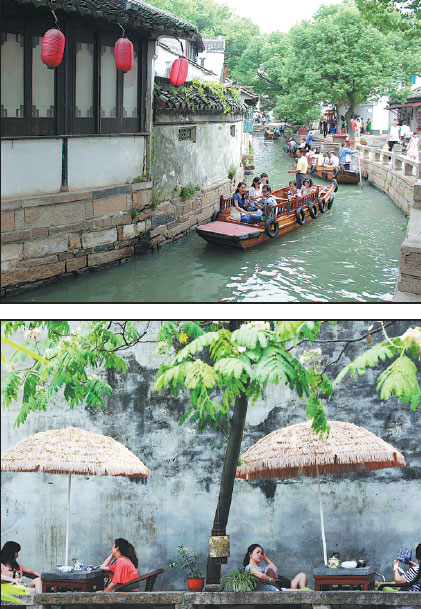
Suzhou's appellation as the Venice of East comes not only from its grid of canals but also from the craft that ply these watercourses.
Traditional gondolas glide through the channels, frequently beneath bridges.
Vessels still drift along the 80 kilometers of the nearly 1,800-km Grand Canal that flows through Suzhou on its way from Beijing in the north to Hangzhou in the south.
The world's longest manmade waterway - a world wonder - was constructed in the Sui Dynasty (581-618).
Over 20 smaller channels dissect downtown within the city's moat.
Night tours offer a more ethereal feel, as passengers slip across dark waters clasped by gardens illuminated as if by moonlight cranked up to full luminosity.
The haunting songs of local pingtan performers onboard float through the air like the boats over the water.
Zheng He Memorial Park
Zheng He "walked like a tiger" and spoke with "the clamor of thunderous bells".
So it's said.
He also explored foreign lands.
That's for sure.
The 100-hectare Zheng He Memorial Park hosts monuments to China's celebrated navigator, the nation's answer to Magellan.
A replica of the eunuch explorer's ship bobs next to a statue of the voyager that's 18 meters high - because he was 1.8 meters tall - on a pedestal that's 2.8 meters high - since his voyages spanned 28 years.
It's an impressive sight, even if the scale metrics' symbology is lost on casual visitors.
The Zheng He Memorial Hall's Tunnel of Time depicts the progression of China's maritime expeditions over millennia.
There are replicas of exotic curiosities - zebras, camels, ostriches - for which he traded Chinese goods like tea and silk.
The giraffe he brought from Africa became an official talisman, since it resembled the qilin, a mythical Chinese totem that proclaims the birth or passing of a great sage.
Tablet museum
Suzhou's Tablet Museum is literally history written in stone.
The inscriptions are time capsules, rocks of the ages that speak to us from eras past.
Their stories perhaps endure today because they're engraved in mineral slabs.
Tough stuff.
These writings are exhibited in a Confucian temple that claims to be the largest outside the wise man's faraway hometown.
It reportedly displays Asia's oldest astronomical and China's oldest national maps.
Another 2,000 rubbings from the Ming (1368-1644) and Qing (1644-1911) dynasties are rendered as apparitions of engravings from those periods.
DAY 2
Taihu
Think of Hong Kong. Then think of a freshwater body twice its size.
That's Taihu Lake.
A local saying declares of its shores: "A different flower every month, a different fruit every season, and fish and shrimp every day of the year."
Indeed, throughout the calendar's fluctuations, the area's flora heaves with peaches, waxberries, pears, tangerines and gingko seeds.
Boats to Jade Island offer tea picking and fruit harvesting.
The lake is ringed by 365 kilometers of bike trails.
Woodpeckers tap trees while egrets wade through water in Taihu's admission-free ecological park.
The park features a laser fountain show that casts colors on a 30-meter-wide screen of aerosol that sprays 130 meters into the air over the lake.
Lights! Water! Action!
Ebizui Park
Ebizui is today a placid place built over wars and woes.
That's not to mention eyes that foresaw the future before being scooped out upon their owner's request at the moment of his compulsory suicide, as is the tale of Wu Zixu.
A pavilion honoring him is perched on the peaceful river shores that have served as the staging points for military attacks, from imperial times to roughly a century ago.
It's a longstanding war zone - replete with bomb shelters and cannon - transformed into a picnic destination, where families wade in wistful waves that caress shores garlanded with greenery.
Pingjiang Road
Hipness meets history in this bohemian bastion, where creative types scrub paintbrushes into easels and thumb through novels outside cafes housed in historical buildings.
Pingjiang Road is a canal-side street lined with teahouses, galleries and shops.
But perhaps the best offerings are hidden in the ancient alleyways that radiate from the main throughway.
It's in these slender lanes that music lovers find museums devoted to Kunqu Opera, pingtan and the city's guqin (Chinese zither) guild.
Pingjiang Road is a place where it's easy to get lost - and advisable.
DAY 3
Tongli
Tongli sits on the outskirts of Suzhou and in the heart of five lakes that pump water through its canals - arteries that carry its cultural lifeblood.
About 50 bridges hop between the banks of the waterways that slice the ancient town into seven islets, atop which Ming (1368-1644) and Qing (1644-1911) dynastic buildings huddle.
Taiping, Jili and Changqing bridges are places of pilgrimage where locals pray for good fortune.
The settlement founded in Suzhou's outskirts in 1271 is a UNESCO World Heritage Site - for good reason.
Tuisi Garden, constructed over two centuries ago for an imperial scholar, offers "a different view at every turn".
True.
But the same could be said about the entire town - and all of Suzhou.
Contact the writer at erik_nilsson@chinadaily.com.cn
China Daily explores three-day itineraries in cities around the country in the series.
|
From top: The Suzhou Museum, designed by world-famous Chinese-American architect I.M.Pei; a waterway of the ancient town Tongli; visitors take a rest at a roadside tea shop at Pingjiang Road. Photos By Wei Xiaohao / China Daily, And Wang Qiming And Wang Jianzhong / For China Daily |




Copyright 1995 - . All rights reserved. The content (including but not limited to text, photo, multimedia information, etc) published in this site belongs to China Daily Information Co (CDIC). Without written authorization from CDIC, such content shall not be republished or used in any form. Note: Browsers with 1024*768 or higher resolution are suggested for this site.
License for publishing multimedia online 0108263 Registration Number: 130349