Shanghai-based artist Li Lei says that lately he has been listening to Sergei Rachmaninoff's Piano Concerto No 2. He is "moved to tears" each time he hears the late Russian composer's piece.
"He was a master at controlling the emotions of listeners. He arranged the notes accordingly, like deploying forces in warfare. And he made musical instruments encounter as well as enhance each other, like performers in a play," says Li, who is also the deputy director of Shanghai's China Art Museum.
The 52-year-old hopes his own works - paintings, sculptures, installations and poems - can also reflect individuality and act as a narrator of stories. And when they come together in a show, they will compose a dramatic visual symphony.
Li conveys this to viewers at the ongoing exhibition, The Apsara's Flowers, at the Minsheng Art Museum Beijing.
The show reviews his explorations with abstract oil paintings, sculptures and installations over the past two decades.
Li hopes the exhibition will create an "emotional friction", as he calls it, among the audience members.
"When people walk among the pieces, like watching a drama, they will build an emotional connection with the works that will evoke thoughts about life and death."
Li has borrowed the title from a story from Vimalakirti Sutra, a Buddhist teaching popular in Asia. One day, an apsara (celestial nymph) throws heavenly flowers onto Buddha and his disciples, and the flowers slip from Buddha's body and stay on his disciples' clothes.
The disciples then try to remove the flowers from their clothes but the creature asks them why. A chief disciple says it violates Buddhist commandments against wearing flowers. Then she argues that it is their dualism that betrays Buddhist laws - the flowers didn't stay on Buddha because he "doesn't have a dualistic mind".
Li says it is same with people's attitudes toward life.
"When one daringly embraces the fear of death and gets rid of inherent habits and prejudices, he is free from exterior interferences that will influence his judgments."
Li says the works on show are like the nymph's flowers, which will pervade the exhibition space and encourage viewers to "open their hearts, reflect on bygone events and think about the future".
He categorizes the artworks into chapters by constructing "three worlds" - one with the hustle and bustle of life, another gripped by depression and miseries, and the last in which he invites people to engage in silent introspection.
At the entrance of the museum's lobby, dozens of colorful silk strips are hung from the ceiling, and people need to walk through them, which is a ceremonial start of the exhibition tour.
The first floor shows Li's two series of abstract oil paintings, Shanghai Flowers and Flames of Pompeii. The rhythmic shadings of vibrant colors seduce and excite people, reminding them of the deceptive nature of the material world.
On the winding stairs to the second floor stand dozens of white dummy models whose waists, eyes and ears are bound with colorful pieces of cloth like the entrance.
Here, the artist asks one question to people who are about to enter the next section of the exhibition: When enjoying earthly glories, are we also blinded by them and turn deaf ears to the crisis of existence?
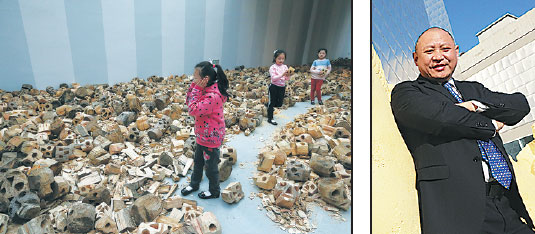
On the second floor, Li shows two visually shocking installations. One is The Graveyard of Angels, in which he has placed sculptures that look like reclining, broken bodies of bald angels.
This, in his view, represents those who sacrifice for their ideals and those who are lost while searching for their life goals.
In another work, Sea of Human Skulls, 3,000 roughly carved wooden skulls and fish are laid on the ground before a huge wall mirror.
"Death is not an end. It is a door that transforms a life into a different state, leading to more possibilities of freedom," Li says.
Hans d'Orville, the exhibition's German adviser, says Li's artworks show the expressive powers of mega-city life that engage and confuse people, that arouse different emotions and also calm.
Liu Chunfeng, the exhibition curator from Beijing's National Art Museum of China, says: "The exhibition can be as a whole seen as a flower that blooms quietly but moves people in a thrilling way."
If you go
10 am-5 pm, closed Mondays, through Feb 16. 9 Jiuxianqiao North Road, Chaoyang district, Beijing. 010-5323-2111.
linqi@chinadialy.com.cn
|
Li Lei (right) is holding his solo show, The Apsara's Flowers, at Minsheng Art Museum Beijing. Photos Provided To China Daily |




Copyright 1995 - . All rights reserved. The content (including but not limited to text, photo, multimedia information, etc) published in this site belongs to China Daily Information Co (CDIC). Without written authorization from CDIC, such content shall not be republished or used in any form. Note: Browsers with 1024*768 or higher resolution are suggested for this site.
License for publishing multimedia online 0108263 Registration Number: 130349