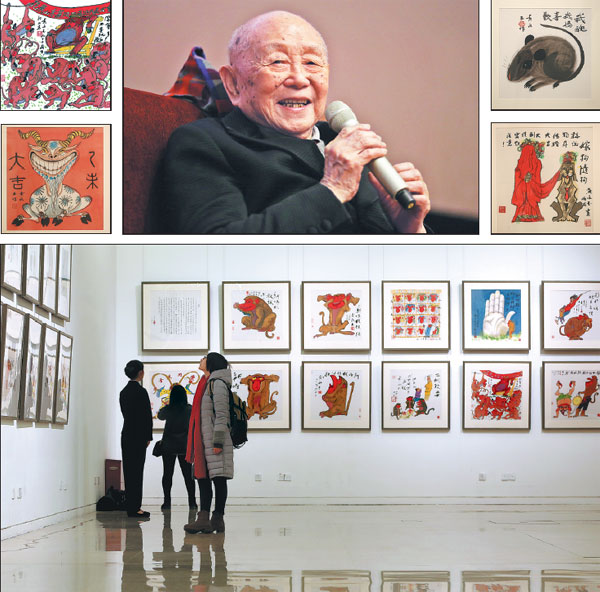
Huang Yongyu, 93, uses the Lunar New Year as an opportunity to comment on social issues and people's behaviors at an ongoing exhibition of his work. Lin Qi reports.
Chinese artist Huang Yongyu, 93, designed a stamp to mark the Year of the Dog in 2006 after being commissioned by China Post. But Huang, who is known for his sense of humor and a down-to-earth style, fell foul of the authorities after he submitted the illustration of a peeing puppy for the stamp.
The design was rejected by the authorities, who then turned to other designers.
Feeling disappointed, Huang, who raises a dozen dogs in his spacious villa called Wanhe Yuan (The Garden of 10,000 Lotuses) in Beijing's eastern suburbs, then produced 12 paintings, depicting many Chinese idioms about dogs through his works.
A friend who runs a publishing house helped him to publish these paintings in a wall calendar.
Huang also did a painting for the calendar cover and crafted a hand-written message for the flyleaf. He distributed the limited-edition calendars to friends as Lunar New Year gifts.
Since then, he has continued with the tradition every year. He just published his 12th calendar to usher in the Year of the Rooster, which will begin on Jan 28 and end on Feb 15, 2018.
The latest calendar completes a full cycle of the Chinese zodiac, or shengxiao, which represents a year on the lunar calendar.
Meanwhile, Huang's paintings and calligraphic flyleaf comments - 168 pieces in total - are on display at an ongoing exhibition, Twelve Months of Twelve Years, at Beijing's National Museum of China.
Huang also held a solo exhibition at the same museum in 2013 to mark his 90th birthday.
At the current exhibition that opened on Thursday, Huang communicates with viewers through "humor with thorns", says Chen Lyusheng, the exhibition's curator and retired deputy director of the National Museum of China.
Huang uses the animals to comment on social issues and people's behavior, says Chen.
The artist was inspired by the Chinese literary classic, Journey to the West, to produce paintings to mark the Year of the Monkey. One focuses on the addiction to mobile phones.
In the work, he portrays the novel's protagonist, the Monkey King, with monkeys in front of the Water Curtain Cave at his residence on the Mountain of Flowers and Fruit.
The monkeys are staring at their mobile phones as the Monkey King tries to attract their attention by saying: "We're in a meeting now! No playing with your mobiles!"
Huang designed Year of the Monkey stamps twice - once in 1980 when China Post started to issue the zodiac animal stamps annually and then again last year.
Speaking about the zodiac animals, Huang says it is most difficult to illustrate the dragon as idioms about the mythical creature are few and far between.
So, for his dragon works, he turned to the tale of the "nine mythological sons of the dragon king" and their distinctive characteristics.
In the tale, the fourth son, Pulao, is described as a creature who screams when hit and hence is seen as a symbol of alarming sounds.
Ancient Chinese used to craft bell handles in the image of Pulao.
In one of Huang's paintings, Pulao is depicted as a man who speaks loudly into a mobile phone on a street.
His works also portray interesting stories gathered during his travels around the country.
In one of his works for the Year of the Tiger, he shows a little girl holding a tiger cub.
Recounting the story behind the painting, he says: "In the 1940s, a teacher and some students in Putian county in Fujian province went on a spring outing. There, some children found a tiger cub in a mountain cave. They showed it to the teacher and said there were more in the cave. The frightened teacher immediately rushed the students back home. Thankfully, the tigress was not there."
For the Year of the Horse in 2014, which is also referred to as the Jiawu Year in the Chinese numbering system of "stems and branches" that comprises 60 terms in a cycle, he wrote: "It (the year) reminds me of the War of Jiawu (also called the First Sino-Japanese War) that took place 120 years ago, when the Manchu-ruled Qing Dynasty court was defeated.
"Then, after the Lugou Bridge Incident in 1937, the War of Resistance Against Japanese Aggression (1937-45) lasted eight years before they surrendered.
"Yet, have they ever admitted their guilt? Or apologized for killing so many Chinese?"
Huang says that working on the zodiac series has enabled him to better understand the tradition. He says that he was so unfamiliar with it that when a friend in Hong Kong asked him to paint the subject many years ago that he included the cat to make it 13 animals.
"The friend said: 'It is fine for you because you are like a cat - you have nine lives.'
"He was right because I almost died twice due to bombings by the Japanese."
Asked if he would continue with the zodiac series, he says he's unlikely to paint for another 12 years.
Contact the writer at linqi@chinadaily.com.cn
If you go
9 am-5 pm, closed on Mondays, through Feb 12. 16 East Chang'an Avenue, Dongcheng district, Beijing. 010-6511-6400.
|
An ongoing exhibition by artist Huang Yongyu at Beijing's National Museum of China features 168 pieces about Chinese zodiac animals. Photos By Jiang Dong / China Daily |




Copyright 1995 - . All rights reserved. The content (including but not limited to text, photo, multimedia information, etc) published in this site belongs to China Daily Information Co (CDIC). Without written authorization from CDIC, such content shall not be republished or used in any form. Note: Browsers with 1024*768 or higher resolution are suggested for this site.
License for publishing multimedia online 0108263 Registration Number: 130349