Spring Festival Eve is the time for a family feast and this year chicken is the star attraction. XU JINGXI reports from Guangzhou.
Pick up a piece of chicken with chopsticks, dip it into a condiment made by combining minced ginger, diced shallot and soy sauce, then tear up the light-colored, nearly white skin and bite the tender meat.
It makes Zou Xiaolu's mouth water whenever the 25-year-old southern Chinese girl thinks of "white cut chicken", a dish in Cantonese cuisine
The dish is Zou's favorite but she said it's difficult to find well-made "white cut chicken" in Beijing where she works, as it is always overcooked.
"The Spring Festival Eve is the most exciting day in the year," says Zou, who moved from Guangzhou to Beijing after graduating three years ago, but returns home every year to celebrate Chinese Lunar New Year with her family.
Then, Zou, along with her parents, grandparents and her uncle's family, sit around the table to enjoy the Spring Festival Eve dinner.
"It (the meal) is not only a family reunion but also a moment to satisfy my 'Cantonese stomach'," she says.
There is a saying in Cantonese: "It is not a banquet without chicken."
Guangdong people's love for chicken can be seen in their numerous ways of cooking it - boiling, steaming, salt-roasting, stewing and stir-frying, usually seasoned with soy sauce, scallion oil or "sand ginger", a special kind of ginger grown in Guangdong that is more pungent than other varieties.
The warm and humid weather of Guangdong may also have something to do with the local preference for chicken over beef and mutton. The latter two generate dryness and heat in the body, from the point of view of traditional Chinese medicine practitioners. Thus, they are more popular in northern China where the winters are severe.
Since this year is the Year of the Rooster, according to the Chinese zodiac that features 12 animals, chicken will undoubtedly be the center of attraction at the table for the Spring Festival Eve dinner in Guangdong.
Besides chicken, a typical menu for the Spring Festival Eve dinner in Guangdong includes fish, shrimp, pork knuckle, pork tongue, dried oysters and rice cake.
Why? Because these ingredients' names sound like "lucky" words in Cantonese, the dialect of Guangdong.
Like in Mandarin, the word for fish sounds like "surplus" and the word for cake sounds like "high" in Cantonese. Therefore, a dish made using fish symbolizes a new year with lots of foods and money.
A dish made using rice cake means you want the children to grow taller and the adults to get promoted at their workplaces.
Only Cantonese-speaking people understand the "lucky" words which sound like the ones for shrimp, pork knuckle and dried oysters because the Mandarin versions are different.
The word for shrimp sounds like "hah", while the word for pork knuckle sounds like the phrase for "do it easily". The word for "tongue" is pronounced like the word "profit", and the word for dried oyster sounds similar to the word for "good business".
"Guangdong also likes to give 'lucky names' to dishes served at the Spring Festival Eve dinner. It is nice to share these dishes with loved ones as if we are sharing good luck," says Wen Zhibin, president of Wen Qifu Restaurant, a restaurant chain in Guangzhou specializing in Cantonese cuisine.
This year, the restaurant has 10 set menus for the Spring Festival Eve dinner, priced from 1,388 yuan ($202.38) to 3,988 yuan per table. The dishes all have "lucky" names. For instance, a dish called "make money easily" is made with stewed pork knuckle and lettuce, whose Chinese name shengcai sounds like "earn money" in Cantonese.
Wen's restaurant will serve about 260 tables of 10 to 12 people each at its three locations in Guangzhou this Spring Festival Eve. And all of the tables had been booked two weeks in advance, says Liang Qinghua, the restaurant's manager.
"More people now dine at restaurants on Spring Festival Eve because it saves them time as they do not need to prepare for the dinner or wash dishes, and they have time to go to the flower markets," says Liang.
Families in many parts of China typically sit in front of the TV after dinner and watch the Spring Festival Gala presented by China Central Television. But in Guangdong, especially in Guangzhou, the provincial capital, most families visit flower markets.
Set up in the open, the Spring Festival flower markets typically run for three days ending on Spring Festival Eve. As the winter in the south is not so severe, it is traditional for people in Guangdong to buy flowers from the markets to decorate their homes to welcome spring.
For many in Guangdong, bustling crowded flower markets are a symbol of the Spring Festival. But for some, such as Johnson Wong, the noise in the kitchen reminds him of Spring Festival.
When Wong was a boy in the 1970s, he would wake up early on the morning of Spring Festival Eve to help his parents prepare dinner. He used to be assigned the job of pushing the millstone to grind rice, to make rice cake.
He also remembers the dinner preparations. For instance, the children were forbidden from standing near the pot when the adults deep-fried the jau gok, a dough snack. This was because it was believed that wishes would be granted if they were spoken when putting the dough into the hot oil. So adults would keep children away from the pot lest they said something inauspicious.
"I don't think young people today know about these traditions or have spent time preparing a Spring Festival Eve dinner together with family members, which is a pity," says Wong, a famous gourmet based in Guangzhou, and the president of the Guangdong Province Food Culture Research Association.
"I treasure the time spent with my family members preparing Spring Festival Eve dinner. Whether it is discussing how to cook a dish or just chatting about what happened in the past year, we communicate with family members," he says.
"For me, communication between family members is the highlight of Spring Festival, whether we dine at home or out in a restaurant, whether we are in the south or in the north."
Contact the writer at xujingxi@chinadaily.com.cn
|
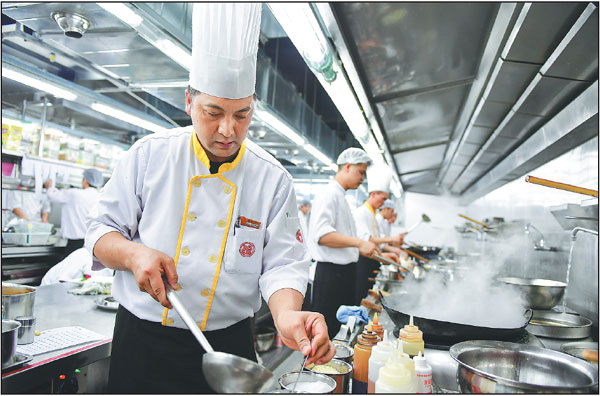
Chefs at Wen Qifu Restaurant busy preparing dishes in one of its outlets in Guangzhou, capital of Guangdong province. All of the restaurant chain's outlets have a full house for the Spring Festival Eve dinner. Their dishes often acquire names that indicate luckiness and good fortune. The above dishes are, from left, simmered dried oyster with lettuce which carries the wish for making good business and big money, stir-fried shrimp with water chestnut which indicates the wish for energy and vitality, and siu mei for riches and honor.Chen Jimin / For China Daily |




Copyright 1995 - . All rights reserved. The content (including but not limited to text, photo, multimedia information, etc) published in this site belongs to China Daily Information Co (CDIC). Without written authorization from CDIC, such content shall not be republished or used in any form. Note: Browsers with 1024*768 or higher resolution are suggested for this site.
License for publishing multimedia online 0108263 Registration Number: 130349