It has been a long journey for Wang Zonghui, who now helps more than 200 women make a living using their needlework skills
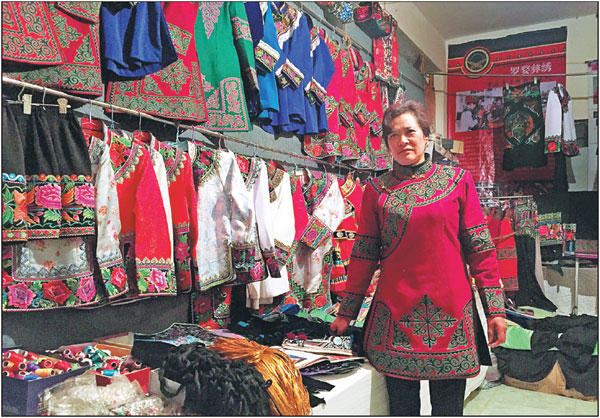
Wang Zonghui never expected a skill she learned as a child would help her become an artist and create wealth in her isolated hometown. Wang, who lived in Sayingpan town in Yunnan province's Luquan Yi and Miao autonomous county, learned ethnic Yi embroidery as a girl.
Recalling those days, she says: "My father told me I would not be able to get married if I did not know how to embroider."
Her initial skills were picked up from her mother, who learned them from her mother.
Luquan is said to have the largest concentration of ethnic Yi people in Kunming and its relative seclusion from the outside world has ensured that local Yi embroidery retains its traditional elements.
The art varies with clothes made for different age groups.
Clothes for elderly women mostly feature blue cloth and round collars, and trees, flowers, butterflies and birds are embroidered on the shoulders and sleeves of the outfits.
A belt made of black cloth and embellished with silver and aluminum decorations give the accessory a three-dimensional look, lending the outfit a simple and elegant look.
Outfits for younger women comprise a red hat embroidered with three black or blue flowers. The whole costume is mostly red and green.
Bridal outfits mostly have embroidery which is similar to that seen on the outfits for younger women, but are slightly different, in that the hat is made of black crepe and features silver accessories resembling dragons, phoenixes and snakes.
Eagles, dragons and tiger's heads are typically embroidered on the costumes for men.
Speaking of her journey, Wang says she always wanted to embroider modern clothes.
"So, I first drew patterns the way I remembered them on the ground with a stick," she says.
Drawing is the first step when doing embroidery.
At first, Wang used white mud blended with water as pigment to draw patterns on the cloth.
But, after years of practice, she can now draw complex patterns in one stroke.
"It's like writing characters, the chance of going wrong is slim," she says.
After the drawings are finished, threads of various colors are sewn on to fill the empty spaces in the drawings.
The techniques can often be complex, including cross stitching, embossing and mosaicking.
"There are different embroidering skills, making for different textures," says Wang.
Her skills won her an invitation to work in Suzhou, in Jiangsu province, in 2006.
The experience enabled her to hone her skills, and her daily salary jumped from 600 yuan to 3,000 yuan in three years.
However, Wang returned to Luquan despite the good income.
And, she was soon leading more than 200 local women in an embroidery business where she taught them how to draw and embroider more complex pieces.
Liu Guifang, 50, who has been working with Wang for four years now, says: "I initially did embroidery at home for myself and my babies, and it did not occur to me that I could sell the work for money."
But like most local women, Liu only knew how to do simple patterns, until she was taught by Wang to do complex designs.
Liu, who typically does embroidery for Wang when she has free time, says: "I might spend eight hours doing it if I don't have any farming to do."
The freelance work yields her more than 1,000 yuan a month.
Meanwhile, as more women get involved in the business, some have set up shop on their own.
And the local government has created an embroidery street in Sayingpan to protect the art and boost its development.
As of now there are more than 10 embroidery shops along the street.
In addition, more than 100 peddlers set up temporary shops to hawk their products during local fairs, which are held mostly on Thursdays and Sundays.
Also, the range of products on offer has grown.
Now, in addition to costumes, local embroidery is also seen on covers for TVs, refrigerators and on pillow covers and bedspreads.
The most common patterns are a phoenix flying across peony cluster, butterflies playing with plum blossoms, a rhinoceros watching the moon and two dragons fighting for treasure.
Speaking about the quality of the work, Wang says: "Good work should have variations in needle technique and consistent density. The more the density, the more durable the work is."
As for pricing, she says there is a lot of difference between handmade and machine-made pieces.
"It might take only an hour or two to finish a vest embroidery using a machine, but handmade work could take a month," Wang says.
Machine-made pieces also don't have subtle changes in texture.
A piece of handmade embroidery at Wang's shop can easily fetch up to 5,000 yuan.
Wang, who was named an art master in October, 2016, and often lectures at art schools in Kunming, has her own methods to ensure quality is maintained.
"If I find works below par I deduct money from the makers and teach them (the women) how to correct the work and improve."
yangfeiyue@chinadaily.com.cn
|
Wang Zonghui runs a shop, which sells Yi embroidery costumes, in Yunnan province's Luquan Yi and Miao autonomous county.Photos By Yang Feiyue / China Daily |




Copyright 1995 - . All rights reserved. The content (including but not limited to text, photo, multimedia information, etc) published in this site belongs to China Daily Information Co (CDIC). Without written authorization from CDIC, such content shall not be republished or used in any form. Note: Browsers with 1024*768 or higher resolution are suggested for this site.
License for publishing multimedia online 0108263 Registration Number: 130349