It's a state with the sixth-largest Chinese population in the US - 134,000 - and Chinese Americans hold just 14 of New Jersey's 5,000 public school board seats, but they are winning more seats and becoming more active in school districts.
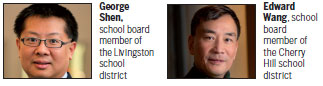
And though they are among that very small number of Chinese Americans on the state's 581 school boards, Shannon Peng, Edward Wang and George Shen see getting elected as a start to get more Asians in school leadership positions. The Asian population stands at 18.5 percent of the state's population and increased 34 percent between 2000 and 2010, according to 2010 Census data.
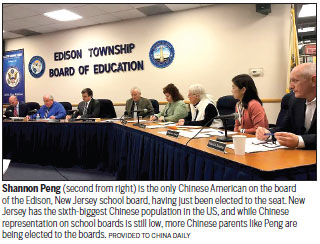
"A lot of Chinese parents don't even know there's a school board," said Peng. "I really hope we inspire more people, especially young people, to get involved. We're setting an example for them, for the next generation."
Peng is the only Asian member of the board in the township of Edison, which has a Chinese population of 7,500, and the only board member who is a parent of students in the school system, which she said is what motivated her to seek a seat.
"This is a volunteer job, you don't get paid and so a lot of members are volunteers. I just think there should be some parents on the board. Not all of them [need to be], but there should be some," she said.
The Edison school district's 10 public schools have 16,000 students, and for Peng the biggest priority is how to spend the school's budget of approximately $200 million.
"Every year they have budgets coming for the board to approve - funds coming from taxes, and we want to make sure tax money is well spent," she said.
"People argue about using the money to increase teachers' salaries, school construction or buying computers. We work with the superintendent's office, and they will bring up ideas and we as a board have to approve for those to be executed," said Peng, who is a software engineer with MetLife Inc.
Her two children, ages 7 and 10, are enrolled in Edison elementary schools, and she said she wanted to motivate the next generation to participate in local politics.
Peng organized her campaign on WeChat, which was built off a chat group that Chinese parents in the Edison school district use to communicate with each other. She had 100 volunteers work on her campaign, and using publicly available information, identified that there were 40,000 voters in Edison and her campaign went door-to-door to 10,000 addresses to persuade people to vote for Peng.
"It was a month and a half process, with volunteers walking around door-to-door almost every weekend, many of them with children who we want to set an example for," she said.
Wang is on the board in Cherry Hill where the district's 19 schools have 11,000 students, 18 percent of them Asian, the largest minority group. But there were no Asian parents or Asian members serving on the board, which is why Wang, a history professor at Rowan University, decided to run.
"There's a major deficit of Asian representatives on the board and in local politics," he said. "We used to have a person who served on the City Council, a Korean American, but now there are no Asian officials.
"We know that in Silicon Valley, the Chinese were not in any significant positions. In American society in general, particularly the Chinese, are not well-represented," said Wang, who has a 9-year-old attending school in Cherry Hill.
The biggest issues to him include getting the school district to consider teaching Chinese, and to declare Lunar New Year a school holiday, which he said has been brought up to the school superintendent but repeatedly struck down.
George Shen, a scientist with the pharmaceutical company Celgene, who won a seat on the Livingston school board, said similarly that "participating in the American democratic process is really important for Chinese. You're not just contributing to your own family's growth and even your own community but you can make not only this town - or wherever you live - prosperous."
Shen, who used to be a Chinese language teacher at the Huaxia Chinese School, said he wanted to highlight the importance of education in the Chinese community to the school district..
The district has nine schools with 5,800 students and is ranked No 6 in New Jersey.
"The goal isn't to do whatever it takes - spending more money and effort - into pushing the ranking up or to focus on top-performing students to make sure they become governors," said Shen, who has three children, a 15-year-old and twins aged 9, in the school system.
"That's not our goal. We want to help the whole [spectrum] of students."
amyhe@chinadailyusa.com




Copyright 1995 - . All rights reserved. The content (including but not limited to text, photo, multimedia information, etc) published in this site belongs to China Daily Information Co (CDIC). Without written authorization from CDIC, such content shall not be republished or used in any form. Note: Browsers with 1024*768 or higher resolution are suggested for this site.
License for publishing multimedia online 0108263 Registration Number: 130349