Province: Majority of people support new regulation
Despite a backlash from scholars, the people of Heilongjiang, the northeastern province that grows more than 10 percent of China's grain, appear to be standing united on its ban of genetically modified crops.
Starting in May, farmers will be prohibited from planting GM crops, according to a provincial regulation released in December. Observers have said the ban will hinder the development of biotech, while others have questioned its legality.
Lu Hao, governor of Heilongjiang, said at a provincial economic meeting in December that the province should not be afraid of controversy and that by issuing the ban, more people will notice what efforts the province has gone to in order to develop non-GM food and protect food safety.
China has, so far, not planted any GM grain, although no national law bans the planting or import of GM crops. Some legal experts have suggested the province does not have a legal basis to issue such a ban.
However, Li Qixiang, an official with the Legislative Affairs Commission of the Heilongjiang People's Congress Standing Committee, said the regulation has a sound basis among the province's residents.
In October, the committee conducted research in 13 cities and found that 91.5 percent of people interviewed objected to GM crops being planted in Heilongjiang, he said.
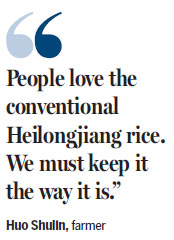
Huo Shulin, 65, a farmer in Suihua city's Fengshou village, said he had never considered planting GM grain in his 34-year career. "People love the conventional Heilongjiang rice. We must keep it the way it is," he said.
Ma Shouyi, a researcher of the Heilongjiang Academy of Land Reclamation Sciences, conceded that the old-fashioned way of planting cannot compete with genetically modified varieties, as the latter is becoming the trend in agricultural biotech. But he is still uncertain about the risks involved in using GM seeds.
Song Kui, president of the Heilongjiang Contemporary China-Russia Regional Economy Research Institute, said the provincial ban will benefit China's agricultural cooperation with Russia, which has become a growing business under the Belt and Road Initiative.
In July, Russia also set up a law that bans planting, producing and importing GM crops. Heilongjiang has established cooperative farms in Vladivostok, Russia, selling conventional agricultural food, which Song said has earned positive feedback in the local market. Some products were sold back to China, too.
Liu Chunming, director of the Chinese Academy of Agricultural Sciences' Institute of Crop Sciences, said any discussion of GM crops should not ignore the fact that China still faces potential challenges to food safety.
Twenty percent of the world's population lives in China, but the country has just 7 percent of the world's arable land - a basic fact Liu said he hopes people keep in mind before jumping to a conclusion.
He cited the fact that China imported more than 80 million metric tons of soybeans last year, most of which were genetically modified. A great percentage of the soybeans were turned into animal feed or ingredients of processed food, including edible oil.
"GM food is not the only way to boost food production," Liu said. "But simply giving it up may not be the wisest decision."
Contact the writers at chenmengwei@chinadaily.com.cn




Copyright 1995 - . All rights reserved. The content (including but not limited to text, photo, multimedia information, etc) published in this site belongs to China Daily Information Co (CDIC). Without written authorization from CDIC, such content shall not be republished or used in any form. Note: Browsers with 1024*768 or higher resolution are suggested for this site.
License for publishing multimedia online 0108263 Registration Number: 130349