Project will restore British graves of Chinese sailors who died at a significant moment in homeland's naval history
Final preparations are underway for a project that will restore the graves of five Chinese sailors who died in the 1880s in Newcastle-upon-Tyne, a city in northeastern England.
Experts consider the tombs to be historical artifacts that mark the birth of the Beiyang or Northern Fleet, the most powerful naval force assembled by China during the Qing Dynasty (1644-1911), which was bolstered by four battle cruisers that China purchased from the United Kingdom between 1881 and 1887.
Located in St. John's Cemetery in the Elswick district of the city, the graves - three of which have collapsed and are half-sunken - contain the remains of Yuan Peifu, Gu Shizhong, Lian Jinyuan, Chen Shoufu and Chen Chengkui, members of the first two naval delegations that China sent to Europe.
The five men died from unidentified illnesses while waiting to bring the cruisers back to China to form the most powerful navy in Asia at the time, according to Chen Yue, president of the Chinese Naval Historical Institute, who specializes in studies of the period.
Despite its power, though, the fleet was defeated by Imperial Japan during the first Sino-Japanese War (1894-95), signaling the end of a modernization movement under the Qing and the start of Japanese colonialism across Northeast Asia.
Last year, photos of the cracked tombstones were posted online by a Chinese student at the Royal College of Art in London and quickly attracted the attention of the China Foundation for Cultural Heritage Conservation, a nonprofit organization.
In December, the foundation launched its first global crowdfunding campaign with the aim of raising 460,000 yuan ($67,000; 62,000 euros; 53,600) to pay for the restoration work, according to Li Xiaojie, the foundation's president. The campaign is ongoing.
The Chinese government spends about 8 billion yuan every year on the protection of relics, but most of the projects are in China, he added.
The tombstones in Newcastle-Upon-Tyne are Chinese landmarks overseas, and as such are of great historical value, according to Chen of the Chinese Naval Historical Institute.
"They are rare historical artifacts of the Qing's modernization movement and Chinese naval history in general."
The China Foundation for Cultural Heritage Conservation and the Newcastle city council have now approved the survey, budget and repair plan. Given the current rate at which money is being donated, the repairs will begin in April and will be concluded by August, says Li Xiaojie, the foundation's president.
"The five sailors can rest peacefully knowing that, even after all these years, people back home still care about them," he says. "This is a project full of human warmth and love."
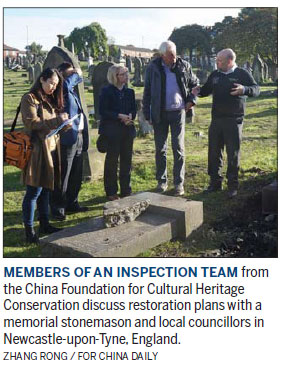
In September, Zhang Rong, the chief engineer for the tombstone restoration project, and his team, which is employed by Li's foundation, flew to Newcastle to clean, inspect the graves and discuss the restoration plans with local experts and city officials.
Initially, Zhang, who is also deputy chief engineer of the Beijing Guowenyan Cultural Heritage Conservation Center, thought the work would be easy, but he quickly realized that his optimism was misplaced.
"It turned out to be the trickiest project I have ever worked on. The tombstones are immoveable historical relics left by Chinese people in a foreign country," he says, adding that because of their rarity, the graves are managed by the local cemetery and protected under British law.
"The repairs must adhere to the protection laws and standards of both countries," Zhang says. "China has no precedent in dealing with such artifacts, so we have to start everything from scratch."
Simon Richmond, owner of Joseph Richmond & Son Memorials, a family-run team of stonemasons in Newcastle, says certain sections of the graves need to be replaced because they are badly damaged.
"But we are trying to keep as much of the original material as possible to maintain the historical integrity of the memorials that have been here for a very long time," Richmond says, adding that the main challenge is the size of the headstones, which are so large that special lifting equipment will be needed to carry out the work.
The northern English weather will also present challenges, so the bulk of the work will be carried out during the summer months to avoid adverse conditions, such as rain and snow, he says.
According to the archives at Newcastle Civic Centre, the first two graves were purchased by the Chinese government in 1881, and the other three in 1887. They cost 5 each at the time, which would equate to about 1,000 ($1,267) per grave in modern terms, according to Alan Macfarlane, historian and professor emeritus at King's College, Cambridge University.
"It does not seem very much but in fact, at the time, the Chinese were relatively short of foreign currency, so it really was a great sacrifice," he says. "It was really a wonderful thing that was done because so many Chinese sailors were lost all over the world and very, very few of them have been remembered. It is marvelous that we are now able to remember one or two of them."
The Northern Britain Chinese Entrepreneurs Association, which is based in Newcastle, has become a major player in the restoration project, which is of great significance to the Chinese community in Newcastle and northeast England, according to Xu Lei, the association's executive vice-president.
"In addition to the historical importance of the project itself, I believe that working together with the local government and community helps overseas Chinese in Newcastle to better integrate with the local community. It also provides local people with a great opportunity to understand some Chinese history and traditions," he says.
Contact the writer at zhangzhihao@chinadaily.com.cn




Copyright 1995 - . All rights reserved. The content (including but not limited to text, photo, multimedia information, etc) published in this site belongs to China Daily Information Co (CDIC). Without written authorization from CDIC, such content shall not be republished or used in any form. Note: Browsers with 1024*768 or higher resolution are suggested for this site.
License for publishing multimedia online 0108263 Registration Number: 130349