International alliances and collaborations should remain unshaken in the face of angry words surrounding Trump's arrival
There is no doubt that Donald Trump has made an extraordinarily successful debut as an American politician. His ability to confuse and destroy so many potential rivals in his own party and to use his unusual style and innovative tactics to set the national political agenda has put him where he is today.
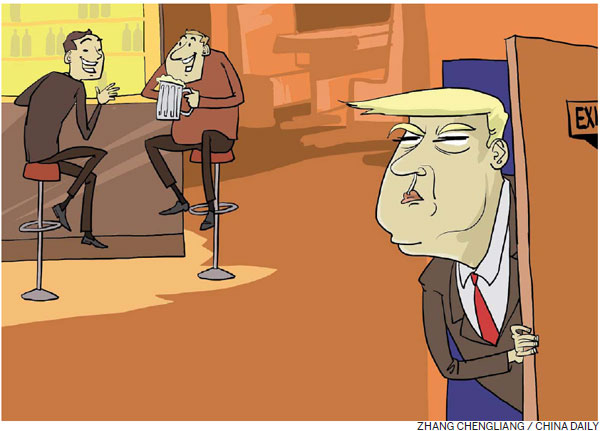
So far, the president is dividing both his country and the West. European leaders would, however, be wise not to fall into the atmosphere of over-excitement that Trump seems to enjoy. The European Union has made clear its concerns about Russian encouragement of separatism in Ukraine. It has a policy of constructive engagement with China. These basic positions should not be changed to appease the White House.
Theresa May was happy to be the first leader to visit Trump at the White House, some would say as part of a desperate attempt to convince herself and her country that there are parts of the global market out there from which the United Kingdom is blocked off because of its EU membership. A week after this visit she at least united her country as, in an almost unique development, the House of Commons voted to call on the president to reverse the "Muslim Ban". Her self-appointment as a bridge between the EU and the United States did not seem very relevant to the rest of the EU, broadly committed to strengthening its security and May has had to distance herself from the almost hostile attitude coming from Trump and some of his key advisers, expressing her support for a strong EU even after the UK leaves it.
Brexit will be a "wonderful thing" he told her in front of the world's press, maybe unaware that she had originally opposed the whole idea. Except for Hungary's Viktor Orban, the rest of the EU seem to be, at a minimum, unsure of the reliability of May's new best friend. Orban describes himself as in favor of "illiberal democracy" and expresses admiration for President Vladimir Putin, who popped into Budapest on the eve of last week's meeting in Malta of the European Council. Putin, no doubt, shares Trump's oft-repeated view that NATO is obsolete.
On the eve of the Valletta meeting, council President Donald Tusk wrote to the EU 28 listing the new US administration as one of several major external threats to the EU, already beset with numerous internal crises seen as potentially existential in their nature. His letter reflected, however, a strange set of priorities. In a key paragraph, which has attracted attention around the world, he wrote: "The first threat, an external one, is related to the new geopolitical situation in the world and around Europe. Russia's aggressive policy toward Ukraine and its neighbors, wars, terror and anarchy in the Middle East and in Africa, with radical Islam playing a major role, as well as worrying declarations by the new US administration all make our future highly unpredictable."
In fact, the only new element mentioned is indeed the start of the Trump administration. All the others are old news. Russia, like Trump, seems intent on splitting - if not destroying - the EU. The issues of terrorism and radical Islam are ongoing. All play into and exacerbate the internal challenges, but the EU still needs to keep cool. However worrying the signals from Washington have become, Europe still needs the US as an ally and an economic partner and this was made clear by EU leaders in Malta. There is no need to give Trump the benefit of the doubt, but as his administration has not fully been set up, the opportunity remains to keep the Atlantic Alliance on track. Success is not guaranteed and signals need to be sent. The refusal of European Parliamentarians to deal, for example, with a US ambassador openly seeking to break up the very EU with which he wishes to be accredited, is timely and well-targeted, as no formal nomination has yet been made.
The reference to China at the top of the Tusk threat list was particularly inappropriate and ill-conceived. Since the 1970s, China has consistently supported European political and economic integration. This policy was established at a time when the USSR (and British leftists like Jeremy Corbyn) had already started attacking the project and hoped it would fail. Unlike the USSR, China favored UK membership at the time of the 1975 referendum and has clearly regretted the Brexit decision of 2016. It remains committed to the closest possible relations with the EU. Yes, transparency and fair trade issues are profoundly important. But it is a very small blip on Europe's geopolitical horizon. Moreover, China, like the EU, is relying on successful globalization and recognizes the importance of fighting climate change, both of which are of immediate importance to Europe.
A few weeks before last July's EU-China Summit, the EU set out an ambitious agenda to continue the deepening of relations with China. As Federica Mogherini, high representative of the European Union for foreign affairs and security policy, put it: "The European Union and China already cooperate on so much. We work together on the global and political issues of our times, such as Iran, Syria, Afghanistan, migration and climate change."
Keeping cool means maintaining consistency in stormy and unpredictable circumstances. The nicest thing one could say about President Trump is that he is sui generis and so to list him as part of a threat list of this kind reflects anxiety rather than strategy. It is an anxiety which leaders like Trump deliberately create. Chaos is part of the plan.
European leaders have to think through the new realities. Neither Theresa May nor Twitter diplomacy is the key. Europe should, instead, continue building alliances with those in Washington and around the world who do not want to upend global stability and will not accept a world order based on "America First". China can be part of this.
The author is a visiting professor at the College of Europe in Bruges and a distinguished teaching fellow at Vesalius College Brussels. He was an official of the European Parliament, based in Washington DC from 2012 to 2016. The views do not necessarily reflect those of China Daily.




Copyright 1995 - . All rights reserved. The content (including but not limited to text, photo, multimedia information, etc) published in this site belongs to China Daily Information Co (CDIC). Without written authorization from CDIC, such content shall not be republished or used in any form. Note: Browsers with 1024*768 or higher resolution are suggested for this site.
License for publishing multimedia online 0108263 Registration Number: 130349