Some residents of rural Hunan still believe in old-style Spring Festival celebrations but fear that traditions may be lost unless they're protected, Liu Xiangrui reports.
Spring Festival, which is celebrated from the first to the 15th day of the first lunar month, is undoubtedly the most significant cultural event in a year for Chinese.
The residents of my hometown, Yueyang, a 2,500-year-old city in Central China's Hunan province, have held onto many traditions for generations.
Like in other parts of the country, preparations for the festival start early every year, with food playing a key role.
In rural Yueyang, for instance, such delicacies as tofu and smoked pork are prepared a month or two in advance.
Then, there are specific days for certain activities.
People offer prayers to the kitchen god on the 23rd of the last lunar month, so that he puts in a good word about the host family when he returns to heaven to file an "annual report" the next day.
The festival is celebrated by putting up auspicious decorations in houses, lighting firecrackers, worshipping ancestors and staying up late on the eve of the Chinese New Year. The night before the year begins is the highlight of the festival, when those working in faraway cities (like myself) try to rush home to catch the family reunion dinner.
Some families have unique menus for this special meal. Fish, which symbolizes prosperity in Chinese culture, is a must.
After dinner, many people watch China Central Television's hit annual Spring Festival Gala and join in the fireworks around midnight.
But these days, the younger generations have found other means of entertainment like going out in groups.
According to custom, the next morning, young people wake up early to greet their parents and grandparents. In some villages, the youth visit elderly neighbors, too.
The most exciting part of the celebrations for children and young adults who don't work is receiving gift money, usually in red envelopes, from parents or other older family members.
In rural areas, one more exciting thing as a child, as I remember, is going door-to-door with a bag in hand to collect goodies from different houses.
The children visit the houses both on the eve of Chinese New Year to bid farewell to the old year and early the next morning to welcome the new year.
They receive all sorts of snacks. Their bags are usually bulging by the time they return home.
Nowadays, fewer children participate in such activities, mostly because people's economic situations have improved significantly.
In the first few days of the new year, people are busy with visits to the houses of their relatives.
They usually take turns to invite each other over and host feasts.
On such occasions, it is also important to remember the deceased.
In Yueyang's villages, locals usually go to sweep the tombs of their loved ones. They take firecrackers and other offerings with them.
Spring Festival officially ends on the day of the Lantern Festival. On this day, people eat sweet dumplings called yuanxiao and light lanterns in the streets while enjoying the full moon.
But the festivities also come with taboos.
For example, it is believed that people should not touch a broom or throw away garbage on the first day of Chinese New Year, in a symbolic gesture of keeping good fortune from leaving families. On the contrary, major housecleaning must be done before the festival so as to drive out any bad fortune.
People are also supposed to avoid saying inauspicious things throughout the festival.
While some customs are still observed, local residents like 67-year-old schoolteacher Xu Lang say that many other traditions are gradually getting lost.
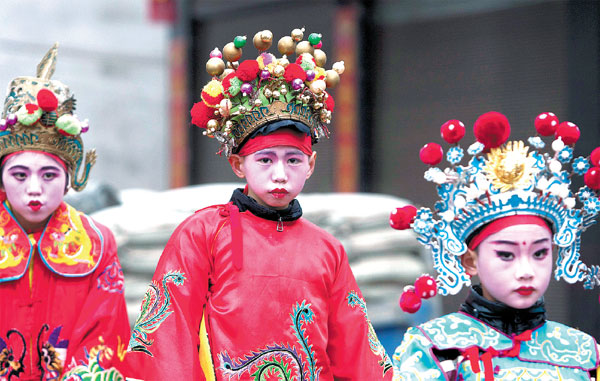
Many festival activities, such as local operas and lion or dragon dances, are fewer today.
Dragon-dance teams would go from village to village in Xu's neighborhood to wish people good fortune during the festival. People would thank them with gift money.
But these days, such sights are rare, he says.
Meanwhile, it has become common for the locals to indulge themselves in games of mahjong or cards.
The situation worries many elderly locals, including Xu, who believe efforts should be made to revive old traditions and avoid unhealthy practices.
"People's lifestyles have changed, and they have more access to different forms of entertainment today, such as the internet or television. But we should do something to keep the old traditions alive as well," Xu says.
"After all, tradition is the essence of Spring Festival."
Contact the writer at liuxiangrui@chinadaily.com.cn
|
Children clad in costumes of local opera take part in a parade for the Spring Festival in Yueyang, Hunan province. Photos Provided To China Daily |




Copyright 1995 - . All rights reserved. The content (including but not limited to text, photo, multimedia information, etc) published in this site belongs to China Daily Information Co (CDIC). Without written authorization from CDIC, such content shall not be republished or used in any form. Note: Browsers with 1024*768 or higher resolution are suggested for this site.
License for publishing multimedia online 0108263 Registration Number: 130349