The late painter Lin Fengmian, who challenged convention, is honored with a display of his works in Beijing. Lin Qi reports.
In 1931, master painter Qi Baishi received an artwork from Lin Fengmian, a fellow artist and then-principal of the Hangzhou Fine Arts School (now the China Academy of Art) in the country's east. In the painting Roosters, Lin portrays three white-feathered birds with red crests in light strokes of ink.
Qi treasured the gift, and after his death it was donated with many other artworks he created to the Beijing Fine Arts Academy.
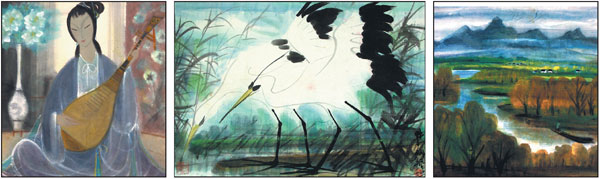
The painting is now on show at the academy's art museum for an exhibition marking Lin's contributions to modernizing Chinese painting and fine-arts education.
|
The show Loneliness of Wild Ducks marks Lin Fengmian's contributions to modernizing Chinese painting and fine-arts education. Photos Provided to China Daily |
Lin was also among the few people to recognize Qi's talent when he was still an unknown artist from Central China's Hunan province.
When Lin headed what is now the Central Academy of Fine Arts in Beijing in 1927, he employed Qi to teach classical Chinese painting.
The decision was denounced by the elites in the capital's art circles who looked down upon Qi because of his background as a rural carpenter without formal art training. But Qi fought on.
In his autobiography, Qi wrote: "I'm from the countryside. I understand that it won't be easy to lecture at a Western-style school ... But to my surprise, headmaster Lin and several other teachers think highly of me ... Students admire me and listen attentively in my class ... So, I'd like to continue the job."
Besides the painting Roosters, the current exhibition also displays dozens of Lin's works encompassing such subjects as court ladies, landscapes, birds and flowers. These paintings done between the 1940s and '70s are mostly from the collection of the Shanghai Artists Association, the Shanghai Chinese Painting Academy and the China Art Museum, also in Shanghai.
Lin lived in the metropolis for more than 20 years. He relocated to Hong Kong, where he lived the rest of his life, in 1977.
The exhibition is called Loneliness of Wild Ducks. Ducks and other birds recur in Lin's works, in which he often presents a feeling of solitude and sadness. The title also refers to his struggles to get his artistic ideas accepted by China's mainstream society.
Lin was born in Meixian, in Guangdong province. He first studied sculpture at Ovide Yenccesse's studio at the School of Fine Arts in Dijon, France, in 1921. He then transferred to the National School of Fine Arts in Paris to practice oil painting. He also traveled and painted in Germany for a year.
Lin was nourished by post-impressionism, fauvism and expressionism. These movements affected his build-up of rich colors and helped him to form a distinctive composition style that features many blocks in a fine arrangement. He blended Western elements with his understanding of Chinese culture.
It is said that on Lin's first day at the French art school, Yenccesse told him that, as a Chinese, he should first understand the value of Chinese art before learning about modern art. The French sculptor told Lin to visit some oriental museums in Paris and explore the treasures of his home culture.
Lin sourced inspiration from ancient Chinese traditions, such as making ceramics and lacquer ware. He also attempted to present the elegance and tranquility of Eastern aesthetic philosophy.
Wang Mingming, director of the Beijing Fine Arts Academy, says Lin knew both Chinese and Western cultures and therefore was able to find what they have in common.
"He expressed what he felt, whatever he worked with - be it oil, ink, brush or watercolor," Wang says.
"The interaction of colors, the strength of the lines and the mobility of compositions in his paintings strike us so forcefully that we share both his artistic zeal and his sadness."
Lin's innovation of Chinese art education helped several famed artists, including Zao Wou-ki, Chu Teh-chun, Wu Guanzhong and Li Keran. They all studied under Lin's direction at the Hangzhou Fine Arts School.
After Zao entered the school in 1935, he got so bored with the regimented training of Chinese painting at the time that he sometimes skipped classes.
During one major exam, he drew a circle in ink, calling it "a rock". This angered his instructor and ink master Pan Tianshou.
Pan wanted Lin to dismiss Zao. But Lin persuaded Pan to be more patient.
After Zao graduated, Lin offered him a teaching assistant's position at the same school while also encouraging him to study abroad.
In 1948, Zao moved to Paris, where he gained international fame as an abstract painter.
In the 1970s, he visited Shanghai and found his old headmaster going through a difficult time during the "cultural revolution" (1966-76).
Wang says the uniqueness of Lin's art adds luster to 20th-century Chinese art history.
"He is a master, who deserves our respect."
Contact the writer at linqi@chinadaily.com.cn




Copyright 1995 - . All rights reserved. The content (including but not limited to text, photo, multimedia information, etc) published in this site belongs to China Daily Information Co (CDIC). Without written authorization from CDIC, such content shall not be republished or used in any form. Note: Browsers with 1024*768 or higher resolution are suggested for this site.
License for publishing multimedia online 0108263 Registration Number: 130349