Performer Zhang Jun will stage Kunqu Opera in Beijing to revive the ancient art form. Chen Nan reports
It was perhaps a twist of fate. In 1986, when representatives of the Shanghai Drama School came to the metropolis' Qingpu district to recruit new students, Zhang Jun, then age 12, took the exam. His mother had him learn the accordion and the erhu (two-stringed fiddle), so Zhang signed up as an instrument major.
But to his surprise, after several rounds of interviews, Zhang found himself on the long list of candidates vying to study Kunqu Opera, an ancient Chinese theatrical art form.
Famous Kunqu Opera actress Zhang Xunpeng, a judge of the exam, told Zhang Jun's mother that her son's high-pitched, silky voice and slim, handsome face were perfect for xiaosheng, young male roles in the opera.
|
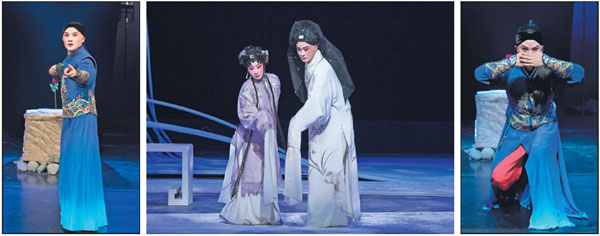
Zhang Jun keeps pushing the boundaries of Kunqu Opera in projects like I, Hamlet (left and right) and Blossoms on a Spring Moonlit Night. Photos Provided to China Daily |
Three decades later, Zhang Jun has become one of China's top Kunqu Opera performers.
He won the Plum Performance Award, the highest honor for Chinese theater artists, and is regarded as the "prince of Kunqu". After graduating from the Shanghai Drama School, Zhang Jun earned his master's degree from the Shanghai Theater Academy.
In March, Zhang Jun will stage Blossoms on a Spring Moonlit Night in Beijing. The operatic piece is inspired by a Tang Dynasty (618-907) poet's work.
Zhang Jun is the show's producer and will play the lead role. The opera, written by Luo Zhou, is based on a love story, which transcends life and death.
"Luo's creativity is based on sticking to the tradition of Kunqu Opera," says Zhang Jun, adding that it is tough to write an original Kunqu Opera today due to its ancient cultural connotations.
The show debuted in Shanghai in 2015 and won acclaim from both critics and fans. During the past two years, it has been performed more than 20 times in China.
In 2001, UNESCO proclaimed Kunqu Opera as an "intangible heritage of humanity". In 2011, Zhang Jun was recognized as an Artist for Peace by the world body for his endeavor to popularize the art form.
His focus has been to keep it alive by capturing the romance and elegance of Kunqu while introducing contemporary aesthetics in performances.
In a bold move, Zhang Jun resigned from his position as the deputy director of the Shanghai Kunqu Opera Troupe in 2009 and established his own company, the Zhang Jun Kunqu Opera Center.
"A stable life can make you lazy sometimes. It also constrains your imagination. I want to experiment with my 'crazy' ideas," says Zhang Jun.
He once founded a hip-hop group and worked with pop singers, such as Chinese-American singer-songwriter Leehom Wong, to expand the dimensions of Kunqu Opera.
In 2010, Zhang Jun collaborated with Oscar-winning composer Tan Dun, staging Peony Pavilion, one of the most famous Kunqu Opera pieces written by Ming Dynasty (1368-1644) playwright Tang Xianzu.
Breaking the convention of performing inside theaters, he staged the production in a landscaped garden in Shanghai.
Zhang Jun has presented Peony Pavilion in different countries, including France, Italy and the United States, in the past few years.
He has also performed a major role in Chinese composer Tan Dun's opera Marco Polo that was nominated for a Grammy Award in 2010.
Speaking of Zhang Jun's performance, Tan once said: "He is neither here to perform Kunqu Opera nor to learn from Western theater. He is here to inspire a Western audience and be inspired."
Last year, in his one-man Kunqu production, I, Hamlet, Zhang Jun delivered the famous line "to be or not to be" in English while mixing the words with traditional Kunqu singing. In his play, he adapted the Kunqu style of monologue and played four roles: Hamlet, Ophelia, the ghost of Hamlet's father and the gravedigger.
"Zhang Jun introduced a new Hamlet to me. I am surprised to see how a classic Western story is told through Chinese Kunqu Opera," says John Howkins, a visiting professor at the Shanghai Theater Academy.
In December, Zhang Jun presented the opera at Southbank Centre in London, Britain's largest cultural institution. In January, the show was staged in New York at the annual conference of the Association of Performing Arts Presenters. In April, I, Hamlet will be staged in Shanghai.
"When I start a new project I have no idea where it will go. I just test my ideas in the rehearsal room," says Zhang Jun. "The process is exhausting but also tempting."
He is more concerned about reviving the ancient art in its homeland than introducing Kunqu to the West. Like many traditional art forms, the opera's popularity is sliding.
Zhang Jun does over 100 shows every year and also gives lectures to young Kunqu students.
"Compared with TV shows, the influence of Kunqu Opera is limited," he says.
He does not plan to stop working to revive it.
Contact the writer at chennan@chinadaily.com.cn




Copyright 1995 - . All rights reserved. The content (including but not limited to text, photo, multimedia information, etc) published in this site belongs to China Daily Information Co (CDIC). Without written authorization from CDIC, such content shall not be republished or used in any form. Note: Browsers with 1024*768 or higher resolution are suggested for this site.
License for publishing multimedia online 0108263 Registration Number: 130349