Expert alleviated poverty to ease pressure on endangered species
NANNING - Chinese zoologist Pan Wenshi, 80, believes the secret of his success in saving endangered white-headed langurs lies not just in his love for the animals, but also in his love for people.
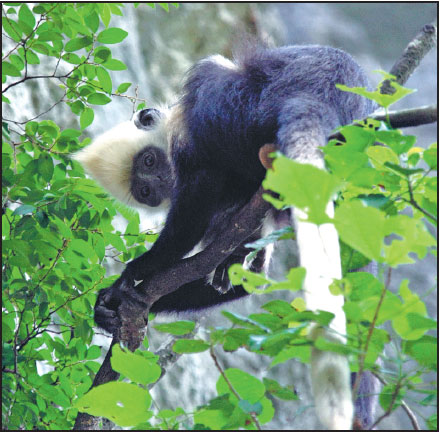
During the past 20 years, he and his team at Peking University have helped langurs, one of the world's 25 most-endangered primate species that are native to China, recover their habitat from the hands of their human neighbors and restore their once dwindling population.
Instead of driving villagers away, Pan led a campaign to improve their lives so that they could befriend the monkeys.
A new book on his field research aims to be the most authoritative and comprehensive monograph ever written on the species.
Grinding poverty
Though initially a prominent researcher of the giant panda, in 1996 Pan went to the karst mountains of Chongzuo, in the Guangxi Zhuang autonomous region, to study langurs.
"I wanted to explore the evolution from animal society to human society," said Pan, adding that Chongzuo, where humans and monkeys coexist, gave him a chance to study both in detail.
All he had for a research base were three rooms in an abandoned building at the foot of Nongguan Mountain, a langur habitat. Residing there, he cooked on a clay stove and slept on a straw mat.
Pan soon found that rampant logging, grass fires and quarrying were destroying the langurs' habitat and almost led to their extinction in the 1990s. The root cause of the animals' predicament was clearly the extreme poverty that forced villagers to feed themselves at the cost of the surrounding environment.
"They had nothing except small patches of farmland," Pan said.
Once, he hired a local farmer as his assistant and gave him some dessert to take to his children as a gift. The next day, he asked if the children had enjoyed it.
"I ate it before I got home. I was too hungry," the farmer replied.
Pan was shocked at such hunger, but soon understood when he visited the farmer's family and saw all they had to feed a family of eight - a single pot of porridge. Their neighbors were just as poor.
He once saw an elderly villager drink water from a pond where several buffaloes had just relieved themselves. Due to contaminated drinking water, many men in the village have liver disease, while some of the women have cervical cancer.
It was clear that the villagers cut down wild plants and took stones from the mountain as they needed to make ends meet.
Some villagers even killed langurs to make a medicated liquor believed to cure disease - a movie ticket could be exchanged for two langurs.
Save people first
Pan realized that if the lives of villagers were not improved, the langurs would soon be extinct.
"We could delay our research into the langurs for 100 or 200 years, but if we didn't save the villagers first, the monkeys' habitat would be destroyed," he said.
First, he encouraged the use of biogas as an alternative to firewood, to restore local vegetation.
In 2000, he donated a 100,000 yuan ($14,500) environmental award he had received from Ford Motor Co to build biogas tanks in three nearby villages.
Later, he collected 2.14 million yuan from the central government and other donors to set up more tanks for more than 1,800 families in 14 villages around Nongguan Mountain.
Finally, he persuaded the local government to help the villagers grow sugar cane, which has a higher economic value than rice, the traditional village crop. He also told them to reduce their use of pesticides for the sake of the environment and to lower costs.
The average per capita income of villagers on Nongguan Mountain reached more than 6,000 yuan in 2015, from less than 400 yuan in 1996.
In addition, Pan collected 13.7 million yuan over 20 years from donors such as friends at home and abroad, private companies and the government, to build a primary school, two clinics, three drinking water projects and a two-kilometer-long road for the villagers. He also set up a biological museum, an education center and an ecological park featuring the langurs.
As the villagers' lives improved, the langur population thrived. Currently, Chongzuo is home to more than 800 white-headed langurs, up from just 96 when Pan first arrived.
"We have many endangered species in the world, but it doesn't mean they have come to an end. They can recover as long as we give them enough time and space," Pan said.
|
A white-headed langur among the branches of a tree at the Chongzuo White-headed Langur Ecological Park in the Guangxi Zhuang autonomous region.Huo Yan / China Daily |




Copyright 1995 - . All rights reserved. The content (including but not limited to text, photo, multimedia information, etc) published in this site belongs to China Daily Information Co (CDIC). Without written authorization from CDIC, such content shall not be republished or used in any form. Note: Browsers with 1024*768 or higher resolution are suggested for this site.
License for publishing multimedia online 0108263 Registration Number: 130349