Dansaekhwa, a low-profile South Korean art genre, will be presented in Shanghai this fall. Deng Zhangyu reports in Seoul.
Dansaekhwa, a genre of monochromatic paintings from South Korea, will make its Chinese mainland debut in September.
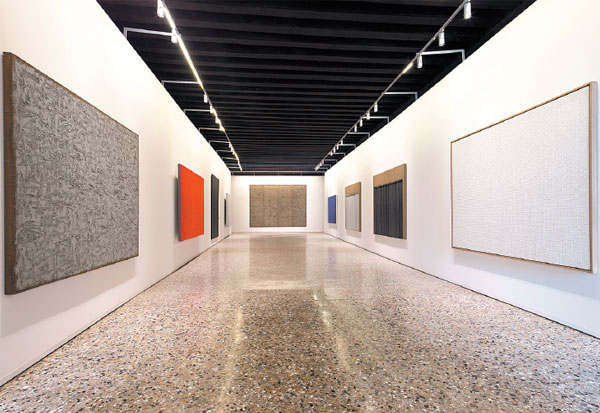
The show at Yuz Museum in Shanghai, featuring more than 70 works by different artists, including the elderly, is expected to draw collectors and lovers of art who share cultural similarities with Korean people. The artworks are largely abstract paintings, with emphases on materials and process, made since the mid-1970s.
Lee Hyun-sook, founder of the Kukje gallery in Seoul, says the exhibition will show works of more than 10 representative artists, both alive and deceased.
Her gallery will borrow the paintings from private collectors and museums in South Korea.
The relatively low-profile art form has been displayed in Western galleries, catching their attention only in the past few years.
Ha Chong-hyun says he didn't think he would see dansaekhwa get international appreciation during his lifetime. The 82-year-old artist, whose works will be on show in Shanghai, is known for painting on the reverse side of burlap. His works have been collected by New York's Guggenheim Museum and the Art Institute of Chicago, among others.
Ha, speaking in his studio in suburban Seoul, says: "People around me keep reminding me not to work this hard. But I want to paint every day since I have limited time left."
At a time when South Korea was under martial rule and still a developing country, dansaekhwa art was being created by artists who wanted to make a statement.
Giving the shortage of materials needed for painting in his country in the 1970s, Ha gathered barbed wire and burlap for his art. Some people see similarities between his work and Western minimalism.
But, Ha says, "they often ignore the historical context" under which he created his pieces.
Park Seo-bo is another artist who will be featured in the same show. The 86-year-old's works - largely influenced by Taoism and Buddhism - make heavy use of pencils on wet paper.
He was attracted to scribbles while watching his son do his homework as a child.
"For me, it's a practice of Buddhism and Taoism to experience the state of being one with my art," explains Park, whose studio once caught fire.
But fortunately for his legacy, some of the works had been stolen before the fire and found their way to auction houses.
Park had struggled with poverty in the early years of his career, and to keep painting, he worked at art studios in schools to gather paints left by students after finishing his cleaning work.
He even painted on wooden boxes due to lack of canvas in the 1950s.
"Poverty used to be my source of inspiration," he says.
His studio today has some Chinese ink paintings and calligraphy works by prominent artists on the walls. He says South Korea and China share a lot in common in culture.
He writes Chinese characters as well. For the show in Shanghai, he says the Chinese audience will have no difficulty in understanding dansaekhwa.
Lee, founder of the Kukje gallery, says Chinese easily understand dansaekhwa art as she has noted from past experience at fairs, such as the Frieze London, Art Basel Hong Kong and ART021 in Shanghai.
When the gallery presented the genre at Shanghai's ART021 in November, many Chinese collectors showed interest in dansaekhwa. This inspired Lee to plan a group show at a museum in China to promote the art among a wider section of the Chinese society.
Back home, in 2014, her gallery held a show of dansaekhwa in Seoul that made the genre even more popular with Koreans. Soon active promotion outside South Korea started.
Some of the artists' works have been sold at much higher rates over the years.
But she explains the success of the art is not fortuitous. In the 1960s, minimalism was popular in the West, such as in Germany, Italy and the United States. Works of the representative artists from the time are already expensive for buyers. Dansaekhwa has been under valued for a long time and was rediscovered only a few years ago.
The elderly artists of this genre in particular have struggled for long and have lived through the country's many twists and turns in history. At least their works survived, says Lee.
"Bringing dansaekhwa to China will open a door for more kinds of Korean art to be shown here in the future," she says.
Contact the writer at dengzhangyu@chinadaily.com.cn
|
The Kukje gallery in Seoul has taken its collection of dansaekhwa to art fairs around the world, such as the 56th Venice Biennale in 2015. Photos Provided To China Daily |




Copyright 1995 - . All rights reserved. The content (including but not limited to text, photo, multimedia information, etc) published in this site belongs to China Daily Information Co (CDIC). Without written authorization from CDIC, such content shall not be republished or used in any form. Note: Browsers with 1024*768 or higher resolution are suggested for this site.
License for publishing multimedia online 0108263 Registration Number: 130349