Filmmaker Yang Chao teams up with Hugo winner Hao Jingfang for a new Chinese science fiction movie. Xu Fan reports.
Science fiction, a dominant genre in Hollywood, has yet to find its feet in the Chinese movie industry. But change is underway.
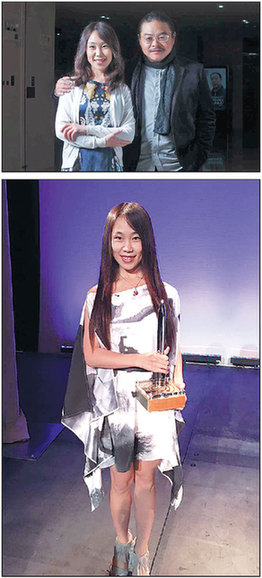
Hugo Award-winning novelist Hao Jingfang and Yang Chao, director of Crosscurrent, an internationally acclaimed Chinese film, have teamed up to bring The Last Brave Man to the country's moviegoers.
Based on a 2012 novel of the same title by Hao, the film will be set in an ambiguously-defined futurist world.
|
Hao Jingfang (above and top left) wins the Hugo Award for best novelette with her work Folding Beijing in 2016. Her latest project is the film The Last Brave Man, directed by Yang Chao (top right). |
The film is likely to be released in late 2018 or early 2019.
The author became the first Chinese woman to win the coveted prize for her other novel - Folding Beijing - in 2015.
Yang, a fan of the genre, made his debut with Passages, a feature that won him the Camera d'Or at Cannes in 2014.
Crosscurrent won awards in Berlin and Taipei.
Seen through the perspective of a clone refugee who is betrayed to his rulers, The Last Brave Man film is expected to explore what human cloning may mean for society.
Interestingly, it will not revolve on Hollywood cliches such as the struggle between morality and science, but instead focus on the uniqueness of an individual's soul as discussed in the book.
"I was then writing my doctoral dissertation, and took several days to finish the story," Hao says in a telephone interview.
The 33-year-old now works as an economic researcher with the Beijing-based nonprofit China Development Research Foundation. In her spare time, Hao writes and consults with filmmakers for projects.
Hao studied physics at the elite Tsinghua University and wrote her PhD paper on economic subjects.
As a student, she read a lot of books covering a range of subjects, from genetics and psychology to history, and began to ponder on the connections between them.
Imperial China's early ruler Qin Shihuang had slaughtered more than 400 scholars and burned classic works around 2,200 years ago. This is one of the darkest chapters in Chinese history - and an inspiration for her book, The Last Brave Man.
"Written text can disappear but the spirit of a book will always be passed down from generation to generation," she says.
In the novel, Hao writes that clones are able to obtain the original thoughts and knowledge in a person's mind through genetic mapping.
The film's director, Yang, has improvised on the story to make it cinema-friendly.
The 42-year-old says he became a science fiction enthusiast in 2002, when he walked into a local bookstore in Wuhan, the capital of Central China's Hubei province, while preparing for the shooting of Crosscurrent, an ode to the Yangtze River. The film was released in 2016.
"I was attracted to A Deepness in the Sky (the book) at first glance. It opened my eyes to a world beyond my imagination," he recalls.
The alien-themed novel by American author Vernor Vinge was first published in 1999. Vinge had also won the Hugo prize.
Yang then purchased many science fiction novels, including collections of world famous writers, and began to think about making a Chinese-language movie.
China's movie market hadn't seen many such titles until 2014, and things started to look even better the following year, thanks to Liu Cixin, the first Chinese to win the Hugo Award for The Three-Body Problem, the first of his famous trilogy.
More than 80 applications for science fiction films were received by the State Administration of Press, Publication, Radio, Film and Television, the sector's top regulator, in 2015.
Hao's win has added to the genre's development in Chinese cinema, convincing more filmmakers to produce such stories.
"Science fiction is mostly about the futuristic world. Chinese viewers have become used to watching Hollywood space epics, but if we want to reshape the genre in China we need to establish a convincing relationship between the story and Chinese society," Yang says.
But for the Chinese market, action sequences are a must. So, Yang says he plans to invite world-class visual-effects studios to take part in the project.
Deeply influenced by the American director Andy Wachowski, Yang says The Matrix franchise is a good example of balancing content and commerce.
"Our film will be about human free will and adventurous spirit, as well as the inheritance of civilizations and the origin of life," he says.
In addition to the grand theme, iconic Chinese locations, such as Beijing's hutong (alleyways), are likely to be used in The Last Brave Man.
"I hope the viewers see it as an authentic Chinese science fiction movie. It will have the Chinese flair in a blockbuster formula," Yang says.
With a budget of up to 150 million yuan ($21.74 million), the film's shooting will start in 2018.
Contact the writer at xufan@chinadaily.com.cn




Copyright 1995 - . All rights reserved. The content (including but not limited to text, photo, multimedia information, etc) published in this site belongs to China Daily Information Co (CDIC). Without written authorization from CDIC, such content shall not be republished or used in any form. Note: Browsers with 1024*768 or higher resolution are suggested for this site.
License for publishing multimedia online 0108263 Registration Number: 130349