Company creating a name for itself by entering a mature British market
Stories of Chinese companies building houses in emerging economies are no longer news, but one Chinese engineering firm made headlines in the United Kingdom's mature housing market last year by announcing an ambitious project.
China Triumph International Engineering Co attracted attention in the industry with its plan to build six modular housing factories in the UK over the next five years. They will create 25,000 new homes and employ 200-250 people in each factory.
The idea signals a trend for Chinese construction firms' increasing expansion into advanced economies: leveraging their construction technology know-how and financial capability.
|
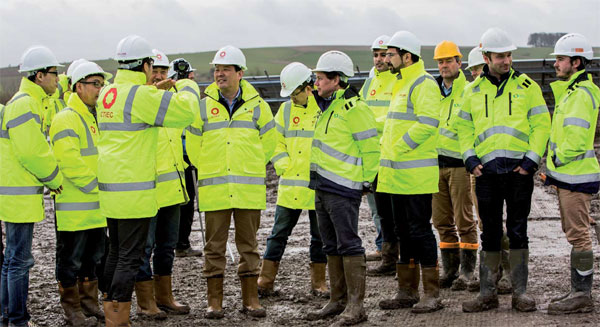
A CTIEC team gathers to work on the Swindon Solar Farm project in Wroughton, United Kingdom. Provided to China Daily |
"We are very optimistic for the expansion of modular construction work in the UK, because we have seen the British government emphasizing the importance of creating affordable housing," says Ray Liu, who manages CTIEC's UK operations.
CTIEC, founded in 2000, is a wholly owned subsidiary of the state-owned enterprise China National Building Material. CNBM, which was listed on the Hong Kong Stock Exchange in 2006, is well known as China's largest manufacturer of several building materials, including cement, gypsum board and fiberglass.
CTIEC was created as a subsidiary responsible for construction projects in China and abroad. Its access to suitable and cost-efficient building materials and funding from CNBM has given it an advantage over competing construction firms.
As well as domestic work, CTIEC has carried out many engineering projects, initially in developing countries but more recently, in advanced economies, including the UK, the United States and Japan.
Many of its projects involve "green" buildings and clean technology, including solar farms.
Last year, CTIEC developed a strategy to expand overseas in modular construction.
"We have been doing modular construction in China for more than 10 years, particularly in regions that require large-scale low-cost housing, such as Anhui and Xinjiang. Last year, we decided to take our experience to international markets, which is why we started planning for projects in the UK, Spain, Latin America and Southeast Asia," Liu says.
Modular construction is a relatively new building technique in which identical housing units are constructed in a factory and then assembled on site, saving money and time. A four-floor apartment building that would take at least a year to construct on site using traditional methods can be erected using modular construction techniques in one or two weeks of factory construction and less than a month of on-site assembly. Modular construction also significantly reduces pollution generated by traditional on-site construction.
CTIEC's strategy comes as the UK government targets investment in affordable homes. It plans to create a 2.3 billion ($2.9 billion; 2.7 billion euros) housing infrastructure fund to deliver infrastructure for up to 100,000 new homes in high-demand areas.
At the time of the announcement, the UK's International Trade Minister Greg Hands hailed the deal as an endorsement of the UK's attractiveness to foreign investors.
The UK's ambitious plans to increase its housing stock have created opportunities throughout the construction sector. But the UK housing market's lack of scale means few local firms have modular construction know-how, giving Chinese and other international firms with such knowledge a big advantage. In addition, Chinese firms' ability to finance such projects with up-front capital gives them another key advantage.
Richard Marshall, a senior infrastructure analyst at BMI Research, expects even more Chinese investment in the UK's modular construction market.
"While Chinese firms are definitely not the only movers in the space, the fact that modular construction fits with China's infrastructure export strategy supports our view that their incorporation will be a major catalyst for the method's use globally," Marshall says.
Another key Chinese company operating in the field is Shenzhen-based CIMC Modular Building Systems, which has completed more than 10 UK projects for clients including InterContinental Hotels Group and Hilton. But unlike CTIEC, CIMC's units are manufactured in China and transported to the UK for assembly.
Liu says CTIEC is keen on localization strategies, which is why it is building factories in the UK, creating local employment and leveraging on local talent and know-how.
"We wanted to use local talent who are familiar with local market requirements and practices, and through our localization strategy we were able to fulfill local security laws, environment laws and other legal requirements," Liu says.
He says the UK government's commitment to affordable housing is a significant factor in making CTIEC feel confident about the success of its UK factory investments, adding that his team has already signed agreements with the UK's central government and local councils in Scotland and Liverpool on project collaboration that will see governments refer new property development projects to CTIEC.
Meanwhile, Liu says his team is preparing for the launch of its first factory, near Bristol, with housing unit construction expected to begin in the first half of 2017.
Despite the rosy picture, there are still risks, in particular obstacles inherent in modular construction techniques.
Marshall says one such risk is the potential disconnect between project sponsors and engineers, created when manufacturing of the modules happens thousands of kilometers away from the construction sites. If any disconnects between the design or delivery timetables occur, construction costs can escalate. In addition, modular construction's reliance on good infrastructure to facilitate the modular units' transportation, need for smooth border control processes and other logistics arrangements mean there are several issues that need to be considered when determining the effectiveness of the construction method, Marshall says.
CTIEC first began its UK expansion in 2014, when it became the construction contractor for Hayford solar farm in Shropshire, in the Midlands. Looking back, Liu says he felt very natural about this first step.
In 2012, CTIEC acquired Germany's solar technology company CTF and, two years later, acquired Avancis, also in solar technology. Those acquisitions helped CTIEC build a network of local talent and trusted partners who then recommended the Hayford solar farm project to CTIEC.
In fact, CTIEC's local partners are also highly important as supply chain companies that carry out a large amount of on-the-ground work for CTIEC's projects. CTIEC's own employees work mostly as project managers and oversee projects from a holistic perspective and liaise with CTIEC's headquarters.
Such partnerships, which characterize CTIEC's operations model for both modular construction and solar projects, are seen by CTIEC and its local British partners as a win-win situation for both sides.
The Hayford solar farm, which took eight months to construct, has a 9.8 megawatt capacity for power generation. Its success set CTIEC on the road to completing six solar farms in the UK.
Looking back at the journey, Liu says the last two solar farms, located in Flintshire and Swindon, were highlights because each took less than 60 days to complete, which is considered very fast by UK standards, and more remarkable because they took place through cold winters.
The Shotwick solar farm, one of CTIEC's latest projects, was the UK's largest solar farm at the time of completion, with 72.2 megawatts of power capacity. This solar farm now provides direct power supply to paper producer UPM's paper mill in Shotton, Flintshire. Effectively, it allows this mill to have up to 100 percent green energy operation in daylight hours and saves 202,500 tons of carbon emissions every year.
"We feel the UK is a very important market for us to prove our strength in a mature economy," he says. "We feel encouraged by the fact that some European customers are already contacting us after witnessing both our renewable and housing projects in the UK."
cecily.liu@mail.chinadailyuk.com




Copyright 1995 - . All rights reserved. The content (including but not limited to text, photo, multimedia information, etc) published in this site belongs to China Daily Information Co (CDIC). Without written authorization from CDIC, such content shall not be republished or used in any form. Note: Browsers with 1024*768 or higher resolution are suggested for this site.
License for publishing multimedia online 0108263 Registration Number: 130349