Changing consumer preferences, shopping habits and rising incomes mean that sellers should be reshaping their strategies to capture the young
Millennials aged 18 to 37 are now a crucial 415 million-strong segment of Chinese consumers, constituting nearly a third of the nation's total consumers. Their changing preferences, shopping habits and spending power are influencing retailers and brands alike to reshape their business strategies, promising to infuse fresh vigor into the economy.
One of the most striking aspects of this trend is the re-emergence of physical shopping, as opposed to online shopping, as a popular pastime - retail therapy, if you will.
Zeng Yingqi, 26, an institutional client manager at a state-owned securities company, buys almost everything online, from hairpins to handbags, but still needs to shop once a week for leisure.
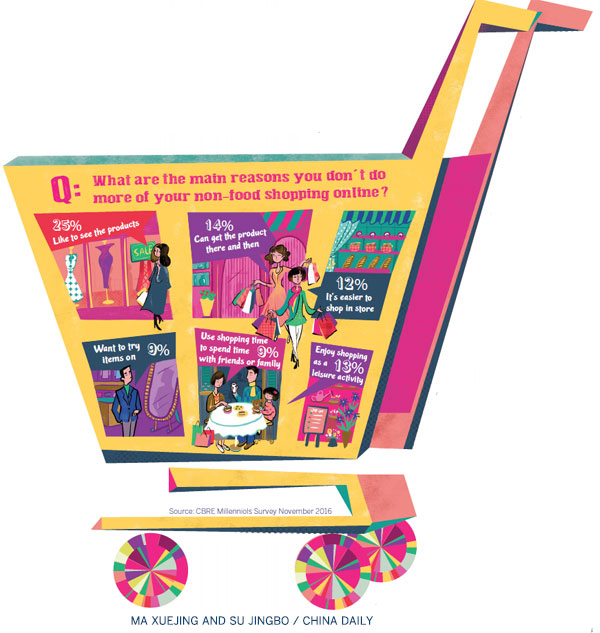
"I can get whatever I need on the internet. But it can't replace the shopping habit. In stores, I can see and touch the products, try them on, and also spend time with my friends," she says.
Recent reports show that Chinese millennials, mostly born in the 1980s and 1990s, though internet-savvy, have a tendency to spend more time and money on experience-based consumption such as shopping at physical stores, traveling and dining out.
Brands are closely studying such consumers' shopping patterns and preferences. They are "entering their prime consumption years", according to a Goldman Sachs report.
China, which will soon be the world's largest consumer market, has been abuzz with e-commerce, mobile games and live streaming platforms. Online business models have been burgeoning in the digital era to woo the millennials.
But now, it seems, consumerism has come full circle in China, with attention shifting back from mobile screens to real-world shopping.
A report by global real estate advisory firm CBRE China found that tech-savvy millennials do like to shop online, but only physical retail - particularly shopping centers - can provide them with the experiences and social elements they crave.
Tangibility and experience are listed as the top two reasons for millennial consumers to visit physical stores, according to CBRE's research.
"I think retailers should integrate their online channels and offline stores more deeply. I mean real integration," says Zeng, adding that several times it took her days to find a pair of shoes in another branch of the same store. "The physical stores can curtail inventory and serve only as an experience center."
Ann Fishman, founder of Generational Targeted Marketing, says: "Millennials' concerns must be your concerns." She has been at the forefront of major generational trends for decades.
By 2025, Chinese millennials' aggregate income is estimated to surge to $3 trillion (2.83 trillion euros; 2.41 trillion) as average annual incomes increase from $5,900 to $13,000, according to Asian consumer research by Goldman Sachs.
Such an increase in spending power, the research says, would amount to more than half the estimated $5 trillion added to total US private consumption expenditure over the next 10 years, if the US were to sustain the compound annual growth rate of 3.7 percent of the past decade.
So, retail marketers are racking their brains to figure out how to win over this most influential consumer segment.
Alibaba Group Holdings Ltd has linked up with department store chain Intime Retail Group. The partnership has reportedly given the e-commerce giant access to Intime's inventory and allowed its online customers to pick up orders from physical stores.
Other retailers are also adopting similar strategies.
Shanghai Malianghang (Hong Kong) Design Co, a three-year-old custom-made jewelry company that started online, opened its first retail store in Shanghai last year and plans to open up to 30 stores nationwide within two to three years.
Company CEO Bill Hu, a post-'90s person who manages a cohort of millennial staff, believes consumers should be able to "feel the products", and that it is essential for his customers to experience on their own how to use 3D printing technology to make custom jewelry.
"At a time when winning customers online has become costlier, it is particularly important for online retailers to get the offline side up to standard," Hu says.
For its part, the Chinese government is also determined to strengthen online and offline integration in retail.
Under a guideline promulgated in late November, the central government urged local governments to help business to improve the layout of physical shops, reduce rent and ease restrictive terms for decoration and remodeling, in an effort to catalyze a "real circulation revolution" in the sector, according to Vice-Minister of Commerce Fang Aiqing.
CBRE Research says the retail industry would do well to promote experience-based elements in shopping and focus on providing an environment for visitors to socialize and relax.
Retail is not the only economic segment that is changing in response to millennials' needs. Travel, catering and entertainment are fast adapting to the trend.
In an email, Yan Xuan, president of Nielsen Greater China, says automobile retailers should start to think about how many seats they would install in their showrooms for visiting prospective customers and what unique elements should be included in their products' design to satisfy the needs of the younger generation.
Similarly, retailers of baby and maternal products should start developing strategies to retain young mothers, he says.
The growing number of millennials, according to Yan, indicates that the outlook for China's future domestic consumption will continue to be good.
"The young generation prefer to buy more than basic consumer goods, and they are willing to foot the bills related to their interests and dreams. This is expected to further drive domestic consumption," Yan says.
In its recent white paper The Chinese Consumer in 2030, the Economist Intelligence Unit said the new-age consumer has come of age, with consumption driving economic growth, which is projected at an annual 5.5 percent between 2016 and 2030, eventually accounting for 50 percent of the world's second-largest economy.
Cheng Yu contributed to the story.
Contact the writer at jingshuiyu@chinadaily.com.cn




Copyright 1995 - . All rights reserved. The content (including but not limited to text, photo, multimedia information, etc) published in this site belongs to China Daily Information Co (CDIC). Without written authorization from CDIC, such content shall not be republished or used in any form. Note: Browsers with 1024*768 or higher resolution are suggested for this site.
License for publishing multimedia online 0108263 Registration Number: 130349