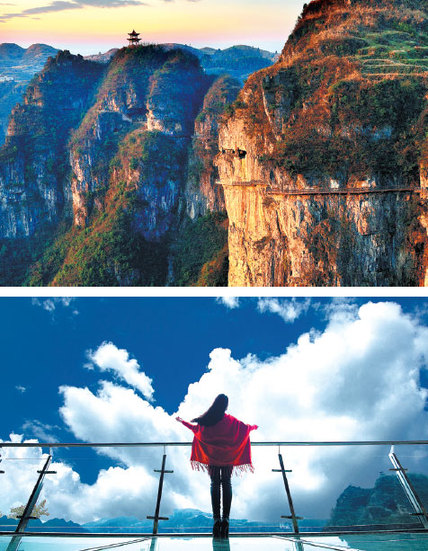
The Zhusha ancient town in Guizhou province once produced mercury and vermilion, accounting for more than 80 percent of the nation's total output. Now, it plays host to tourists. Yang Feiyue and Yang Jun report.
An abandoned mercury mine is shaping up to be a tourism hot spot. The Zhusha ancient town in Wanshan district, Tongren city, in Guizhou province, which covers an area of 5 square kilometers, produced 33,000 tons of mercury and vermilion from 1950 to 2001, accounting for more than 80 percent of the nation's total output then.
But the local government, which shut the mine, is now focused on green development.
"Giving priority to the environment and pushing forward green development is the best way to transform," says Chen Changxu, a member of the National People's Congress and the Party secretary for Tongren.
The local government has made it a point to develop green spaces, and Zhusha has benefited from this policy.
While the local mines have long been shut, the area's natural environment and heritage are being used to develop tourism, says Liu Xianlu, a local official.
The area is now using its mining history to interest tourists.
It has a rare 970 km underground mining tunnel and a mass of natural vermilion.
The local government invested 2 billion yuan ($291 million) in 2015 when it started to develop tourism. Its goal was to build Zhusha into a resort featuring elements from the mining industry and leisure facilities, within three to five years. The refurbished town opened to the public in May 2016.
Now, a cliffside swimming pool and a glass suspension bridge have been built in the area, and attractions like a bar street and high-end hotels will be developed to improve the tourist experience, according to Liu.
Currently, many visitors come to get a glimpse of the mining days and to see Soviet-era structures, a town official says. A Russian restaurant is one of the highlights.
Meanwhile, the increasing popularity of the town has brought about positive changes in the lives of the locals.
One of them is Huang Yaping, who had to leave home with her husband to make a living after the mercury mine went bankrupt in 2001.
"Many of my colleagues left after the mine was shut," says Huang.
There were more than 30,000 people in the town when the mine was at its peak.
Huang returned to the town in 2008 and has run a small grocery business ever since.
Recounting her early struggles when she returned, she says: "First, we could barely keep our heads above water, but as our parents were getting older we could not work away from home."
Things, however, picked up after the refurbished town opened last year. "Now, we see people all over the place at weekends and during major holidays."
Tourism peaks from April to October, but there are also visitors in winter, says Huang.
Her shop sometimes makes more than 1,000 yuan a day now.
Huang also says she senses the popularity of the town through her WeChat account.
She regularly posts pictures and information about developments in Zhusha and many of her posts receive hundreds of responses.
Tourism has also created job opportunities, and many locals have taken up jobs in sanitation and security.
As of now, the town has roughly 25 tourist attractions, with the mercury mining museum as the top draw.
The five-story museum in Tongren, which was built in 1982, was expanded in 2014, and now covers a floor area of 4,800 square meters.
At the museum, visitors can now learn about local culture, and mining history, besides seeing how sculpture and three-dimensional mapping is used to portray ethnic and natural elements.
The Soviet Expert Building, built in 1956 for experts from the former Soviet Union, covers an area of 1,400 square meters and features a garden and an artificial mountain. Many Soviet geologists lived in the building in the early 1950s.
The museum also features a 90-meter time tunnel that resembles a mine shaft and uses modern sound and light technology to create a time-travel experience.
In the tunnel, visitors see polychromatic light columns move in step with the music as they view pictures of miners at work.
The glass bridge in the area is the first of its kind in Guizhou, and visitors get a picturesque view of the mountains in the distance.
The Weilin Temple in the area is believed to be the first place in China to have developed elixirs for emperors. Ancient lore has it that most of the elixirs contained vermilion, which explains why Wanshan was chosen to make them.
For those who want to shop, the vermilion stone sales center at the town's entrance offers raw vermilion and vermilion artifacts.
As for Huang, the changes in her town are way beyond her expectations.
"I felt glad and proud when I say I am from Zhusha. I could not have dreamt of these changes in my life," she says.
Contact the writer at yangfeiyue@chinadaily.com.cn
Dong Xianwu contributed to the story.
|
Passes built on the cliffs and a glass suspension bridge are among the highlights of Zhusha ancient town in Guizhou, which has turned from mercury mine site to a tourist hot spot. Photos Provided To China Daily |




Copyright 1995 - . All rights reserved. The content (including but not limited to text, photo, multimedia information, etc) published in this site belongs to China Daily Information Co (CDIC). Without written authorization from CDIC, such content shall not be republished or used in any form. Note: Browsers with 1024*768 or higher resolution are suggested for this site.
License for publishing multimedia online 0108263 Registration Number: 130349