Businesses spend 1.6 billion yuan on curbing pollution; innovate to make novel products
SHIJIAZHUANG - Four years ago, Liu Jun had an argument with his father about whether to expand production at the family's glass factory or to upgrade the existing production lines. The company, Huijing Glass Technology Co Ltd in Shahe, Hebei province, started producing raw glass in 2003. By 2013 - when Liu's father suggested the addition of a new line to boost production - it had five production lines for sheet glass.
But Liu, the company's general manager, thought it was not a good idea.
"My father believed the company could achieve greater success simply by adding more production lines," he said. "I felt it would lead nowhere as the domestic glass industry was already struggling."
Factories in Shahe, the "City of Glass," produce about 160 million containers (8 million metric tons) of flat glass annually, about 20 percent of all glass produced in China, the biggest flat glass producer in the world.
The son won the argument.
The company branched out and began to make glass products with its own materials, including energy-saving windows and doors, and turned discarded foam glass into frames and boxes.
The company exported more than $3 million worth of products to Walmart last year and inked a deal worth $20 million with Walmart at the beginning of this year.
The success did not come easy.
The company's transition efforts were seen by many other glass makers as "a waste of energy and resources." Those same companies rued not making the same decision when demand for glass plummeted in 2014.
Partly due to the sluggish property market, China's architectural glass production capacity has been in the doldrums since 2010, but high-tech glass products are in high demand. Some high-tech glass products are still imported, said Wu Zihong, deputy director of the Glass Industry Operation Center of Shahe Economic Development Zone.
Besides the vagaries of the marketplace, Shahe must address environmental issues. Before mid-2014, Xingtai city in Hebei province, under whose purview Shahe falls, ranked consecutively at the bottom of air quality rankings among 74 Chinese cities. For Shahe, reducing smog and the capacity of its heavily consuming and polluting glass makers seemed a matter of urgency.
However, the problem was that although all of Shahe's glass producers' discharges were within the environmental standards, there remained the possibility that their combined emissions would exceed environmental tolerances due to the high concentration of glass businesses in the area.
Under those circumstances, the city made reducing pollution a precondition for all glass operators, pushing them to pursue an environmentally-friendly transition.
Zeng Shebin, director of Shahe's Environmental Protection Bureau, said all assembly lines in Shahe must be capable of desulphurization, denitrification and dust collection.
China requires each glass maker to keep its emissions of sulfur dioxide below 400 milligrams per cubic meter and that of nitrogen oxide below 700 mg per cu m. In Shahe, the two standards are 250 and 500 mg per cu m, respectively, Zeng said.
"What we are doing sends the message that we are serious," Zeng stressed.
Commonly, glass furnaces are kept burning for six to eight years for continuous production.
It takes about 70 million yuan ($10 million) to reignite an extinguished furnace, said Zhang Shengyun, chairman of glass producer Shabo Glass Group Co Ltd.
"It is less costly to install expensive equipment for desulphurization, denitrification and dust collection," he said.
The environmentally-friendly measures have been introduced as China overall addresses industrial overcapacity. From 2011 to 2015, Shahe phased out 57 glass businesses and 66 outdated production lines, reducing 48.6 million containers of glass production capacity, 163 percent of the province's target.
Last year, Shahe got rid of all sheet glass production lines and 21.8 million containers of flat glass.
Statistics provided by the Shahe government showed that local glass businesses have spent about 1.6 billion yuan on curbing pollution with all of their 52 operating production lines featuring environmentally-friendly facilities.
Local glass producers and experts agree that while strict environmental policies increase the cost of glass production in the short term, they help upgrade techniques and extend industrial chains for a more value-added, less energy-consuming model.
Xinhua
|
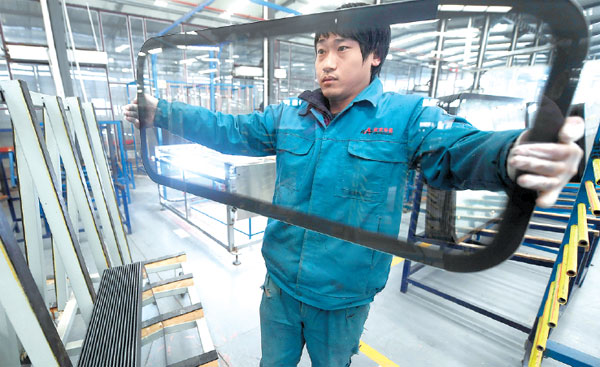
A worker arranges window products for high-speed railways at a special glass factory in Anping county, Hebei province, on Nov 29, 2016. Li Xiaoguo / Xinhua |




Copyright 1995 - . All rights reserved. The content (including but not limited to text, photo, multimedia information, etc) published in this site belongs to China Daily Information Co (CDIC). Without written authorization from CDIC, such content shall not be republished or used in any form. Note: Browsers with 1024*768 or higher resolution are suggested for this site.
License for publishing multimedia online 0108263 Registration Number: 130349