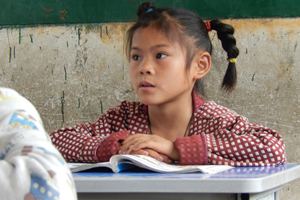
On Wednesday, Li Bin, minister of National Health and Family Planning Commission, vowed on a press release that the authorities will consider introducing more policies that could support more couples to have a second child.
Last week, China Daily reported that the government is considering giving "birth rewards and subsidies" to parents to encourage them to have a second child. This revolution in China's family planning policy - from restricting to encouraging childbearing - is remarkable in terms of both its speed and scope. It also shows how concerned the government is about the state of the country's demography.
At face value, a cash incentive scheme makes sense. Since one of the most frequently cited reasons for restricting childbearing (previously) in China and elsewhere is the cost of raising children, financial support seems like an intuitive response.
Yet the new policy, if approved, is not without some potential flaws. Another reason for restricting childbearing is to try and give the single child the best possible start in life by spending heavily to provide it with the best opportunities in education and other fields. So to make any ostensible difference to household spending to raise another child without appearing to diminish the life chances of the first, the amount of money to be handed to parents should be high. And for a country as large as China, such a policy could be fiscally devastating.
The second problem is that there is only limited evidence that such programs increase fertility. In Singapore, for example, the government gives various incentives worth up to 800,000 yuan ($130,000) per child. Yet Singapore still has one of the lowest fertility rates in the world. Even seemingly successful schemes such as "Maternity Capital" in Russia have, on closer inspection, led to rather mixed results.
The reason for this apparent lack of success for cash incentives is that they only address one partial element of childbearing - the absolute costs. There is strong evidence to show the opportunity costs, especially for women in terms of career progression and the income effect, can be just as important.
Furthermore, considering childbearing purely in terms of financial costs also omits much broader reasons for the regional trends toward lower fertility - poor job prospects for younger people, difficulties in buying a house, cost of living, accessing adequate childcare services, pregnancy discrimination at work coupled with a poor family-friendly work culture, poor prospects of the "marriage package" in terms of diminished freedom and extra responsibilities.
In last week's China Daily report, the only government official cited was Wang Pei'an, vice-minister of the NHFPC. Wang has been instrumental in driving through these revolutionary changes in the family planning policy. But the rest of the government should also realize that the state of the country's demography is not simply a matter for the NHFPC. The reasons for very low fertility also stem from issues which lie under the purview of various other agencies and ministries, such as human resources and social security, education, housing and urban-rural development and so on. It was not just family planning restrictions that shaped China's demography over the past decades. These other ministries and agencies must therefore recognize the part they have played and take a more active role in the response.
Other countries' experiences suggest a broad social system that supports citizens to meet their aspirations - not just parents, but potential parents, children and the elderly - tends to equate to higher fertility levels. If the government is serious about clearing the "bottleneck" preventing couples from having a second child, it will need to do more than just hand them a check. It needs a societal transformation which supports parents, people who want to be parents and, ironically, people who don't.
The China Daily article quotes a "mother of a 3-year-old girl in Beijing" named Bai as saying: "I don't expect cash from the government for a second child. Sound social public policies to help working parents raise the children are needed more."
More specifically, she referred to "prolonged maternity leave, equal working opportunities for mothers, easy access to quality education resources for children and a well-functioning social welfare system". Well, Bai, I couldn't have put it better myself.
And the good news is that, Li Bin, the head of the health authorities, has promised to take care of all these factors.
The author is a visiting associate professor of social science at the Hong Kong University of Science and Technology.




Copyright 1995 - . All rights reserved. The content (including but not limited to text, photo, multimedia information, etc) published in this site belongs to China Daily Information Co (CDIC). Without written authorization from CDIC, such content shall not be republished or used in any form. Note: Browsers with 1024*768 or higher resolution are suggested for this site.
License for publishing multimedia online 0108263 Registration Number: 130349