His fascination with Chinese philosophy and classical literature leads to new connections between two cultures. May Zhou reports from Houston.
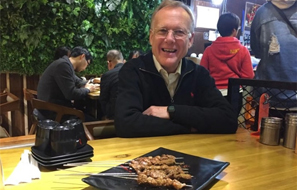
Roger Hart's favorite philosophers are Zhuang Zi and Lao Zi, and the Chinese classic A Dream of the Red Mansions remains one of his favorite books.
His strong interest in the two ancient Chinese philosophers led Hart, director of the Confucius Institute and associate professor of history at Texas Southern University, first to Taiwan and then to the Chinese mainland.
He eventually mastered the language to be able to appreciate Dao De Jing (or Tao Te Ching) and Zhuangzi - the two most influential Chinese books of all time - in their original Chinese form.
As a young man, Hart loved philosophy and took his passion seriously.
"The foundation of philosophy is the science of mathematics in the Western tradition, so I went to MIT to study mathematics as an undergraduate and then to Stanford University as a graduate student of mathematics," says Hart.
Having read Zhuangzi in English and being fascinated by it, Hart joined an Asia volunteer program at Stanford and went to Taiwan to teach English for one year in 1983.
He started to study Chinese at that time. A year later, Hart wanted to study Chinese more and took another volunteer assignment in a Beijing university for two years. Then he studied a couple more years in universities in Guangzhou and Beijing again.
"I studied ancient, modern and contemporary Chinese literature," says Hart.
"As I studied Chinese, I became more interested in Chinese history, culture and literature. Whatever I studied about China, it was absolutely fascinating."
When Hart returned to the US five years later, he was well versed in Chinese. He contemplated his favorite Chinese philosophers by reading their original works. Hart read many Chinese classics, and A Dream of the Red Mansions became his favorite.
"It is a very captivating and mesmerizing book. I'd forget where I was after a chapter or two. The portrayal of thoughts and love, the real and unreal, all the logical twists, it's very critical that it makes you think in ways you normally wouldn't. I would put this book along with Zhuangzi, Tao Te Ching, and Lu Xun's books as critical works; they make you think differently," says Hart.
It's a great pleasure to be able to appreciate the original works, he says, as "a whole lot is lost in translation".
Hart jokingly calls himself "a migrant scholar", since he pursued a PhD in UCLA, joined in academic programs at Harvard, UC Berkeley and the University of Chicago, got his first tenure-track job at the University of Texas, and then went to Seoul National University on a fellowship.
In those years, Hart focused on research and produced two scholarly books: The Chinese Roots of Linear Algebra and Imagined Civilizations: China, West and Their First Encounter.
While traditional Western academic works view the 17th century Jesuit missions to China as a great encounter between two civilizations, Hart's second book offers a different perspective: The Italian Jesuit Matteo Ricci went to China to serve the Chinese emperor.
Hart says his China study experience gave him a critical view of all things. When it comes to American ideologies and ideas, Hart thinks that he holds more objective views compared with some of his fellow academics.
"Many of my colleagues tend to think that the US is exceptional. A lot of books were written in the way to explain the alleged uniqueness of the alleged West. All these other countries were alleged to lack something in science," Hart says.
To Hart, many American scholars have predicted the fall of China for the past 60 years and they have been wrong. "My work in China prepared me to realize that these views are not necessarily scientific and accurate; it's more like cheerleading for the US."
Hart took his current position at Texas Southern in Houston in 2013, when he came back from Seoul. "I spent 15 years in China-related research and lost a lot of my Chinese ability and lost track of how fast China is changing. This job gives me a chance to catch up with contemporary China," says Hart.
Hart finds his current job possibly his most rewarding experience so far because "I am building China-US friendship; I am trying to find a win-win situation for people involved. I am helping the TSU students learn about China, the global economy and the enormous changes that are happening."
Hart has been taking TSU students to China through programs at the Confucius Institute every summer for the past few years.
"Some students had never left Houston. Some had never left Texas. The first time they flew, they flew to Beijing on Air China. It was quite an experience for them. For some, the trip changed their lives," Hart says.
"I hope that by being here, I can provide a model for students that it's possible to learn Chinese."
Contact the writer at mayzhou@chinadailyusa.com.cn




Copyright 1995 - . All rights reserved. The content (including but not limited to text, photo, multimedia information, etc) published in this site belongs to China Daily Information Co (CDIC). Without written authorization from CDIC, such content shall not be republished or used in any form. Note: Browsers with 1024*768 or higher resolution are suggested for this site.
License for publishing multimedia online 0108263 Registration Number: 130349