In the past three weeks, China has seen three games-adapted movies released. But the big fan bases are no guarantee of success. Xu Fan reports.
How do you turn a popular game into a successful movie? It is the question for which Hollywood has been seeking an answer for a while. And recent events in China show that there is no formula to guarantee success.
In the past three weeks, China has seen three games-adapted movies - Assassin's Creed, Resident Evil: The Final Chapter, and Kingsglaive: Final Fantasy XV - hit the big screen.
Assassin's Creed and Resident Evil: The Final Chapter opened on Feb 24, while Kingsglaive: Final Fantasy XV, the third installment of the series inspired by the Japanese game franchise Final Fantasy opened across the Chinese mainland on March 10.
|
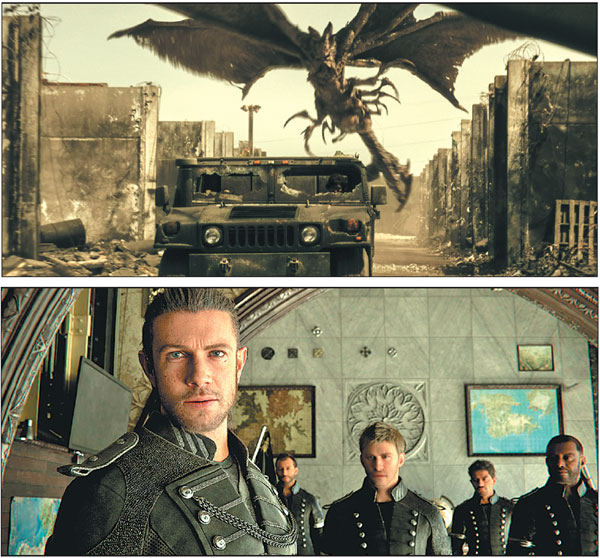
From top: Resident Evil: The Final Chapter and Kingsglaive: Final Fantasy XV are among the games-adapted movies that hit the big screen recently on the Chinese mainland. Photos Provided to China Daily |
But only The Final Chapter, the sixth installment and also the finale of the 15-year-old zombie-themed franchise Resident Evil, won hearts locally.
So far, the adventure of Milla Jovovich - playing the zombie-fighter Alice - has grossed around 1.1 billion yuan ($159 million) in China, more than six times the film's total receipts in North America.
The other two films have not been so lucky in China, which boasts nearly 41,000 screens - the most in the world.
Even with Michael Fassbender's Chinese tour, Assassin's Creed has raked in just 160 million yuan. It is now being shown on less than 0.4 percent of Chinese screens.
The French game publisher Ubisoft's first such game-adapted movie has no chance to rewrite its fate.
Kingsglaive: Final Fantasy XV is seen as a historic release for game fans as it is the first time that China officially shows a big-screen production about the magical land of Lucis. The first Final Fantasy game was published in 1987.
Takeshi Nozue, the director, says cutting-edge technology was used to make the film. Up to 800 members from top visual-effects studios joined the one-year postproduction process.
But the 110-minute feature has seen a mediocre performance at the box office, grossing merely 26.5 million yuan in six days.
The genre of games-adapted films began with the 1993 American movie Super Mario Bros, followed by franchises like Tomb Raider and Resident Evil in the 2000s.
But most of these movies flopped.
A turning point emerged last year. The huge box-office success of The Angry Birds Movie and Warcraft, respectively released in China in May and June, revived confidence in the genre, igniting hopes that the movie and game sectors could work together successfully.
But the recently-released three movies have killed those hopes.
Commenting on the performance of the three films, Jiang Yong, a Beijing-based industry watcher, says that despite the huge fan base of the games, their innate characteristics make them unsuitable for the big screen.
"Games require interactive content to lure players. But movies are a more personal, silent journey for the audiences," he says.
"So, whichever side a director chooses to be faithful to, he is unfaithful to the other, and leaves either game fans or movie fans dissatisfied," says Jiang.
Film critic Han Haoyue echoes this view, saying that most video-game movie directors lack the skills and knowledge when it comes to developing a game into a movie.
"A good movie should have something more than the tale. It must touch your heart, not just dazzle you with stunts and action," he says.
China has seen local firms explore the game-movie combination since 2011, when the country's largest game company Tencent introduced its "pan-entertainment" strategy to develop franchises including games, movies, TV series and literature works.
A series of domestic video game films are in production. They include Onmyoji, adapted from the namesake Netease game about a ghost hunter, and The Legend of Sword and Fairy, which has a hit TV series led by stars Hu Ge and Yang Mi.
Meanwhile, some Chinese filmmakers seem to have learned lessons from Hollywood and Japan when it comes to the game-movie combination.
Chen Hongwei, deputy head of Tencent Pictures, says the studios' adaptations will focus on building connections with audiences.
Zhang A'mu, president of Giant Pictures, the film subsidiary of Shanghai-based game publisher Giant Interactive Group Inc, tells The Beijing News that a video game-adapted movie should make film content its priority.
Contact the writer at xufan@chinadaily.com.cn




Copyright 1995 - . All rights reserved. The content (including but not limited to text, photo, multimedia information, etc) published in this site belongs to China Daily Information Co (CDIC). Without written authorization from CDIC, such content shall not be republished or used in any form. Note: Browsers with 1024*768 or higher resolution are suggested for this site.
License for publishing multimedia online 0108263 Registration Number: 130349