As China's population gets older, solutions are needed to provide care for the elderly
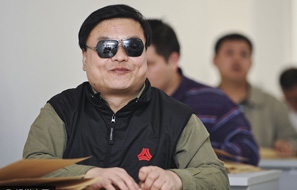
Once the director of the Martial Arts Association in Jinhua, Zhejiang province, and a Beijing Olympic torchbearer, 66-year-old Miu Longsheng arrives in a wheelchair with the help of his 63-year-old wife, Zhao Linli. Having recently suffered a stroke, he no longer has the ability to walk or speak. Wearing a black and white racing suit and posing in front of a racing car with his wife in a matching outfit, the years seem to fall away, and when the crew compliments them, Miu lifts his head back and laughs with joy.
Called the The Modern Grandpa and Granny Photography Competition, the event, organized by Natali, a Shanghai healthcare company, was inspired by a series of images created by photographer Xiaoye Jiexi. Xiaoye put his 85-year-old grandfather - a man who lived his entire life in the countryside as a farmer - in modern outfits and took pictures of him hanging out in the city. The shots went viral in 2016. This optimistic attitude toward aging is an expanding trend in today's China, one that companies like Natali are keen to indulge.
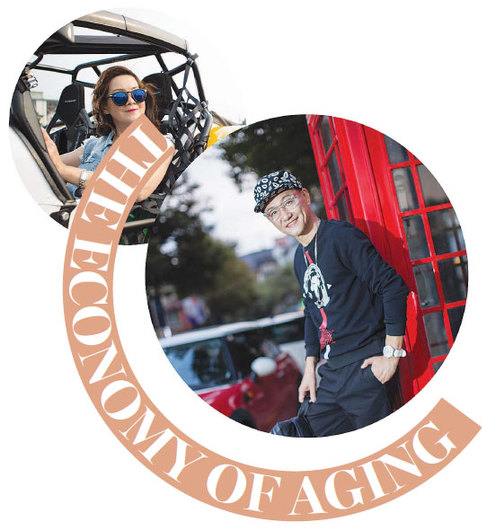
With the help of a group of stylists and Xiaoye himself as the photographer, the competition attracted elderly contestants through local newspapers, giving them a complete makeover.
"Many older people are used to a simple, casual life, but we want to show them the possibilities of a colorful life through the transformation of their appearance," Wan Qinjing, brand-marketing director at Natali, says. "They can have all kinds of interests and hobbies and, most important should enjoy a certain quality of life whether they are young or old.
A similar event, held in June, was the Summer Solstice Music Festival rock concert held at Shanghai's MAO Livehouse for a senior audience, featuring a band with members all over the age of 50. It was a roaring success.
As marketing strategies go, these tactics are certainly different. More often than not, even in commercials and ads for products designed for seniors, they are depicted as passive recipients, smiling and nodding at their children, who make the money to buy them those products.
With an aging population, however, changes are bound to happen. By 2050, there will be 300 million people over the age of 60 in China, roughly equal to the entire population of the US. Though it is indeed a challenge to China's future economy and social security system, the aging population is also a potentially profitable market for healthcare-related service providers and product manufactures.
The current model for elderly care promoted by the Chinese government is labeled "9073," which means 90 percent of the elderly are encouraged to rely on their own family to provide care, seven percent on purchasing services provided by communities, or shequ (residential areas governed by the basic-level city government agencies, 社區), and 3 percent on retirement homes, according to guidelines from the Ministry of Civic Affairs in 2011. Costing only few hundred yuan per year, seniors can subscribe to services of Ankangtong, one of China's major homecare and healthcare company, through their shequ.
Considering that 44 percent of Ankangtong's current users have a monthly income of less than 1,000 yuan ($144; 135 euros; £118), there's not much room for profit. At the moment the company settles for credibility and reputation and hopes to grow the market in order to cut back on the per-user cost.
The market is currently limited by the purchasing power of their elderly consumers, and strengthening that power seems difficult, to say the least. For decades China has struggled to build a healthy pension system. The social security tax on employees in the private sector has increased every year, adding up to a staggering 28 percent of an employee's income, 20 percent of which is paid by the company and eight percent paid by the individual.
Today's pensioners are funded by the current workforce, and the falling ratio of active-to-retired workers and limited channels of pension investment are plaguing China's ailing social security system.
The government is more than happy to let the private sector take over. Most recently, on Dec 23, the State Council announced its plan for fully open the elderly care service market by 2020, and it encourages enterprises to provide diversified services.
Already an industry leader, Natali still has one problem. "The biggest obstacle we have now is conventional mindsets," Wan says. "(The customers we target) like to say, 'I'm fine, I don't need this,' even though many of them have the purchasing power. We are filtering potential customers who are open-minded about changes and who are willing to pay for a quality-of-life upgrade. We are a business, after all - but then, the best situation is to promote public welfare in the process of doing business."
Courtesy of The World of Chinese, www.theworldofchinese.com
The World of Chinese




Copyright 1995 - . All rights reserved. The content (including but not limited to text, photo, multimedia information, etc) published in this site belongs to China Daily Information Co (CDIC). Without written authorization from CDIC, such content shall not be republished or used in any form. Note: Browsers with 1024*768 or higher resolution are suggested for this site.
License for publishing multimedia online 0108263 Registration Number: 130349