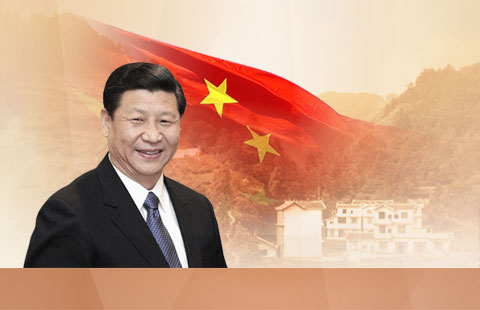
Can China do it? This is the crucial question for the world's biggest and boldest economic, political and social experiment. At the core of understanding the country's prospects is the governance philosophy of its leader, Xi Jinping.
Xi is leading more than 1.3 billion people on a march toward the Chinese Dream - bringing an end to poverty and rejuvenating a nation that has already made astonishing progress in creating prosperity.
The 63-year-old reformer has brought his own thinking to bear on problems down the road, especially after a year of tumultuous global events.
With the needs of the people his first and foremost concern, Xi's experience, commitment, determination and ability to govern and lead have become something of a rarity on the global political stage.
This year, the 19th National Congress of the Communist Party of China will elect new leaders for a five-year term, covering a crunch period for Xi's vision of a well-off nation by the Party's centenary in 2021.
China's GDP is forecast to exceed 90 trillion yuan ($13 trillion; 12.2 trillion euros; 10.7 trillion) by 2020, when the nation is expected to have a middle-class population of about 400 million.
The goal is fast approaching and will only be met if officials at all levels align their thinking with that of the central leadership and act according to Xi's "Four Comprehensives" - the cornerstones of prosperity, reform, rule of law and strict Party governance. The strategy aims to lead the country to modernization and standing at the center of the world stage.
This is China's own story, one neither copied from nor imposed on any other country.
New thoughts, actions
At this year's sessions of the State legislature and political advisory body, Xi expressed his confidence: "As long as we gather the wisdom and strength of more than 1.3 billion Chinese people, there can be no limit to the success of our cause."
From being the youthful head of a poor village in northwestern China to Party chief of the nation's advanced eastern regions to leader of the nation, Xi has shown a deep understanding of governance, evident in economic and social reform, foreign affairs and military transformation.
He has led China to achieve remarkable economic growth, even though other major economies are faltering. The country contributes more than 30 percent of global economic growth.
Xi calls the current phase the new normal, from which an economy is emerging that is more sustainable and inclusive. To ensure this rebalancing succeeds, he has put forward supply-side structural reform.
Fundamentally different from the supply-side economics of the West, Xi's policy takes a harsh stance against inefficient industries and replaces them with new, innovative systems of work and production that will neither destroy the environment nor succumb if another global financial crisis hits.
China hopes to increase GDP by about 6.5 percent this year. At this rate, the nation will generate more output than it did during the days of double-digit growth.
Xi is at the wheel of a reform juggernaut, revitalizing almost every aspect of the economy and society, from the financial sector to healthcare. Changing the lives of hundreds of millions of people means the abandonment of what is no longer relevant, including the one-child policy and "re-education through labor", a method of dealing with minor offenders introduced more than 50 years ago.
He emphasizes the rule of law and checks on power, as seen in his decision to create a national supervision commission. Lawmakers are also compiling a civil code to better protect people's rights.
Xi's campaign against corruption - he has warned that graft could destroy the Party and cause the downfall of the State - has gained "crushing momentum". Since the 18th CPC National Congress in 2012, at least 240 senior officials and more than 1 million lower-level officials have been investigated.
As Chinese businesspeople, tourists and students reach almost every corner of the globe, Xi sees China as not only a beneficiary of globalization but a contributor to it. He has visited about 50 countries as head of state, pursuing his mission to build "a community of common destiny".
His strong defense of free trade and warnings against protectionism have surprised and delighted observers.
China's trade relationship with the United States "supports roughly 2.6 million jobs in the US across a range of industries", according to a report in January by the US-China Business Council based in Washington.
The Belt and Road Initiative proposed by Xi in 2013 is expected to connect Asia with Europe and Africa. In three years, Chinese businesses have helped build 56 economic and trade cooperation zones in 20 countries along Belt and Road routes, with total investment exceeding $18 billion. They have helped generate more than $1 billion in tax revenue and create more than 160,000 jobs.
China's commitment to the Paris agreement on climate change is also comforting and unshakable.
Code of success
Making a great country requires strong and competent leadership devoted to the fundamental interests of the people.
"China's most important successes rest on strategic planning and decision-making by the central leadership," said Zhang Weiwei, director of Fudan University's Institute of China Studies.
Unlike Western democracies, which seem increasingly obsessed with showmanship and short-term elections, China's leadership has a long-term target and is more inclined to plan for the next generation and beyond. Once the Chinese leadership makes a blueprint, it sees it through.
Poverty relief is one such example. It has been included in the work plans of the Chinese leadership for generations.
Fundamental to a well-off society, poverty alleviation efforts have helped 55 million Chinese people enjoy better lives from 2013 to 2016. The government has pledged to eradicate poverty by 2020.
Poverty alleviation is not the only matter at hand; speed and efficiency are of the essence. When working in Fuzhou, capital of Fujian province, Xi reminded officials of their duty to "take immediate action" - the working style he wants to see across the country.
China's system of governance remains resilient and robust because of how it selects and mobilizes officials. A cadre is promoted only after he or she has served at various grassroots posts and acquired enough experience.
How many jobs has an official created? Where are the tangible results regarding economic and social development? Is the environment cleaner or more polluted? These key factors are considered for any promotion. Those found to be ineffective are demoted and, in some cases, penalized.
The 13th Five-Year Plan (2016-20) has made local officials accountable for the environmental damage they cause, even if it is discovered after they have left office.
China stresses the unity of Party leadership, people being the masters of the country and the rule of law. The approach has shown its advantage over the so-called Western model, according to Zhang at Fudan University.
Making history
The two sessions, among China's most important political events, supports the next round of reform. Thousands of lawmakers and political advisers have made suggestions on development. Crucially, the sessions created a national consensus to unite more closely around the CPC Central Committee, with Xi as the core.
"Xi's core status came through his leadership in advancing the Party's great cause," said Dai Yanjun, a professor at the Party School of the CPC Central Committee.
The largest modernization movement in human history has united a political party, with 88 million members, around a core leader. This common dream not only benefits China but also the whole world.
The real test, however, lies ahead. Xi and his colleagues are facing a number of challenges. Few developing countries, for example, have avoided the so-called middle-income trap.
Daunting as the difficulties may be, Xi's vision stands out: "History is created by the brave."




Copyright 1995 - . All rights reserved. The content (including but not limited to text, photo, multimedia information, etc) published in this site belongs to China Daily Information Co (CDIC). Without written authorization from CDIC, such content shall not be republished or used in any form. Note: Browsers with 1024*768 or higher resolution are suggested for this site.
License for publishing multimedia online 0108263 Registration Number: 130349