A light beer based on a recently discovered 5,000-year-old Chinese recipe may sell well among modern customers.
Since archaeologists from Stanford University published a study on an excavated ancient brewery in China last year - including a 5,000-year-old recipe for what was brewed there - beer makers in China and the US have been inspired to try a modern take on the historic brew.
Seattle-based Lucky Envelope Brewing took the information from the scholars' paper and did a rendition for the modern palate.
"It tasted a little familiar - like a light lager, but with a bit of sweet flavor. It didn't have any flavor that turns people off," said Barry Chan, Lucky Envelope's brewmaster.
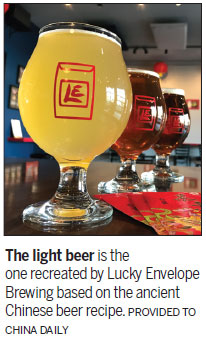
"When you add in unique ingredients, including millet, Job's tears, tubers and lily flowers, it adds some character to it, making it taste unique, but it still tastes like a light, refreshing, everyday drinking beer, so I think it has the potential to sell very well," said Chan, who is Chinese American.
The general consensus, particularly in the US, is that beer was invented in Samaria/Mesopotamia around 3,500 BC, said Chan. "Chinese were brewing beer around the same time that Mesopotamia has been given credit for inventing the modern brewing process," he said.
The ancient recipe was discovered by Li Liu, a professor in Chinese archaeology at Stanford, along with doctoral candidate Jiajing Wang and a group of other researchers, by studying the residue on the inner walls of pottery vessels found at the Mijiaya site near the Weihe River in Shaanxi province.
The ancient Chinese made beer mainly with cereal grains, including millet and barley, as well as with Job's tears, a type of Asian grass, according to the research. Traces of yam and lily root also appeared in the concoction.
Last month, Liu and her students recreated the ancient Chinese beer as the final project of Liu's course Archaeology of Food: Production, Consumption and Ritual.
Liu calls it "experimental archaeology".
"Archaeologists attempt to test hypotheses by replicating ancient technologies. This type of research helps us to achieve a better understanding about the life and behavior of ancient people," Liu explained.
"We want students to obtain empirical knowledge about the past, in addition to books," she added.
The ancient Chinese beer looked more like porridge and likely tasted sweeter and fruitier than the clear, bitter beers of today, according to Liu.
The result of the students' experiment will be used in further research on ancient alcohol making.
This research will help generate a comparative database for studying starches that are affected by the fermentation process. And that database will be used for future research on residues from archaeological artifacts used for alcohol production, according to Liu.
The study of ancient alcohol makes archaeology more interesting and relevant to modern life, Liu said. "It certainly helps us to trace some modern behavior to a deep antiquity in China," she said.




Copyright 1995 - . All rights reserved. The content (including but not limited to text, photo, multimedia information, etc) published in this site belongs to China Daily Information Co (CDIC). Without written authorization from CDIC, such content shall not be republished or used in any form. Note: Browsers with 1024*768 or higher resolution are suggested for this site.
License for publishing multimedia online 0108263 Registration Number: 130349