A Beijing-based 'anthropological photographer' zooms in on the people of the Great Rift Valley, where our species originated. Wang Kaihao reports.
Photographer Zou Junxin is known by his assumed name, Jun Cheng, which means "a rugged journey" in Chinese - for good reason.
It fits.
He's not a person who prefers a comfortable, well-planned life.
|
Jun Cheng's photos are now on display in Beijing, presenting Africa with a Chinese perspective. Photos by Jun Cheng / Provided to China Daily |
"You have many plans before you set off," the Beijinger says.
"But you'll find many things don't match expectations. The meaning of a journey is to abandon presumptions you take for granted."
Jun Cheng has visited Africa's Great Rift Valley eight times since 2011 to record the ecology, humanity and geology along the 6,000-kilometer-long trench.
He thinks of himself as an "anthropological photographer".
Jun Cheng worked as a journalist for more than a decade before he quit in 2008 to fully immerse himself in photography.
He started collecting pictures related to cultural relics, and fell in love with fieldwork and anthropology.
This led him to spend a long time exploring the Tibet autonomous region.
Then, he turned his lens toward Africa.
"It's natural to search for the cradle of humanity if you're interested in anthropology," he says.
"That's East Africa, where Lucy is from."
Lucy refers to the 3.2 million-year-old skeleton of a female belonging to the early hominin species Australopithecus that was excavated in Ethiopia in 1974. She's commonly considered the oldest discovered ancestor of Homo sapiens.
Jun Cheng snapped over 100,000 photos while traveling over 20,000 km in East Africa - far beyond the Lucy site.
He pointed out a photo during a recent Beijing exhibition.
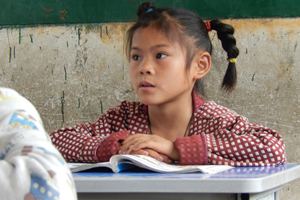
The image taken in 2012 shows a 7-year-old girl named Beitukan sitting by the front doorway - although there is no door - of an earthen shelter in the small Ethiopian town of Balk.
"Her eyes were full of hope, even though her family was poor. That really touched me," he explains.
Jun Cheng believes in destiny. He began to sponsor her.
He sent her family money so she could attend school. But he found all the money had been used to build a new house when he returned two years later.
"People there believe it's useless to educate girls," he says.
"She should get married according to tradition. Many things in East Africa have long remained unchanged."
He has photographed Ethiopian tribes whose lifestyles have changed little over millennia.
But change is drastic when it arrives.
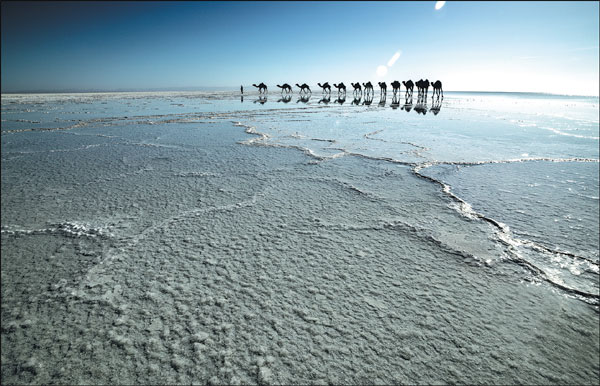
For instance, the local economy around the banks of the country's Dallol salt lake has long depended on camel caravans transporting manually harvested salt in the desert.
Jun Cheng believes he may have photographed the last days of this two-millennia-old tradition during his return visit in February.
"European mining companies are moving in. New roads are being built," he says.
"How can the caravans last if it takes a camel a week and an automobile three hours to transport salt?"
Jun Cheng believes it's crucial to return to the same locations to capture changes.
Transformations are especially conspicuous when photographing nature. A volcano that has been active for a century may be dormant later.
Not everyone can endure such journeys.
Jun Cheng recalls one team member quit when they were approaching the airport.
"He feared epidemics," he says.
"There are many unfair stereotypes about Africa."
He says many impressions of Africa have been shaped by Western lenses, creating misleading images.
"I want to share a Chinese perspective," he says.
"I want to engage in dialogue with local communities on an equal footing, without airs of superiority arising from colonial history or novelty-seeking."
It's perhaps in this spirit that he followed Doctors Without Borders to chronicle the lives of sex workers with HIV/AIDS and prisoners in squalid conditions in Malawi.
His journeys through the Great Rift Valley are portrayed in the five-episode TV documentary, A Place Torn Apart, that aired on the Hainan province-based Travel Channel in 2016.
"What Jun Cheng has presented is his love for the land where the human race was born," veteran French photographer Jean Turco said at a recent contemporary art forum in Beijing.
"Of course, these are photos, but they are beyond photos: They are beautiful episodes in Jun Cheng's great spirit."
China Photographic Publishing House's director, Zhao Yingxin, says: "He doesn't aim to capture instability in the villages (in East Africa). There is serenity in his work. Anthropology gives his photography a broader horizon. He's a persistent thinker who retrospectively examines humans' past and looks to the future."
Jun Cheng doesn't sink much money into the most advanced cameras.
"Technology develops so fast. There's no end to catching up with it," he explains.
"What really matters is to find a theme and consistently follow it. Photography is about expressing thought, not collecting social-media likes."
Contact the writer at wangkaihao@chinadaily.com.cn




Copyright 1995 - . All rights reserved. The content (including but not limited to text, photo, multimedia information, etc) published in this site belongs to China Daily Information Co (CDIC). Without written authorization from CDIC, such content shall not be republished or used in any form. Note: Browsers with 1024*768 or higher resolution are suggested for this site.
License for publishing multimedia online 0108263 Registration Number: 130349