Chinese filmmakers are now seeking to tap the highly developed movie markets of North America and Europe. But what about the countries in China's neighborhood? Are Chinese films doing well there?
The answer is that more needs to be done, according to the annual report on the global influence of Chinese cinema, recently released by the Academy for International Communication of Chinese Culture affiliated with Beijing Normal University.
The report, which was compiled after five months of data collection and analysis, says about 28 percent of those surveyed say they didn't watch any Chinese film in 2016. And 41 percent say they watched five or fewer Chinese films in 2016. Only 6.9 percent of those surveyed say they watched more than 20 Chinese films in 2016.
The study is based on about 1,500 detailed answer forms, sent to filmgoers in 16 countries near China.
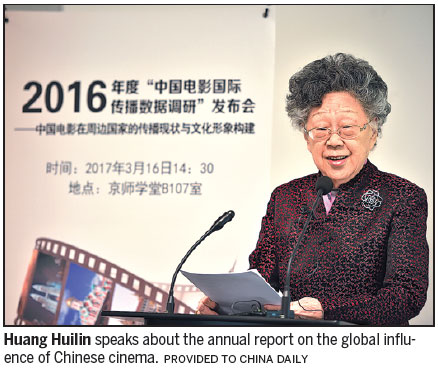
One surprising finding was that, though China is part of East Asia, Chinese films have less influence in East Asian countries (like Japan and South Korea), compared with South Asia, Southeast Asia and Central Asia, according to the report's main author Huang Huilin, a professor and the head of the academy.
Japan's viewing average was 1.21 Chinese films a year. South Korea's was 1.8.
"It (the low figures) may be partly because of the similarities between Chinese and other East Asian cultures," says Huang. "Sometimes, different cultures with similar origins can be mutually exclusive.
"However, it also shows that more needs to be done to improve the quality of Chinese films and promotion methods."
East Asia is also less sensitive to the modernity (high-speed trains and WeChat) conveyed via Chinese movies, which Huang attributes to the region's technologically advanced status.
In contrast, Southeast Asia, which has large Chinese communities and is greatly influenced by Hong Kong and Taiwan films, shows a much stronger interest in Chinese movies.
The viewing average for Chinese films in Vietnam was 3.71 in 2016.
The survey also shows that patriotism, emotional connection among family members of different generations and an emphasis on collectivism were three important takeaways from Chinese films for moviegoers in neighboring countries.
"Those surveyed were more impressed by the technology and production values of Chinese films compared with their underlying messages," says Huang.
"While these (results) can be seen as a thumbs-up for Chinese technical skills, it can also be seen as an excessive focus on technology at the expense of content."
The report also says when viewers watched 15 or more Chinese films a year they paid more attention to the films' underlying messages.
"The number matters," says Huang. "So, if more Chinese films reach a wider audience through various distribution channels, it will be helpful."
She adds that kung fu and action films are the most popular Chinese film genres in neighboring countries - a situation similar to the West - but comedy films are gaining ground.
Yu Guoming, a communications professor at Beijing Normal University, says: "China's business and cultural sectors are not on the same page when it comes to tapping opportunities abroad.
"Many biases and stereotypes about China still exist. So, there can be no effective solution (to promoting Chinese films) without solid investigations," he says.
"To figure out what global filmgoers want, we need to look at the report to see what is absent or done poorly in Chinese films."
It's the sixth time that Huang's academy has published such a document, using answer sheets rather than big data.
There is no such long-term survey by the country's film administration on the global influence of Chinese films.
Hu Zhifeng, editor-in-chief of Modern Communication, a major academic magazine that first published the report, says: "Its detailed answer sheets give the survey a human touch which goes beyond cold numbers.
"So far, we have always focused on the North American and European markets, but knew very little about how our films fare in neighboring countries. This report fills that void."
He also says the annual reports will be key to helping Chinese films do better in the region in the future.
Ma Chen, a researcher from Huang's team and co-author of the report, says: "As a research project on human behavior, six years is very short. But over a longer period, we can figure out trends.
"Things are changing. For instance, with online-broadcast platforms, there are more ways to give Chinese films exposure. So, we will adjust our survey methodologies in the coming years."
wangkaihao@chinadaily.com.cn




Copyright 1995 - . All rights reserved. The content (including but not limited to text, photo, multimedia information, etc) published in this site belongs to China Daily Information Co (CDIC). Without written authorization from CDIC, such content shall not be republished or used in any form. Note: Browsers with 1024*768 or higher resolution are suggested for this site.
License for publishing multimedia online 0108263 Registration Number: 130349