In the face of rising protectionism, cooperation can create innovative and efficient businesses for the future
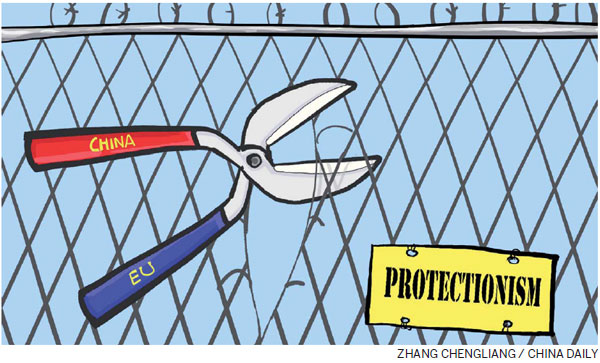
Protectionism is on the rise, both in developed and emerging economies. Slower economic growth, unemployment and sometimes weak political leadership pave the way for anti-trade, anti-globalization rhetoric.
This rhetoric can win the brains of certain leaders and the hearts of the population in Western countries in search of a new path to growth, as we have seen in the US election, the Brexit vote and the election campaigns in Germany, the Netherlands and France.
At the same time, global trade growth is indeed slowing down, likely to less than 2 percent in 2016.
In an increasingly globalized economy, China has rapidly become an innovation powerhouse over the last few years, mostly fueled by and focused on its domestic markets. Usage-driven, customer-centric innovations have developed massively around on-demand, online-to-offline services. The size of the domestic market, the growth of the middle class, the connectivity of this population, the appetite for new products and services, for choice and early adoption, is fueling incredible creativity and business model ingenuity.
New digitally-enabled products, services and commerce are developed every day, and in no country other than China do these products find access to the market, if they are relevant to a customer segment. Typical examples include e-commerce platforms, urban mobility services, last-mile logistics, connected objects and associated services, peer-to-peer finance, genomics and artificial intelligence, to name a few.
While China has built some global champions in the digital and ICT market, most of these innovators remain relatively focused on the vibrant domestic market, with the exception of mobile phone designers and manufacturers. Few Chinese players bring their very innovative mass-customization, online-to-offline concepts to global markets, where they could fuel productivity, competition and growth. China already has the Apple and Google of tomorrow's world, but a lot remains to be done for them to go out to the world and create standards.
At the same time, overall innovation is not developing fast enough. Total factor productivity, which is a way of measuring innovation by subtracting the growth contributions of additional labor or capital inputs, is declining in China.
Total factor productivity is a good proxy for the contribution of innovation-driven productivity. The reason for this paradoxical trend is the domination of industrial and infrastructure investment, as well as rising labor costs, as compared with the dynamism of customer-usage-driven innovation and growth. Industrial modernization and increasing productivity, from industrial goods to consumer products and services, is a critical imperative for the economy if it is to succeed in building a "moderately prosperous society", a core element of the Chinese dream. This is why China has launched the Made in China 2025 plan, which is focusing on 10 key sectors, mostly in the industrial goods area.
Complementarity between China and Europe can play best in combining a European approach to industrial upgrading with a Chinese approach to consumers. Industrial modernization, the upgrading of production processes, takes time. This is due, of course, to industrial investment cycles but also to the need for the accumulation of engineering experience, integration of longer-cycle research and development, integration of feedback and lessons learned from operating experience.
This is where European industrials still have an edge, as they have been confronted with the need to improve productivity and maintain competitiveness already for three or four decades in a globalizing economy. This competitive edge has not gone unnoticed by Chinese leaders: Recent acquisitions of European assets by Chinese private and state-owned companies, as well as investment funds, demonstrate trust in European contributions, as well as openness to foreign investment.
Overseas acquisitions by Chinese companies alone will not be sufficient. A lot of integration work remains to be done in order to reap the hoped-for benefits - integration of management teams, efficient allocation of resources, integration of Chinese and European companies' supply chains - to improve quality, cost and productivity.
This is today insufficient and for those companies that have acquired assets in Europe or the rest of the world. Most of the benefits in terms of learning curve - access to new markets, access to the Chinese market for European products and services, joint technology improvement - are not there. Encouraging European companies' acquisitions in China across all sectors would also accelerate the industrial transition and modernization. Increasing integration is therefore a key to materializing the strength of the complementarity between Chinese and European industrial systems.
A bridge can be created between the Chinese innovation powerhouse and European markets to boost European companies - combining the power of the European Industry 4.0 approach to industrial modernization and digitization, with the strength of Chinese innovation in the field of on-demand product and services. This is the perfect match for a creative ecosystem, not only for large companies but also for small and medium enterprises, from China and from Europe, to develop new products and services. We foresee new organizational structures and decision making processes in transnational companies, in order to combine European production, or production tools, and the Chinese internet economy in the digital area.
Due to the nature of the digital economy, in terms of diversified customer behavior and fast marketization, Chinese companies have become market leaders in generating new applications and new business models. This is a weak point for product-focused European companies in their digital strategies. Digitization and the industrial revolution associated with it are creating a global-level playing field again. From this new start line, new Chinese-European champions can emerge.
China has recently launched several multilateral initiatives to accelerate global trade and create or develop new markets, including the Belt and Road Initiative and the Asian Infrastructure Investment Bank. At the other end of the road lie European markets and companies that have no interest in rising protectionism and that have long demonstrated their openness to foreign and Chinese investment, with a strong export drive and appetite for the Chinese market.
Denis Depoux, Asia Deputy President and Senior Partner of Roland Berger Strategy Consultants
The views do not necessarily reflect those of China Daily.




Copyright 1995 - . All rights reserved. The content (including but not limited to text, photo, multimedia information, etc) published in this site belongs to China Daily Information Co (CDIC). Without written authorization from CDIC, such content shall not be republished or used in any form. Note: Browsers with 1024*768 or higher resolution are suggested for this site.
License for publishing multimedia online 0108263 Registration Number: 130349