BERLIN - With urbanization gaining pace and air pollution clouding the view in major cities, contemplating the stars in a pitch-black sky is fast becoming a rarity that tour operators are banking on as a new selling point.
From a total solar eclipse to the Milky Way to the northern lights, many experts at Berlin's ITB, marketed as the world's leading travel trade show, were making the case for astronomical experiences this year.
"Astro-tourism is really an increasing business. We now see a lot of travel agencies which offer this kind of tourism," says Andreas Haenel, an astronomer and director of the planetarium museum in northwestern Germany's Osnabrueck.
While space tourism may be the holy grail for the most committed of stargazers, its astronomical price tag puts it out of reach for most, not to mention health and safety concerns over forays beyond the atmosphere.
Enter astro-tourism, which allows enthusiasts of celestial movements to experience the natural phenomena with both feet firmly on planet Earth.
With few places sufficiently dark for observations, some European and US national parks have now classified certain areas as "dark-sky preserves".
Meanwhile, deserts in Namibia, Botswana and Iran are marketed as ideal stargazing sites that also offer the exoticism of sand dunes.
Keyvan Lankarani, the European representative of an Iranian tour company, says the sector started developing in his country due to domestic demand.
"It really started within the Iranian market itself. Because of the vast central desert, we have pretty big spaces of darkness," he says.
Northern lights
But beyond just searching for familiar favorites like Orion's belt or the Big Dipper, Haenel says recent years have seen a boom in "event astro-tourism" - travel to witness an eclipse, a meteor shower or the northern lights.
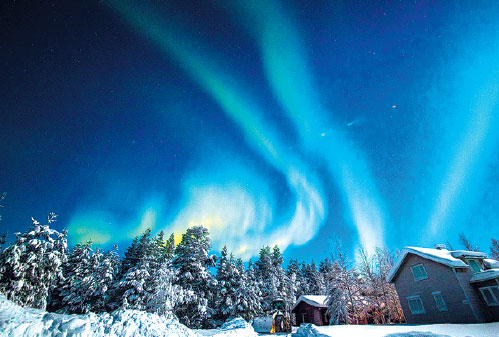
At the ITB show, the brochure promoting Canada's Yukon sells the moment that "you will never forget" when skies suddenly light up with colorful streaks as a result of gaseous particle collisions.
Known commonly as the northern lights, the aurora borealis has become a major selling point for towns around the Arctic Circle.
"There has been an increasing interest since the last four years. It has to do with our marketing, of course, and an awakening," says Ellen Kachel of the Northern Norway Tourist Board, noting that demand has grown in particular among Asian clients.
The northern Norwegian city of Tromso has seen the number of visitors explode, and every photo shared on social networks only serves to fuel further interest in the region.
But this year, the big astro-tourism seller is the Aug 21 total solar eclipse, which will only be visible along a stretch running from Oregon to South Carolina, cutting diagonally across the United States.
"Nobody knows how many tourists are going there. The estimations go from several hundred thousands to several million people. But it seems to be becoming a great event," says Haenel.
In nearby Idaho, the tourism sector is already in full gear to welcome an influx.
"We are almost sold out," says Nancy Richardson of Idaho Tourism.
"We've been selling this product (the solar eclipse) for two years already."
Patience with the 'diva'
For some on the planet, starry skies are already a thing of the past.
Defenders of the "dark sky" warn that the space available is shrinking faster due to light pollution. That's a problem not just for star gazing but also for nocturnal animals that thrive in the dark.
Harald Bardenhagen, an astronomer and director of the Stars without Borders workshop, notes that "many Europeans have never seen properly the Milky Way".
"In 2024 you won't be able to see the stars anymore if nothing is done against the light pollution," he says.
As the sector's popularity grows, some warn that it should be careful not to fall victim to its own success.
For Kachel, the sector will have to find a balance of moderate growth that respects nature.
At the same time, astro-tourism may not be for everyone as it not only calls for patience but also the acceptance that tonight may just not be the night.
"We never promise. That's why we call it 'hunting the lights'. You are looking for it, but you don't know if you'll see it," says Kachel.
After all, she went on, the aurora borealis "is a diva" - sometimes it's just not in the mood to perform.
Agence France-Presse
|
Finland is among the Northern European countries that draws tourists from around the world for the northern lights. Provided To China Daily |




Copyright 1995 - . All rights reserved. The content (including but not limited to text, photo, multimedia information, etc) published in this site belongs to China Daily Information Co (CDIC). Without written authorization from CDIC, such content shall not be republished or used in any form. Note: Browsers with 1024*768 or higher resolution are suggested for this site.
License for publishing multimedia online 0108263 Registration Number: 130349