Anheuser-Busch InBev SA/NV, the world's largest brewer by sales, announced on Tuesday that it has made a new commitment to secure 100 percent of its purchased electricity from renewable sources by 2025.
This move will cut 30 percent of the beer company's operational carbon footprint, which will be equivalent to removing nearly 500,000 vehicles from the road.
Eager to protect the environment and fight climate change, AB InBev has set the target of becoming the largest corporate direct purchaser of renewable electricity in the global consumer goods sector.
The Belgium-headquartered brewer's first power purchase agreement was signed with Iberdrola in Mexico. In total, this will shift 6 terawatt-hours of electricity annually to renewable sources in markets where AB InBev operates and will help transform the energy industry in countries including Argentina, Brazil, India and South Africa.
This increase in renewable electricity generation - the same amount of energy produced in one year by solar panels covering an area equivalent to more than 400 soccer pitches - will support efforts to achieve climate targets under the 2015 Paris Climate Change Conference agreements.
"Climate change has profound implications for our company and for the communities where we live and work," said AB InBev CEO Carlos Brito. "Cutting back on fossil fuels is good for the environment and good for business, and we are committed to helping drive positive change. We have the opportunity to play a leading role in the battle against climate change by purchasing energy in a more sustainable way."
As part of this initiative, AB InBev - maker of Budweiser, Corona and Stella Artois, among others - expects to secure between 75 and 85 percent of electricity through direct power purchasing agreements. The remaining 15 to 25 percent will mainly come from on-site technologies such as solar panels.
The renewable energy target also demonstrates AB InBev's continued commitment to following a low carbon path, in line with the United Nations' Sustainable Development Goals.
The company has also joined RE100, a global initiative of influential businesses that are committed to using 100 percent renewable electricity.
Under the RE100 initiative, involved companies can achieve their emissions-cutting goals through using or producing energy from renewable resources and sourcing their energy under green electricity contracts with utilities, power purchase agreements or renewable electricity certificates.
AB InBev's renewable electricity transformation will begin in Mexico, which is home to the company's largest brewery, located in Zacatecas. AB InBev has signed a power purchase agreement with Iberdrola, one of the largest electricity companies and among the forerunners in renewable energy development worldwide, for 490 gigawatt-hours per year. With this new partnership, AB InBev will be able to meet all of its purchased electricity needs for production sites in the country.
The agreement with Iberdrola is also expected to increase Mexico's wind and solar energy capacity by more than 5 percent.
Iberdrola will build and install 220 mW of wind energy capacity in the state of Puebla, and energy generation is expected to begin in the first half of 2019.
AB InBev plans to enter into similar agreements in other markets in the near future. By launching this new initiative in Mexico, the company hopes to demonstrate that by switching to renewable electricity, businesses around the world can operate with 100 percent renewable electricity in the future.
AB InBev is, to date, operating more than 40 breweries in China. The company plans to continue to invest and expand its existing breweries. It has invested in making alcohol-free and low-alcohol beer and hopes to continue to broaden its portfolio.
In the second half of 2016, BlackRock, the world's largest assets manager, issued a climate change warning, stating that investors could no longer ignore the phenomenon and that they should factor in the costs of environmental problems - such as fossil fuel usage, water consumption and carbon emissions - as a percentage of annual sales when they decided which companies to invest in.
In China, the central government has already stated that the country's latest priority is quality, green and low-carbon urban development through the building of a more efficient urban public transportation system and tougher rules on carbon emissions.
"Even though conducting environmentally-friendly activities and raising public awareness cannot be done overnight, adopting renewable sources to generate power is a powerful step in promoting sustainability," said Ding Rijia, a professor at the China University of Mining and Technology in Beijing.
To use energy more efficiently, Ding said the government can convert excess industrial heat into urban heating through new technologies and international cooperation, and that building more modern high-efficiency, low-emission supercritical and ultra-supercritical coal-fired power plants can emit 35 percent less carbon dioxide than older sub-critical plants.
zhongnan@chinadaily.com.cn
|
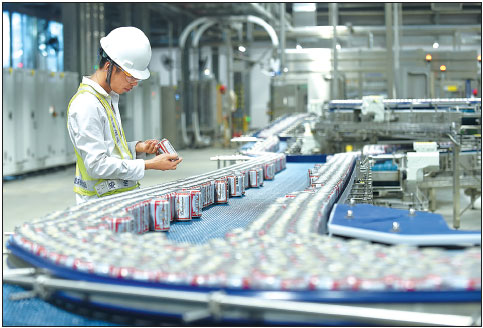
A worker checks cans of beer at a brewery of Anheuser-Busch InBev located in China.Provided To China Daily |




Copyright 1995 - . All rights reserved. The content (including but not limited to text, photo, multimedia information, etc) published in this site belongs to China Daily Information Co (CDIC). Without written authorization from CDIC, such content shall not be republished or used in any form. Note: Browsers with 1024*768 or higher resolution are suggested for this site.
License for publishing multimedia online 0108263 Registration Number: 130349