Information age fosters deep mutual understanding between countries that must cooperate to survive and thrive
The most important relationship in the world?
It's China and the United States, both economic superpowers towering above the rest, and whose interdependence led the historian Niall Ferguson to coin the expression "Chimerica".
China's rise to global greatness has been swift enough to surprise the rest of the world, especially the US. However, such a swift rise is not unique. Along with other sudden large-scale disruptions, like France under Napoleon from 1799, or Germany after unification in 1871, these events have created precedents for today's predictions of doom.
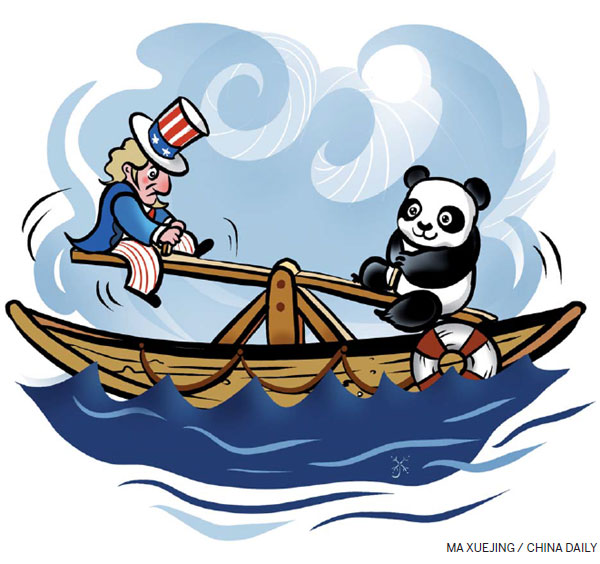
If the incumbent superpower, the US, and new kid on the block, China can succeed in creating a peaceful world in which both can continue to grow, it will be a first in world history. Future world peace and prosperity depend on the successful development of a relationship between two profoundly different cultures. Is this really possible?
In the West vs East (or developed vs emerging world) arguments, which often dominate discussions about China's new position, the huge economic benefits brought by China's emergence tend to be overlooked. China's contribution to global growth has been fundamental to world economic stability and growth, particularly since the financial crisis of 2008.
In 2009 and 2010, when the developed world was in economic crisis, China's controversial demand stimulus played a vital role in maintaining global growth. Even today, with US economy back on its feet, China continues to make the largest contribution to global economic growth of any one country.
From the mid-1990s - and particularly after 1999, when China agreed to join the World Trade Organization - China's role as a supplier to the world of labor-intensive manufactured products put global consumer prices far below where they otherwise would have been. This benefited everyone, but particularly the poorer, most price-sensitive members of society, as well as many poorer countries in the emerging world.
Today, with a quadrupling of Chinese labor costs from 2007 to levels comparable with some European states like Portugal and Greece, many supply chains - which depended a decade ago on cheap Chinese labor - have shifted elsewhere. Instead, now it's the emergence over the next few decades of China's huge middle-class that provides a major, long-term growth opportunity to Western multinationals, many of whom have come to depend on China's consumer market for growth and profits.
Volkswagen, General Motors, Qualcomm, Apple, Boeing, Airbus, L'Oreal, Rolls-Royce - the list, a very long one, includes virtually every company of size anywhere, along with many small- and medium-sized enterprises.
Outward flows of Chinese foreign investment began to play an important role in Africa and South America a decade ago. Today, the focus of Chinese overseas investment has shifted, from emerging to developed countries and from commodities like copper (for computer circuit boards, ships and household plumbing) and iron ore (for steel), to technology-rich manufacturers like Kuka, the leading German robotics company, which was acquired last year by Midea, one of China's largest electronics companies.
Chinese companies, already significant employers in emerging countries, are becoming important players in the US and Europe as well. Fuyao Glass, which started life as a Sino-foreign joint venture in 1987 and became a major supplier of glass to China's auto manufacturers, has invested $700 million (644 million euros; 557 million) and created 1,700 new factory jobs in the US Midwest. Chinese investment in the US rose sharply in 2016 to approach $60 billion.
China, set to become the world's largest exporter of capital, is positioned to increase its economic stake further in the developed world, while the ambitious and far-reaching Belt and Road Initiative will provide a vast range of new development opportunities throughout Central Asia and in Eastern Europe.
In a few years, China's participation in the global economy, which has brought employment, economic growth and lower prices, has become so significant that it's impossible to think what the world would look like today without it. At the same time, China's global impact has brought some social and economic disruption that the established order has found hard to deal with.
In the US, Donald Trump used this fear of change among the American electorate in his 2016 election campaign to win votes and become president.
Developed countries need to respond to the challenge of change not by closing their economies to external trade and investment but by removing barriers to growth, work and innovation.
France, which has a maximum 35-hour work week and requires companies to give laid-off employees one year's pay, is a good example. The best, most productive response to global competition is investment in education and retraining, promotion of innovation and new ventures, and more global engagement, not less.
Between them, the US and China account for about 40 percent of nominal world GDP, and nearly half if the purchasing-power parity method is used.
The US-China relationship has become a vital axis on which many global economic and geopolitical issues revolve. It has deep implications for the resolution of global security issues.
From this perspective, the traditional US-China hotspot issues of currency valuation and trade have faded in recent years to relative insignificance.
The fundamental differences in US and Chinese cultural and historical background appear to present an insurmountable barrier to long-term mutual understanding. But such are the large and growing advantages of cooperation to both sides (and to everybody else) that these differences turn out to be potentially an enrichment and a strength.
Perhaps the development of a long-term, deep and multidimensional relationship between the world's two biggest economies could not have been possible in an age other than the present one, in which communication and social media have shrunk the globe, making cross-cultural and inter-regional relationships an everyday matter. If that is so, then the greatest benefit of the internet age in which we now live could be that it permits the development of a deep mutual understanding between China and the US, two vastly different countries that must cooperate to survive and prosper.
The gloomy precedents of history have been transcended and made redundant by technological development. US Secretary of State Rex Tillerson recognized this basic fact on his recent Beijing visit when he said that China and the US can only be friends. Viewed this way, perhaps the US-China relationship can be perceived as an unbreakeable link, a rock on which a future world of prosperity and peace can be built.
The author is a visiting professor at Guanghua School of Management, Peking University. The views do not necessarily reflect those of China Daily.




Copyright 1995 - . All rights reserved. The content (including but not limited to text, photo, multimedia information, etc) published in this site belongs to China Daily Information Co (CDIC). Without written authorization from CDIC, such content shall not be republished or used in any form. Note: Browsers with 1024*768 or higher resolution are suggested for this site.
License for publishing multimedia online 0108263 Registration Number: 130349