Collector of miniature cars has built up a massive trove of iconic toy vehicles
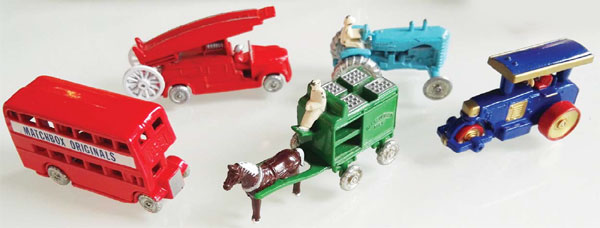
Miniature die-cast Matchbox vehicles have been iconic toys for those born since the 1950s.
Made by British company Lesney Products, more than 3 billion toy vehicles have been sold by Matchbox across 12,000 model lines since the company's inception in the late 1940s.
While the primary target audience for such toys is children, the brand does have its fair share of adult collectors in China.
|
A retro set of Matchbox's early models. Photos Provided to China Daily |
Shi Ming, 41, operations director of DHL Aviation Services in Shanghai, is one such avid collector. He has a whopping 3,000 Matchbox cars in his collection and can name every car model on display in his home.
"It was so fascinating when my mom gave me my first Matchbox car when I was at elementary school in 1986. It was very cheap, only 1.6 yuan ($0.25; 0.20 euro; 0.19), but it was nevertheless unique at the time," says Shi.
Shi, who has been collecting Matchbox cars for 31 years, says the toys were more than just a form of entertainment - they were also his first foreign language teachers.
He remembers how he would excitedly read all the product descriptions that came with each vehicle, and this helped to improve his grasp of English. When children were only beginning to learn English during the fifth grade, Shi was already familiar with words such as "caution", "firefighting" and "refuse truck".
These toys gave him insights into a world beyond China. In the 1980s, China was home to just a handful of car brands but Matchbox taught him that others, such as Jeep, Volkswagen, Audi, Skoda and Renault, existed elsewhere in the world. He recalls how he would get excited whenever he spotted familiar foreign cars in movies.
A major milestone in the history of Lesney Products was when the company produced a miniature model of Queen Elizabeth II's coronation coach in 1953. A few months later the company's co-owner, Jack Odell, designed an even smaller model that could fit in a matchbox for his daughter to take to school as a toy. This formed the foundation upon which Matchbox would build its success.
In the 1960s, Hot Wheels, a new line of vehicles by US toy giant Mattel, emerged to become Matchbox's fiercest competitor. To keep up with the competition posed by these new toy cars that had racing-style wheels, sleeker tires and brighter colors, Matchbox improved the quality of its toys and expanded the number of models.
In 1982, Matchbox was bought by American Universal Toys and gradually opened factories in Chinese cities such as Shanghai.
Shi says that Shanghai Universal Toys Company, which produced miniature car models from 1982 to 2004, was pivotal in igniting an interest in such toys in Shanghai. He bought many Matchbox models from the company's official store on Beijing West Road.
Matchbox was eventually bought by Mattel in 1997 and the combination of these two iconic toy companies resulted in several stylistic changes to the toy vehicles. Instead of obtaining authorization from automobile makers and designing scaled-down miniatures of the real cars, Shi says Matchbox started to create "some weird models" after the takeover - notably a helicopter that looked like a dragonfly, trucks shaped like cows and jeeps with oversized wheels.
While children loved the new Matchbox models, adult fans like Shi found them unsatisfactory.
In 2004, the year it released a new batch of toys that Shi says were impressive, Shanghai Universal Toys went bankrupt. Those models were what inspired his hobby of collecting cars.
He later developed a fondness for Hot Wheels cars as well and since 2007 has amassed more than 1,500 of these. Shi says that he spends around 5,000 yuan every year on additions to the collection. He says some collectors purchase these toys as investments. Some buy two sets of a collection - one for playing with and the other for investment.
"A model I bought several years ago cost me just 16 yuan. Today the same model could fetch up to 160 yuan," says Shi.
There are several other collectors like Shi in Shanghai who have formed a club that organizes activities. The club allows him to share his joy of collecting with like-minded individuals such as Chen Yunling, the founder of a website for Matchbox toy collectors where enthusiasts can discuss news and memories. He also operates an online forum that facilitates research on various models.
In China, most Matchbox lovers are based in Shanghai. There are smaller groups in Wuhan, Hubei province and Guangzhou, Guangdong province and in Beijing. Some Western counterparts have even more impressive collections that span more than 60 years and cover a more diverse range of models.
Shi says his Matchbox collection helps him relax but he laments that his 10-year-old daughter is more interested in electronic games than his historical toys.
"Some electronic games, like crossword puzzles or car racing, may help develop intelligence but the negative effects, such as the damage to the eyes and cervical vertebra, are more obvious. I'd rather she spent more of her leisure time on a toy collection or playing with Legos," says Shi.
Asked whether he would ever consider giving up his hobby, Shi is quick to say no.
"These aren't just toys. They are a matter of emotional dependence."
Cao Chen contributed to this story.
xuxiaomin@chinadaily.com.cn




Copyright 1995 - . All rights reserved. The content (including but not limited to text, photo, multimedia information, etc) published in this site belongs to China Daily Information Co (CDIC). Without written authorization from CDIC, such content shall not be republished or used in any form. Note: Browsers with 1024*768 or higher resolution are suggested for this site.
License for publishing multimedia online 0108263 Registration Number: 130349