|
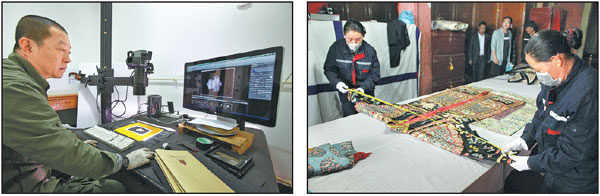
Left: A staff member from the Palace Museum in Beijing uploads the museum's cultural relics to the system. Right: Staff members from the Potala Palace in Lhasa, capital of the Tibet autonomous region, sort out cultural relics. Photos Provided to China Daily and by Wang Kaihao / China Daily |
China's cultural relics now have national ID cards. A report by the State Council on Friday shows that there are 108 million moveable cultural relics in State-owned institutions on the Chinese mainland, based on a five-year national study, the first since the founding of New China in 1949.
And 64,073,178 of them are in a national database, under 15 categories.
Each item has a unique code in the database, and more than 50 million pictures of them have been uploaded to the system.
The report shows 7 million cultural relics were discovered during the national survey.
The five main categories were coins and bank notes, books, paper files, pottery and ceramics.
The Qing Dynasty (1644-1911) relics comprised a major part of the hoard, covering about one-third of the total, followed by the Song Dynasty (960-1279).
The survey also shows that about 40 percent of the cultural relics need restoration. And a conservator is typically responsible for about 2,290 cultural relics, showing the extent of the personnel deficit.
Liu Yuzhu, director of the State Administration of Cultural Heritage, says conservation training will be boosted.
Nearly 30 departments under the State Council worked on the survey, which Guan Qiang, deputy director of the State Administration of Cultural Heritage, compared with a demographic census.
According to Guan, though museums were the main targets for the survey, universities, temples and even Chinese embassies were covered, necessitating the participation of departments in charge of education, religion and foreign affairs.
Statistics from the Ministry of Finance show that 64 million yuan ($9.3 million) was allocated by the central government for the database and the training of investigators. And 1.18 billion yuan more was spent by local governments to support the work.
"Though some institutions had their own register before, a uniformed platform with standard criteria was lacking," Guan says.
"Now, this platform will also be open for privately owned cultural relics."
According to WangLi, deputy director of the office in charge of the survey, the authorities were also inspired by similar exercises conducted overseas.
For instance, she cites the French experience, Italy's register system and Japan's laws.
"We'd like to share our experiences, criteria and results," she says.
"International cooperation on protection of cultural relics will also be enhanced."
Duan Yong, an official in charge of a museum under the State Administration of Cultural Heritage, also says that such a survey is helpful for the repatriation of lost cultural relics.
"A major problem when it comes to getting back artifacts from overseas is the lack of evidence," he says.
"But if the items are in the database, it is easier to trace them if they get stolen."




Copyright 1995 - . All rights reserved. The content (including but not limited to text, photo, multimedia information, etc) published in this site belongs to China Daily Information Co (CDIC). Without written authorization from CDIC, such content shall not be republished or used in any form. Note: Browsers with 1024*768 or higher resolution are suggested for this site.
License for publishing multimedia online 0108263 Registration Number: 130349