Once considered a wartime food, wild vegetables are now being thrown into the culinary spotlight by chefs specializing in Huaiyang cuisine
Chef Hou Xinqing, one of China's most recognized chefs for Huaiyang cuisine, beamed with pride as he served the new specials in the spring menu at Jiangnan Wok at Shangri-La Nanjing, Jiangsu province.
The seasonal menu features 14 dishes, many of which use yecai, or wild vegetables, as the main ingredient instead of the usual fine hams and abalones.
"Wild vegetables are the new meat," he quipped.
Huaiyang cuisine, which is derived from the native cooking styles of the regions in the lower reaches of the Huai and Yangtze rivers, was created by China's richest salt merchants centuries ago. It distinguishes itself from the other three pillar cuisines of China as being the most pedantic about the quality of ingredients and the need to maintain their true flavors. Although Beijing and Shandong are known as the home to Lu cuisine, chefs often employ cooking techniques from Huaiyang cuisine when preparing State banquets.
"They each have their own distinctive fragrances that remind us of the arrival of spring through the palate. There is no limit to the use of wild vegetables. The key thing to note is to use as little flavoring as possible," he added.
Chinese are no strangers to yecai, having consumed them on a daily basis in the past when China was ravaged by wars and famines. While these vegetables - there are around 300 edible types - were merely a means of sustenance back then, they are today taking center stage on the menus of fine dining restaurants serving Huaiyang cuisine, generally considered the most refined of all types in China.
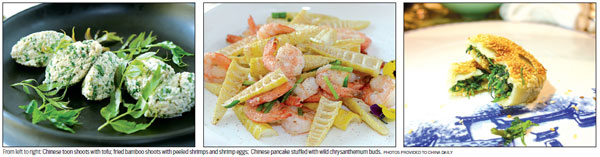
At Jiangnan Wok, yecai is shredded and served with tofu as a salad, used as part of the fillings for dumplings and fried pancakes, and wok-fried with bamboo shoots and peeled shrimps.
Over at one Michelin-starred restaurant Yong Yi Ting at Mandarin Oriental Pudong in Shanghai, malantou, a type of wild vegetable, is blended into ice cream to produce a distinctive flavor that tastes like mint leaf.
Hou is a protege of Zhou Xiaoyan, a Chinese master chef who has in recent years been working to have the Huaiyang cuisine listed by UNESCO as an intangible cultural heritage.
Hou said he was inspired to create a menu that celebrated these vegetables after working for three years in Nanjing where the tradition of eating such greens all year around has existed for as long as the city's centuries-old ramparts.
According to local media reports, Nanjing residents consume more than 10 tons of wild vegetables every spring.
"As the capital of six dynasties, Nanjing has been historically more vulnerable to wars and regional conflicts than any other cities in China. Wild vegetables are hence popular as they represent a form of sustenance and livelihood for the people," said Ren Quanjin, a senior scholar with Nanjing Botanical Garden.
Ren noted that there are about 30 types of yecai in Nanjing, but only eight of them are commonly used. Nicknamed qi tou yi nao, which means "seven heads and one brain" (or seven shoots and one bud), they include toon shoots, goji leaf shoots, pea leaf shoots and the bud of wild chrysanthemum.
While Ren defines wild vegetables as those that can be found in the mountains, by the lakes and rooted in crannied walls, much of the produce consumed in Nanjing and cities in the Yangtze River Delta region come from farms.
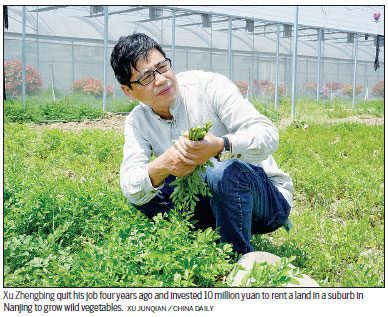
Xu Zhengbing is one such farmer of yecai. The former hotelier quit his job four years ago and invested 10 million yuan ($1.45 million) to rent a land in a suburb in Nanjing to grow wild vegetables. He now has 120 types of wild vegetables from all over China planted in his farm, selected based on his personal taste preferences.
"Yecai is more resilient than regular ones as they can survive in the wild. This innate vitality should benefit the diners," said Xu.
The 49-year-old, who grew up in a family of cooks and used to work as a chef before taking on management roles at hotels, said he is aiming to do more than just supply his yecai to supermarkets, restaurants and hotels, noting that the profit margin is low.
Next year, he will make a return to the kitchen to prepare special dishes that feature his wild vegetables with crayfish - the signature dish of his hometown Xuyi in Jiangsu province.
xujunqian@chinadaily.com.cn
(China Daily USA?04/21/2017 page9)




Copyright 1995 - . All rights reserved. The content (including but not limited to text, photo, multimedia information, etc) published in this site belongs to China Daily Information Co (CDIC). Without written authorization from CDIC, such content shall not be republished or used in any form. Note: Browsers with 1024*768 or higher resolution are suggested for this site.
License for publishing multimedia online 0108263 Registration Number: 130349