|
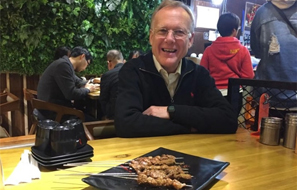
Gregory Hayes, chairman and chief executive officer of United Technologies Corp. Provided To China Daily |
Smart, connected solutions and localization are the key to drive UTC's growth
Gregory Hayes, chairman and chief executive officer of United Technologies Corp, believes that globalization will not only increase trade among countries - but will also create global supply chain networks across developed and developing countries.
"As global supply chains expand, it has become more accessible to developing markets, allowing businesses in these countries to participate in the global economy more efficiently and cost effectively," said Hayes.
There was no free lunch when he was appointed CEO in 2014, as he immediately had to lead his group to reach more growth targets in its businesses - including elevators and escalators, aircraft engines, aerospace systems and climate control and security systems - as well as to further digitalize them to compete with other rivals in the fast-developing digital era.
While China is undergoing an industrial and consumption upgrading boom, along with the Made in China 2025 initiative, the Connecticut-headquartered conglomerate expects the use of digital and connected solutions will play an increasingly important role there.
Hayes spoke to China Daily on UTC's strategy for business growth and various other aspects. The following are the edited excerpts from the interview:
Do you have any new investment plan or strategies to expand your market presence in China this year?
United Technologies will continue to invest in China. Otis is making a significant investment in Shanghai, where it will build a 220-meter test tower to test the next generation of high-speed elevators. We have brought all our high-rise R&D facilities to China as well.
We will also continue to invest on the commercial side. Carrier - our air conditioning, heating and refrigeration subsidiary will continue to make investments - has an R&D center that is moving into a much larger facility outside Shanghai this year.
On the aerospace side, we are making investments in products that are currently manufactured in the United States but we are moving some of that production here for the local Chinese market.
What is your assessment of the Chinese economy and how will the country's economic transformation affect your investment strategy?
It is always interesting when people talk about 6.5 percent GDP growth. From the perspective of the US - where we see 2 percent growth - we would love to see 6.5 percent growth. And again, 6.5 percent growth in a $12 trillion economy, means $780 billion of GDP growth. So we say China's slowing down, but it's inevitable just because the economy is getting so big.
I think importantly, when you look at where the GDP growth in China is coming from, the services side and consumer spending now represent 50 percent of GDP, and that is probably growing at 10 percent plus.
UTC is not here just for the next five years. We view China as a place where we'll be doing business for the next 50 to 100 years and beyond and for us the service sectors are going to be equally important as manufacturing growth.
Do you have specific plans to develop the markets along the Belt and Road Initiative?
We have already started to adjust our strategies in China by bringing our technology center for high-rise construction here to Shanghai. China also currently serves as a manufacturing base to export across Asia - and even back to the United States in some cases. However there remains an opportunity for us to continue to expand manufacturing for exports.
What decisive measures have affected or helped the company's development, specifically under your management?
We recognize that the products we have today are not going to be sufficient for the markets of tomorrow, so we're focused on how we can change and evolve our products. How do you take advantage of, for instance, the digital age, internet of things, taking information gained from the jet engine of today?
We have 4 million bits of data generated by a jet engine after every flight. How do you take that data and use it to make the engines more efficient, but also lower costs for the airlines? How can you predict when an engine is going to fail? We've done similar things on elevators, with remote electronic monitoring.
How do you remain competitive in China and how do you see the country's market conditions evolving?
The key to being successful is innovation. For Otis that means coming up with machines that run faster and quieter, plus have aesthetics in the cabins that are more pleasing for the passengers. They also have to have a cost position that is better than the competition to price your product at a point where you can be successful.
I would say China is no longer low cost. We're looking for ways to automate; at the Otis factory in Tianjin, we have a number of robots replacing work that used to be done by workers. We still have over 1,000 people working in the factories there, but because of the higher labor costs we are also automating.
What's your biggest achievement in China as group CEO?
I think it is the continued growth of the business and the fact that each one of our businesses is led by a local leader today. We don't have expats running the business. We have local leaders top to bottom in each one of our businesses.
How can digital technologies improve your company's business?
Digital technologies will help us create newer and better ways to use the data coming off our products to drive greater efficiency into our operations.
These technologies will also help transform our products and services to create real value for our customers - from predictive maintenance for jet engines, to remote electronic monitoring for elevators to intelligent building controls that can adjust the climate in one of our buildings to suit the preferences of a particular customer.
How do you motivate your international team?
I've often said that companies don't innovate, people do. I believe one of the best ways to motivate people is to make sure they are engaged and excited about the work they are doing.
We encourage continuous, lifelong learning for our employees and strive to create an environment where employees are empowered to take control of their careers.
What's the secret of your business success in China?
We believe our success in China lies in our ability to serve our local customers with our local businesses. We depend on the strong relationships we have developed with suppliers, customers and government officials throughout our long presence in China.
Our ability to localize our manufacturing, product management, engineering and supply chain has also been very critical.
We are very familiar with the needs of our customers in China, and are committed to providing solutions that deliver value and support the trends we see in sustainability, urbanization and commercial aerospace.
How do you promote your business in China?
The best way to promote our business is to deliver innovative products and services that our Chinese customers want. We continue to invest in technology to develop innovative and sustainable solutions for the aerospace and building industries that keep people safe, comfortable, productive and on the move.
Our long history in China is invaluable - we have many successful partnerships and understand the needs of the local market.
What are your hobbies? How do you spend your time off duty while in China?
I enjoy reading - my favorite topics are economics and business, but I like fiction as well.
When I visit China, my favorite part of the trip is always getting to know people and learning about what is on their minds - whether it's employees, customers, suppliers or government officials. These interactions offer a unique opportunity for me to learn something new about either China itself or our businesses.
What do you think about the Chinese Dream? What are your dreams or ambitions in China?
I think the concept of the Chinese Dream is a powerful way to inspire people. Its guiding principles will be important as China continues to grow and prosper.
I think the Chinese Dream is also about a sustainable future and I'm proud of UTC's role in providing solutions that meet these needs.
We are confident in the future of China's aviation market. Our solutions support that growth as well - from the world's most fuel-efficient jet engines to advanced aerospace components.
zhongnan@chinadaily. com. cn
CV
Age: 56
Nationality: United States
Career:
2016 onwards: Chairman and Chief Executive Officer, UTC
2014: President, CEO, UTC
2008: Senior Vice-President and Chief Financial Officer, UTC
2004: Vice-president, Accounting and Controls, UTC
2003: Vice-president and Controller, UTC
1999: Vice-president, Financial Planning & Analysis, Hamilton Sundstrand, UTC
Education:
1982: Bachelor degree in economics from Purdue University, Indiana
Certified Public Accountant




Copyright 1995 - . All rights reserved. The content (including but not limited to text, photo, multimedia information, etc) published in this site belongs to China Daily Information Co (CDIC). Without written authorization from CDIC, such content shall not be republished or used in any form. Note: Browsers with 1024*768 or higher resolution are suggested for this site.
License for publishing multimedia online 0108263 Registration Number: 130349