|
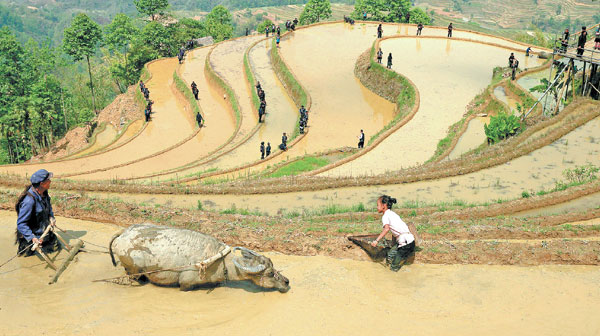
The Hani work on the terraced paddy fields in Yunnan province. Their lifestyle and culture are a source of inspiration for Chinese musicians. Photos By Jiang Dong / China Daily |
In 1983, when Guan Xia was learning to compose at the Central Conservatory of Music in Beijing, he and four classmates traveled to the Honghe Hani and Yi autonomous prefecture in Southwest China's Yunnan province to seek inspiration from the folk music of the Hani and Yi ethnic groups.
After spending days on a train from Beijing to Kunming, the provincial capital, and then a few more days on a bumpy bus ride and a trek through the mountainous roads, the five finally saw the stunning terraced fields, among which the Hani people live, and watched them perform their ancient folk songs, accompanied by traditional instruments.
The trip inspired Guan's future compositions, in which he combined ethnic and classical music.
Guan, who has been the president of China National Symphony Orchestra since 2004, recalls how Hani folk music influenced him.
In April, he arranged to send five young Chinese composers to remote villages in Honghe again along with musicians of the national orchestra.
In a week, the young composers listened to the polyphonic folk songs performed by the Hani people, and climbed the mountains to participate in Girls' Day, a grand festival of the Yiche people, a Hani subgroup.
Six musicians of the national orchestra enthralled the locals with their outdoor performances of Western composers' works that the prefecture isn't familiar with.
"The Hani people's music has a narrative style. Through translators, I learned that the songs tell tales about their history and daily life. It is impossible to write music without stories. So I encourage young composers to go out and discover such treasures hidden in the remote villages," says Guan, who couldn't make the trip to Yunnan this time.
Li Zhenqing, vice-president of the orchestra, made the trip along with the composers and musicians.
"As practitioners of Western classical music, we always want to compose original music in Chinese style. Our ethnic groups have a long tradition of music, which offers us limitless inspiration," Li says.
Besides Yunnan, the team went to Fuzhou, the capital of Fujian province, to collect material on nanyin, a musical style of Fujian, which was listed as intangible cultural heritage by UNESCO in 2009.
Li also says the national orchestra established the Chinese Symphony Research and Development Center in 2014, aiming to train young composers and promote original Chinese symphony pieces. Every year, regular tours at home and abroad are held, and the national orchestra also sends musicians to collect folk sounds from around the country.
"After each trip, we digest what we absorb. But one trip isn't enough," says Li.
In 2015, Guan led musicians to the same villages of Yunnan he visited in 1983. The same year, the national orchestra established three bases in the province, which now offer a platform for more composers to stay, collect and research folk music.
In 2016, besides collecting musical material in Yunnan, more than 120 musicians of the national orchestra performed under the baton of Guan at the Honghe Grand Theater, in Mengzi city in Yunnan, presenting their adaptation of traditional Hani music.
Composer Huang Kairan, who joined the Yunnan trips last year and this year, says: "Before we saw the terraced fields, the singing of the Hani people came along clearly. Their singing was melodic. Though we couldn't understand the lyrics, we were impressed by the music and the sound of their instruments."
After the trip, Huang wrote a 10-minute piece, titled Somewhere in There, which was performed by him and his colleagues at the Honghe Grand Theater.
"I borrowed the percussion beats and adapted a Hani children's ballad into a piece for chamber music," says the 28-year-old.
Composer Liu Qing joined the orchestra's trip to Yunnan for the first time this year.
"When I met the Hani people and listened to their music, ... I was eager to compose my own works based on their folk music," says Liu, who teaches at the China Conservatory of Music.
Liu has made trips to Yunnan before. In 2005, she traveled to Tengchong, in western Yunnan, and had an unforgettable evening with the Yi people that inspired her to compose The Song of Jumping on the Moon. That night was the Torch Festival, the biggest annual event of the Yi people.
"It was raining heavily. When we thought that the festival was about to be canceled, the rain stopped. All the people in the village came out, dancing and singing. The ground was muddy, and we took off our shoes and joined the celebrations," recalls Liu.
"It's not just their music but also their lifestyle, such as food, language and clothing, which inspired me," she says. "Every score I wrote seemed to become a picture."
Contact the writer at chennan@chinadaily.com.cn




Copyright 1995 - . All rights reserved. The content (including but not limited to text, photo, multimedia information, etc) published in this site belongs to China Daily Information Co (CDIC). Without written authorization from CDIC, such content shall not be republished or used in any form. Note: Browsers with 1024*768 or higher resolution are suggested for this site.
License for publishing multimedia online 0108263 Registration Number: 130349