|
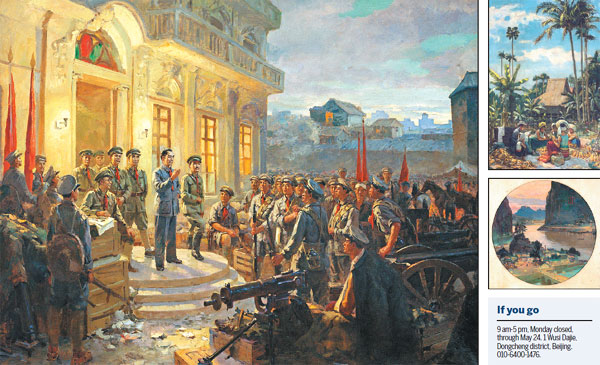
The ongoing exhibition showcases some 300 oil paintings, watercolor works and sketches by Li Binghong, including the 1960 reproduction of the oil painting Nanchang Uprising; Landscape of Xishuangbanna and Hydropower Station. Photos Provided To China Daily |
A painting by the late Li Binghong, which marks the founding of the People's Liberation Army, is now available for public viewing at the National Art Museum. Lin Qi reports.
Li Binghong (1913-86) is not a household name, but his oil painting Nanchang Uprising marks a significant moment in China's history. His 1959 work depicts armed resistance under the leadership of the Communist Party of China that took place on Aug 1, 1927, in Nanchang, in the eastern Jiangxi province.
The painting shows Zhou Enlai, one of the Party members who organized the engagement, inciting insurgent soldiers to counter the Kuomintang's anti-Communist purge.
Zhou later became the first premier of New China.
The military action marks the birth of an independent army led by the Party, and the day is celebrated annually as establishment day by the People's Liberation Army.
Li painted the work after being commissioned by the National Museum of China in Beijing.
He was then the head of the oil painting department of the Hangzhou-based China Academy of Art.
He reproduced the painting in 1960, with a few changes, for the capital Military Museum of the Chinese People's Revolution.
He made a third copy in 1977, which entered the collection of the Nanchang August 1st Memorial Hall.
Now, for the first time, the three paintings are on show at Beijing's National Art Museum of China. They are the centerpieces of an exhibition, Innermost of Painting, which marks the 90th anniversary of the PLA.
Besides, it reviews Li's endeavors in creation and education, showcasing some 300 oil paintings, watercolor works and sketches, as well as his drafts, letters and photos.
Li's output includes not only iconic works reflecting the country's revolutionary course in the 20th century, but also portraits showing his concern for people at the grassroots and landscapes displaying poetic refinement.
Li was born in Vietnam to a Chinese father, who migrated from South China's Guangdong province to work in the coal mines in Hongay, a port city in Vietnam, and later married a Vietnamese woman.
Li's father had Chinese sailor friends who worked on cargo ships, and they often gave Li empty cigarette packets to play with.
The pictures on the packets ignited his interest in painting, and he spent most of his free time copying the pictures.
Li did not attend art college, but at age 15 he received basic painting training from a Vietnamese artist who had studied painting in France.
After dropping out of school at 16, Li brushed up his painting skills on his own. He then moved to Hong Kong and took up odd jobs to support his family.
After the War of Resistance against Japanese Aggression (1937-45) started, Li joined youth groups that rallied people to stand up against the invaders and raised funds for Chinese troops. There he got to know some CPC members and joined the Party in 1947.
After he began teaching at China Academy of Art in 1953, Li spent time exploring a Chinese approach to oil painting.
He said then: "One should not simply repeat techniques and compositions of classic Chinese paintings on canvas, but should foster an Eastern temperament."
He also traveled extensively, after being inspired by the natural scenery of his country and ordinary people in the factories and on the farms.
Although he was an acclaimed painter, Li was always gentle and jolly, say his students including Xu Jiang, now the academy's director.
"We would play music when we sketched in the classroom, though it was against the rules," says Xu.
"He never stopped us. But he sketched with us and danced a little to the music.
"Three decades have passed. But I can still feel his easy-going attitude and enthusiasm for art."
Contact the writer at linqi@chinadaily.com.cn
If you go
9 am-5 pm, Monday closed, through May 24. 1 Wusi Dajie, Dongcheng district, Beijing. 010-6400-1476.




Copyright 1995 - . All rights reserved. The content (including but not limited to text, photo, multimedia information, etc) published in this site belongs to China Daily Information Co (CDIC). Without written authorization from CDIC, such content shall not be republished or used in any form. Note: Browsers with 1024*768 or higher resolution are suggested for this site.
License for publishing multimedia online 0108263 Registration Number: 130349