Fujian province now houses treasures from the Palace Museum, thanks to the opening of the Kulangsu gallery. Wang Kaihao reports.
A three-story neoclassical building on Kulangsu, a 1.88 square kilometer island off the coast of Xiamen, in Fujian province, has been given a three-year makeover. The building, built by American missionary and medical practitioner John Abraham Ottel in 1898, was called Hope Hospital and was the first modern hospital in the southern part of Fujian. But despite its refurbishment it will not be used to treat patients.
Instead, it will be used to showcase treasures from the Palace Museum in Beijing.
The maze-like 2,800 square meter exhibition space, which comprises former wards will be filled with royal artifacts.
|
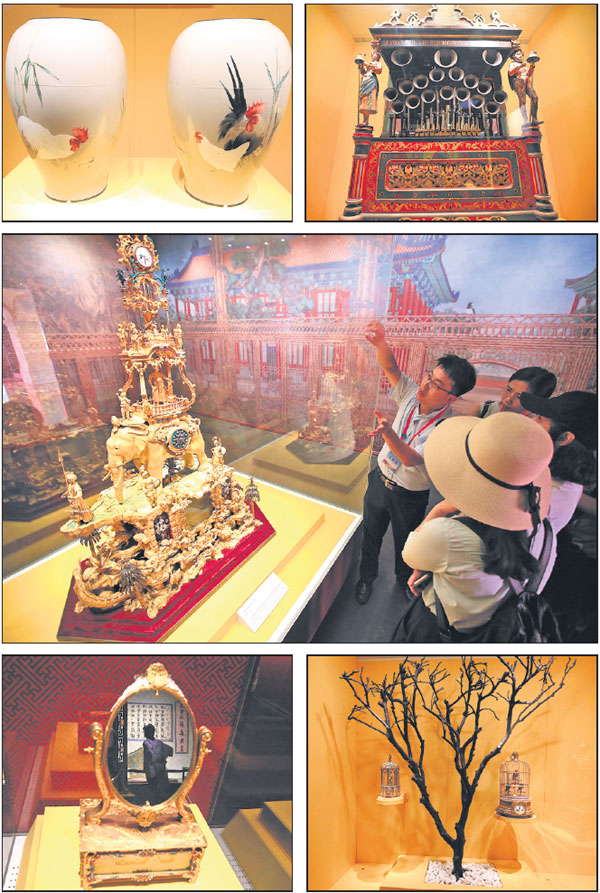
The ongoing exhibition at Kulangsu gallery in Xiamen, the Palace Museum's first satellite gallery, showcases many artifacts ranging from antique clocks and scientific instruments to enamel pieces and porcelain. The artifacts are mainly gifts from Western missionaries and diplomats to Chinese kings from the 16th century to the early 20th century. Photos by Jiang Dong / China Daily |
The Kulangsu Gallery of Foreign Artifacts from the Palace Museum Collections opened to the public on May 14.
The ongoing exhibition, which is scheduled to run for a year, showcases 219 artifacts ranging from antique clocks and scientific instruments to enamel pieces and porcelain. The artifacts come from more than 10 countries, and span a period from the 16th century to the early 20th century.
According to Shan Jixiang, director of the Palace Museum, or the Forbidden City as the museum is referred to, this is the museum's first satellite gallery outside Beijing.
Data from the museum shows that there are around 13,000 foreign cultural relics now housed in the institution, but there was no permanent space to display them.
Referring to the satellite gallery, he says: "It has been set up to expand the influence (of the museum) just like top museums overseas set up branch galleries.
"Our current exhibition space in the Forbidden City is limited, but Kulangsu, where China interacted with other cultures is a perfect place to show these treasures."
As for Kulangsu's history, it is a true melting pot, as 13 countries, including the United Kingdom and the United States, established settlements there starting in the 1840s.
As a result, the tiny island features structures reflecting different cultures.
Coming to the rich collection of artifacts, the Palace Museum, which was China's royal palace from 1420 to 1911, received many gifts from Western missionaries and diplomats during the imperial years.
Many of the emperors were very fond of buying artifacts from abroad, according to Wan Xiufeng, a researcher at the Palace Museum.
One of the items that was a hot favorite with the rulers was clocks. So, not surprisingly, the Kulangsu gallery features a 2-meter-high brass 18th century British revolving clock which is shaped like an elephant.
"Carrying exquisite clocks as gifts was common for Western missionaries approaching imperial courts since the late Ming Dynasty (1368-1644)," says Wan. "And the emperors and their concubines' interest in clocks did not die even in the following Qing Dynasty (1644-1911)."
Also, he says, that as many Western missionaries became officials in China, they brought a large number of scientific instruments to the courts.
For instance, emperor Kangxi (1654-1722) was a big fan of Western astronomy and geography, while his grandson emperor Qianlong (1711-99) was interested in Western items, ranging from snuff bottles to knives.
Some items at the satellite gallery focus on that history.
"Qianlong contributed hugely to the foreign artifact collection in the Palace Museum," Wan says.
"Qianlong was well known for his interest in Western art pieces. The gilt and enamel boxes at the exhibition showcase his tastes."
The emperors, however, were not only interested in Western treasures, and also focused on their neighbors.
For example, the exhibits also include top Japanese art works from the Edo Period like lacquer boxes.
In the 19th century, shippo-yaki, a delicate and light cloisonne enamel was favored by Chinese royal families.
"Some of the items might not have been very expensive when they were made, but there are interesting stories behind them," Wan says.
Giving an example, he points to an American ointment for headaches.
It was given to emperor Guangxu (1871-1908) by Yuan Shikai, a key figure in Chinese politics in the early 20th century.
Other examples include daily-use articles belonging to emperor Puyi (1906-1967), who is probably best known overseas through the Oscar winning Bernardo Bertolucci film The Last Emperor.
Puyi was allowed to reside in the Forbidden City even after the monarchy fell. But as he was driven out in 1924, Puyi left many of his belongings in the palace, and more than 1,300 items still survive today.
Meanwhile, Ren Wanping, head of the gallery in Xiamen, says that some of the exhibits, like paintings and textiles, will be replaced after three months, as the humid and hot climate in Xiamen could affect them.
As for the precautions taken to preserve the artifacts, she says that equipment has been installed in the gallery to maintain a constant temperature and humidity.
A monitoring system there has been connected with the central network of the Palace Museum to ensure the safety of the cultural relics, and only up to 2,800 visitors will be allowed to enter the gallery daily.
With regard to managing of the gallery, Ren says: "We will train people in Xiamen, and gradually transfer daily management to them."
Separately, the museum director says that a permanent gallery for foreign artifacts will be set up in the Forbidden City.
"A research institution specializing in foreign artifacts will be established in our museum by the end of May," he adds.
Contact the writer at wangkaihao@chinadaily.com.cn




Copyright 1995 - . All rights reserved. The content (including but not limited to text, photo, multimedia information, etc) published in this site belongs to China Daily Information Co (CDIC). Without written authorization from CDIC, such content shall not be republished or used in any form. Note: Browsers with 1024*768 or higher resolution are suggested for this site.
License for publishing multimedia online 0108263 Registration Number: 130349