Editor's Note: China is divided into as many culinary regions as there are different ethnic groups. Its geographical diversity and kaleidoscopic cultural profiles contribute to the unending banquet of flavors.
Anyone familiar with Chinese food is bound to have come across a small dried red fruit that's often found floating in soups or added to dishes as a garnish. And if you bit into it, you would have enjoyed its sweetness, though you'd have been surprised by its very slight bitter aftertaste.
This is the wolfberry, the gouqizi, also known as goji berry, barberry, boxthorn fruit and matrimony vine fruit.
|
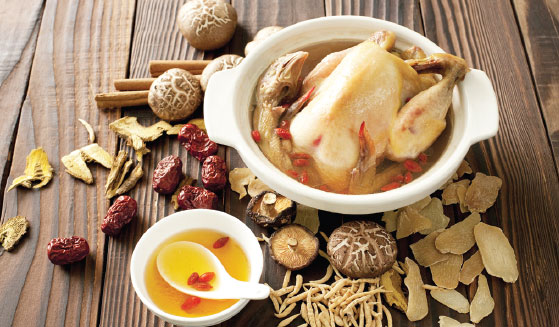
Wolfberry and chicken soup. Photos Provided to China Daily |
In the Western world, it was popularized around the 2000s as a superfood and extensively taken in juices and dried supplements and marketed as Tibetan goji berries.
Most of the world's best wolfberries, however, come from the Ningxia Hui autonomous region in northwestern China.
There are two species of wolfberries, both native to China - Lycium barbarum and Lycium chinense. These boxthorn plants are actually nightshades, and cousins to the potato, tomato, pepper and aubergine, or eggplant.
Their culinary and medical benefits were recorded thousands of years ago, with the most comprehensive explanation written by Li Shizhen, the Ming Dynasty (1368-1644) scholar and author of Bencao Gangmu, the Compendium of Material Medica. He is acknowledged as the father of traditional Chinese medicine.
While the bush like Ningxia wolfberry (Lycium barbarum), is grown mainly for its fruit, the taller, shrublike Lycium chinense is grown in the warmer, wetter southern regions - such as the Guangxi Zhuang autonomous region and Guangdong province - and is eaten as a vegetable.
Wolfberry leaves are plucked off their thorny stems and cooked mainly in soups or blanched in chicken stock and served with scrambled eggs. They are believed to be highly nutritious and good for the eyes.
Parents have been known to cook up the dish whenever an important test or examination looms. The slightly bitter leaves were sweetened with slices of liver in a soup so rich in iron it often turned dark.
Another well-known restaurant offering is wolfberry leaves poached in rich chicken stock and topped with a three-egg combination - salted eggs, century eggs and soft-cooked eggs. It would then be garnished with a handful of wolfberries.
But it is the berries that are most widely eaten.
In the Xinjiang Uygur autonomous region and Ningxia, eight-treasures tea or babaocha is served to honored guests. Tea leaves, dried longans, chrysanthemum, osmanthus, rock sugar and wolfberries are the main ingredients, and the mix is infused in hot water and served in a Chinese tea bowl with a lid.
The drink is slowly sipped and enjoyed as the dried fruit and flowers release their fragrance and flavor.
Gouqijiu, or wolfberry liqueur, is a common homemade infusion in northern families. Wolfberries are soaked in Chinese white spirits and a small glass is drunk regularly, usually with the evening meal, as a health supplement.
As more Chinese suffer the effects of overindulgence after the lean years, diabetes is on the rise. And wolfberries are touted as good for diabetics. That is because the berries are rich in various vitamins, especially vitamin A, which is believed to help eyesight that's been weakened by clogged capillaries.
Apart from its many health benefits according to TCM principles, wolfberries are loved by modern Chinese chefs who use them infused in teas, boiled long and slow in steamed soups or added to stir-fries for color. They are, to the Chinese kitchen, what parsley and cherry tomatoes are in the West.
Wolfberries are not purely decorative. There is this folk tale that is often retold about its nigh magical properties:
In ancient times, along a western outpost of the Silk Road, traders at an inn were surprised by the sight of a young woman berating a wizened old man.
Curious onlookers asked the young woman: "Why are you being so disrespectful to the elderly?"
The infuriated woman spun around and snapped: "Disrespectful indeed! I'm just teaching my grandson how to live. Look at him, he won't drink his wolfberry tea daily. He's only 99 and this is what he looks like now." Grandma, it seems, was already more than 200 years old.
We don't know if they were therewith a caravan of wolfberries to sell, or if she really was his grandmother or if it was just another brilliant marketing ploy. The story certainly made it into folklore.
The wolfberry plant is precious enough for Chinese authorities to treat it as a national heritage. In Ningxia, there is a dedicated research center where wolfberries are carefully cultivated and the best varieties propagated on a large, sprawling farm. The mother plant of all the new superlarge berries is protected here.
Most of us have never seen or tasted the fresh berries.
They are an elliptical fruit that form on long stems in threes or fours after the lavender flowers wilt. The plant flowers in summer, and by late autumn the bright red and orange berries are ready for harvest.
Traditionally, they are spread out on the ground to dry in the sun, but these days they tend to be air-dried in factories.
Wolfberries are very fragile before they are dried, so it is rare to see fresh berries on the market. If you get lucky, the shops at the Yinchuan Hedong International Airport in Ningxia's capital often sell boxes of fresh wolfberries to curious visitors.
Whether or not you believe in the curative powers of the wolfberry, it is very much a part of the mise en place in Chinese cooking.
paulined@chinadaily.com.cn
Wolfberry and Chicken Soup
1 small silky chicken, or two large chicken breasts
2 slices fresh ginger
100 grams dried wolfberries
Salt to taste
Clean the chicken and remove the skin. Trim off all visible fat. Using the heel of your hand, press down on the chicken until you feel the breast bone crack. If using just chicken breast, lightly hammer the meat with the back of your cleaver. This helps to release the chicken flavors.
Rinse the berries and reserve a large spoonful for garnishing.
Heat up a pot of water to boiling, then drop the chicken, wolfberries and ginger in. After it returns to the boil, reduce heat to a low simmer and cook for 40 minutes.
Season to taste, then, just before serving, add the reserved berries to the bowl. It will add fresh color, since cooked wolfberries lose their redness.




Copyright 1995 - . All rights reserved. The content (including but not limited to text, photo, multimedia information, etc) published in this site belongs to China Daily Information Co (CDIC). Without written authorization from CDIC, such content shall not be republished or used in any form. Note: Browsers with 1024*768 or higher resolution are suggested for this site.
License for publishing multimedia online 0108263 Registration Number: 130349